

Transpiration and the Leaf Energy Budget
23 1
directly overhead views 40 fiercent soil and 60 percent vegetation, assuming emissivity to be 1.0, the radiometric temperature would be 35.7" C
((0.6 * 2984 + 0.4 * 3234)1/4 = 308.7 K). If the view zenith angle of the
infrared thermometer were changed to 85" , the view would be mainly
vegetation and the indicated temperature would change to about 25" C.
Since the aerodynamic temperature would have to be the same for the
two infrared thermometer view angles, clearly the two temperatures can
be quite different.
Since leaf and canopy temperature are determined, in part, by stomatal conductance, and conductance is determined, in part by availability
of water to the plant, an effort has been made to sense plant water stress
from airplanes or satellites using thermal imaging of vegetation temperature. For a dense, full-cover canopy, radiometric temperature may
approximate aerodynamic temperature within 1" C. However, Eq. (14.8)
provides a means of finding canopy conductance from measurements
of canopy and air temperature only if wind, radiation, and vapor deficit
are known. Without measuring these confounding variables, or at least
making the measurements during times when they are relatively constant
(such as midday on clear days with high vapor deficits), determining
water stress very accurately using this technique is difficult. Even when
water stress can be determined from a canopy temperature measurement,
additional information is needed to determine whether a crop needs irrigation. Stomata may close and canopy temperature increase for many
reasons, only one of which is a soil water deficit.
14.4 Transpiration and the Leaf Energy Budget
Another useful application of the leaf energy budget is to compute the
transpiration rate. Written in terms of latent heat loss (useful in the energy
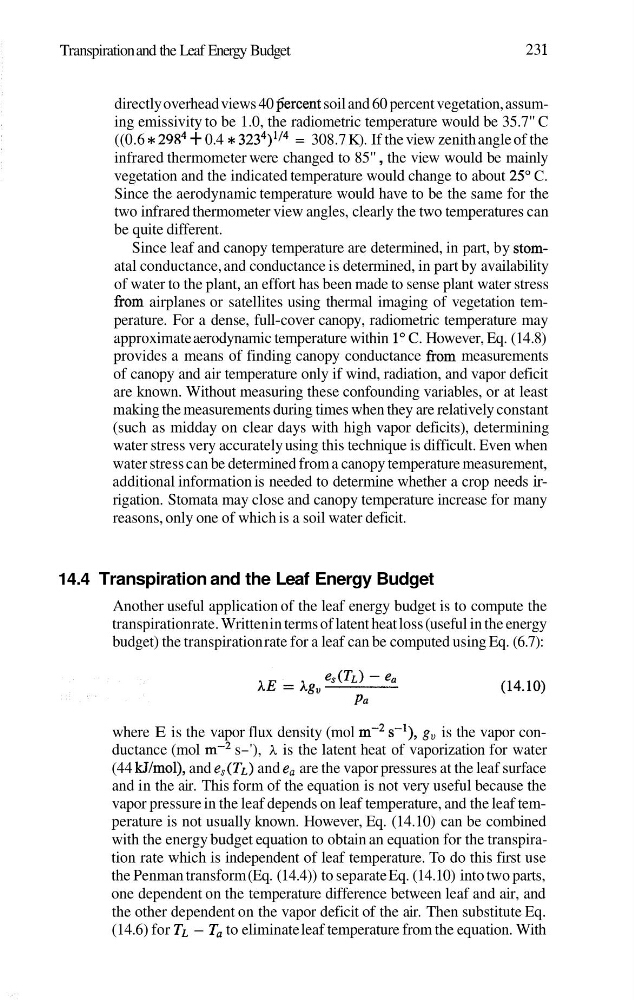
budget) the transpiration rate for a leaf can be computed using Eq. (6.7):
where E is the vapor flux density (mol m-2 s-'), g, is the vapor conductance (mol m-2 s-'), h is the latent heat of vaporization for water
(44 Wmol), and e, (TL) and e, are the vapor pressures at the leaf surface
and in the air. This form of the equation is not very useful because the
vapor pressure in the leaf depends on leaf temperature, and the leaf temperature is not usually known. However, Eq. (14.10) can be combined
with the energy budget equation to obtain an equation for the transpiration rate which is independent of leaf temperature. To do this first use
the Penman transform (Eq. (14.4)) to separate Eq. (14.10) into two parts,
one dependent on the temperature difference between leaf and air, and
the other dependent on the vapor deficit of the air. Then substitute Eq.
(14.6) for TL - T, to eliminate leaf temperature from the equation. With
23 1
directly overhead views 40 fiercent soil and 60 percent vegetation, assuming emissivity to be 1.0, the radiometric temperature would be 35.7" C
((0.6 * 2984 + 0.4 * 3234)1/4 = 308.7 K). If the view zenith angle of the
infrared thermometer were changed to 85" , the view would be mainly
vegetation and the indicated temperature would change to about 25" C.
Since the aerodynamic temperature would have to be the same for the
two infrared thermometer view angles, clearly the two temperatures can
be quite different.
Since leaf and canopy temperature are determined, in part, by stomatal conductance, and conductance is determined, in part by availability
of water to the plant, an effort has been made to sense plant water stress
from airplanes or satellites using thermal imaging of vegetation temperature. For a dense, full-cover canopy, radiometric temperature may
approximate aerodynamic temperature within 1" C. However, Eq. (14.8)
provides a means of finding canopy conductance from measurements
of canopy and air temperature only if wind, radiation, and vapor deficit
are known. Without measuring these confounding variables, or at least
making the measurements during times when they are relatively constant
(such as midday on clear days with high vapor deficits), determining
water stress very accurately using this technique is difficult. Even when
water stress can be determined from a canopy temperature measurement,
additional information is needed to determine whether a crop needs irrigation. Stomata may close and canopy temperature increase for many
reasons, only one of which is a soil water deficit.
14.4 Transpiration and the Leaf Energy Budget
Another useful application of the leaf energy budget is to compute the
transpiration rate. Written in terms of latent heat loss (useful in the energy
budget) the transpiration rate for a leaf can be computed using Eq. (6.7):
where E is the vapor flux density (mol m-2 s-'), g, is the vapor conductance (mol m-2 s-'), h is the latent heat of vaporization for water
(44 Wmol), and e, (TL) and e, are the vapor pressures at the leaf surface
and in the air. This form of the equation is not very useful because the
vapor pressure in the leaf depends on leaf temperature, and the leaf temperature is not usually known. However, Eq. (14.10) can be combined
with the energy budget equation to obtain an equation for the transpiration rate which is independent of leaf temperature. To do this first use
the Penman transform (Eq. (14.4)) to separate Eq. (14.10) into two parts,
one dependent on the temperature difference between leaf and air, and
the other dependent on the vapor deficit of the air. Then substitute Eq.
(14.6) for TL - T, to eliminate leaf temperature from the equation. With