

Canopy Transpiration
233
Wind Speed (mls)
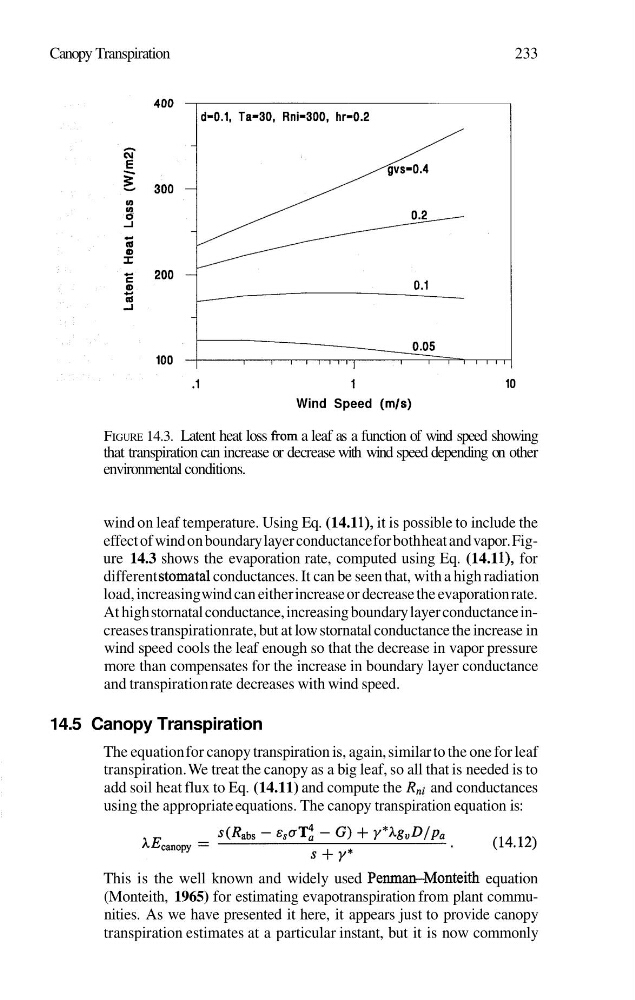
FIGURE 14.3. Latent heat loss from a leaf as a function of wind speed showing
that transpiration can increase or decrease with wind speed depending on other
environmental conditions.
wind on leaf temperature. Using Eq. (14.1 I), it is possible to include the
effect of wind on boundary layer conductance for both heat and vapor. Figure 14.3 shows the evaporation rate, computed using Eq. (14.1 I), for
different stomata1 conductances. It can be seen that, with a high radiation
load, increasing wind can either increase or decrease the evaporation rate.
At high stornatal conductance, increasing boundary layer conductance increases transpiration rate, but at low stornatal conductance the increase in
wind speed cools the leaf enough so that the decrease in vapor pressure
more than compensates for the increase in boundary layer conductance
and transpiration rate decreases with wind speed.
14.5 Canopy Transpiration
The equation for canopy transpiration is, again, similar to the one for leaf
transpiration. We treat the canopy as a big leaf, so all that is needed is to
add soil heat flux to Eq. (14.11) and compute the Rni and conductances
using the appropriate equations. The canopy transpiration equation is:
This is the well known and widely used Penman-Monteith equation
(Monteith, 1965) for estimating evapotranspiration from plant communities. As we have presented it here, it appears just to provide canopy
transpiration estimates at a particular instant, but it is now commonly
233
Wind Speed (mls)
FIGURE 14.3. Latent heat loss from a leaf as a function of wind speed showing
that transpiration can increase or decrease with wind speed depending on other
environmental conditions.
wind on leaf temperature. Using Eq. (14.1 I), it is possible to include the
effect of wind on boundary layer conductance for both heat and vapor. Figure 14.3 shows the evaporation rate, computed using Eq. (14.1 I), for
different stomata1 conductances. It can be seen that, with a high radiation
load, increasing wind can either increase or decrease the evaporation rate.
At high stornatal conductance, increasing boundary layer conductance increases transpiration rate, but at low stornatal conductance the increase in
wind speed cools the leaf enough so that the decrease in vapor pressure
more than compensates for the increase in boundary layer conductance
and transpiration rate decreases with wind speed.
14.5 Canopy Transpiration
The equation for canopy transpiration is, again, similar to the one for leaf
transpiration. We treat the canopy as a big leaf, so all that is needed is to
add soil heat flux to Eq. (14.11) and compute the Rni and conductances
using the appropriate equations. The canopy transpiration equation is:
This is the well known and widely used Penman-Monteith equation
(Monteith, 1965) for estimating evapotranspiration from plant communities. As we have presented it here, it appears just to provide canopy
transpiration estimates at a particular instant, but it is now commonly