

228
Plants and Plant Communities
In the plant kingdom many examples of adaptations are seen which
appear to be for the purpose of controlling leaf temperature near optimum
levels. For example, in deserts, where water is scarce and air temperatures
tend to be above optimum temperature for photosynthesis, leaves tend to
be small, allowing leaf temperatures to be as near to air temperature as
possible without evaporating large amounts of water. In alpine regions,
where air temperature is likely to be below optimum temperature, leaves
are not necessarily small, but plants tend to grow in dense clumps or
cushions near the ground. This provides a large effective characteristic
dimension and low wind speed, and thus results in temperatures sometimes 10 or 20" C above air temperature. Perhaps the most interesting are
some species which orient their leaves or have leaf hairs which minimize
the radiation load on the leaves. Ehleringer and Mooney (1978) describe
a desert shrub, Encilia farinosa, that has relatively large leaves with high
reflectance. The shrub grows along drainage channels where water is relatively more plentiful and can therefore maintain high transpiration rates.
Its leaves are often several degrees below air temperature.
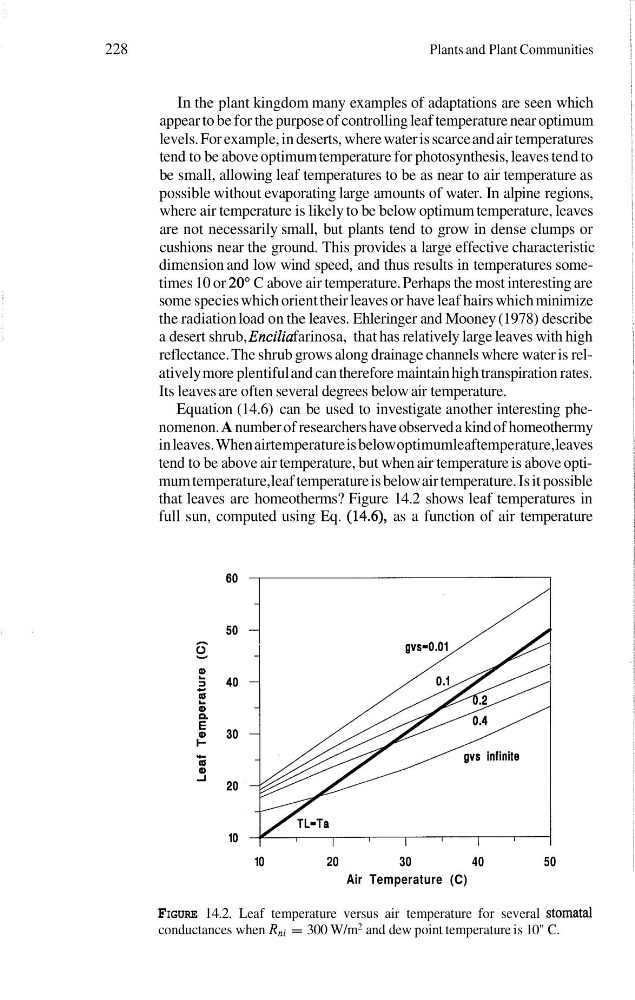
Equation (14.6) can be used to investigate another interesting phenomenon. A number of researchers have observed a kind of homeothermy
in leaves. When airtemperature is below optimumleaftemperature, leaves
tend to be above air temperature, but when air temperature is above optimum temperature, leaf temperature is below air temperature. Is it possible
that leaves are homeotherms? Figure 14.2 shows leaf temperatures in
full sun, computed using Eq. (14.6), as a function of air temperature
10
20
30
40
50
Air Temperature (C)
FIGURE 14.2. Leaf temperature versus air temperature for several stomata1
conductances when Rni = 300 W/m 2 and dew point temperature is 10" C.
Plants and Plant Communities
In the plant kingdom many examples of adaptations are seen which
appear to be for the purpose of controlling leaf temperature near optimum
levels. For example, in deserts, where water is scarce and air temperatures
tend to be above optimum temperature for photosynthesis, leaves tend to
be small, allowing leaf temperatures to be as near to air temperature as
possible without evaporating large amounts of water. In alpine regions,
where air temperature is likely to be below optimum temperature, leaves
are not necessarily small, but plants tend to grow in dense clumps or
cushions near the ground. This provides a large effective characteristic
dimension and low wind speed, and thus results in temperatures sometimes 10 or 20" C above air temperature. Perhaps the most interesting are
some species which orient their leaves or have leaf hairs which minimize
the radiation load on the leaves. Ehleringer and Mooney (1978) describe
a desert shrub, Encilia farinosa, that has relatively large leaves with high
reflectance. The shrub grows along drainage channels where water is relatively more plentiful and can therefore maintain high transpiration rates.
Its leaves are often several degrees below air temperature.
Equation (14.6) can be used to investigate another interesting phenomenon. A number of researchers have observed a kind of homeothermy
in leaves. When airtemperature is below optimumleaftemperature, leaves
tend to be above air temperature, but when air temperature is above optimum temperature, leaf temperature is below air temperature. Is it possible
that leaves are homeotherms? Figure 14.2 shows leaf temperatures in
full sun, computed using Eq. (14.6), as a function of air temperature
10
20
30
40
50
Air Temperature (C)
FIGURE 14.2. Leaf temperature versus air temperature for several stomata1
conductances when Rni = 300 W/m 2 and dew point temperature is 10" C.