

Radiometric Temperature of Plant Canopies
229
for several values of stomatal conductance. Dew point temperature, and
therefore atmospheric vapor pressure, is kept constant as air temperature
changes (as it is during the day). The heavy black line shows the slope
which would result if a one degree increase in air temperature resulted in
a one degree increase in leaf temperature. It can be seen that, in fact, temperatures of transpiring leaves do tend to remain more constant than the
air temperature. It is obviously not, however, an active response of leaves
to maintain constant temperature, since a wet wash rag (infinite surface
conductance) maintains the most constant temperature of all. The apparent homeothermy is just a normal response of an evaporating surface.
Obviously, this does not prevent it from being beneficial to the plant.
14.2 Aerodynamic Temperature of Plant
Canopies
An equation for predicting the aerodynamic temperature of plant canopies
can be derived just as was done for a leaf. This temperature is referred
to as aerodynamic temperature because it is derived from the solution of
aerodynamic transport equations. There are two differences: the energy
budget of a plant canopy must include the heat storage in the soil, and the
boundary layer conductances and absorbed radiation must be computed
using the appropriate equations from Chs. 7 and 11. The energy budget
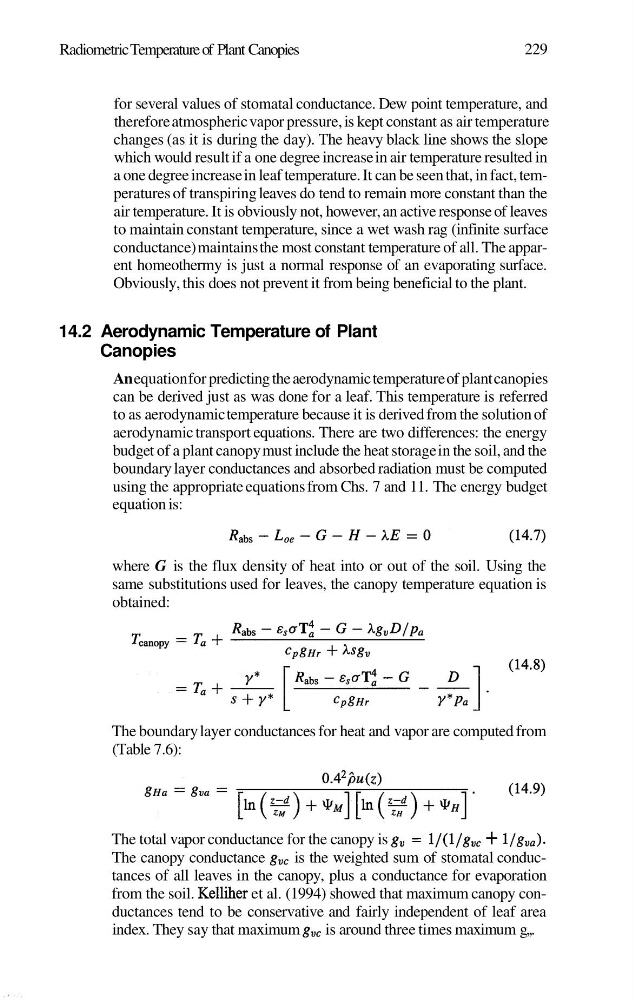
equation is:
where G is the flux density of heat into or out of the soil. Using the
same substitutions used for leaves, the canopy temperature equation is
obtained:
The boundary layer conductances for heat and vapor are computed from
(Table 7.6):
The total vapor conductance for the canopy is g, = l/(l/g,, + l/g,,).
The canopy conductance g,, is the weighted sum of stomatal conductances of all leaves in the canopy, plus a conductance for evaporation
from the soil. Kelliher et al. (1994) showed that maximum canopy conductances tend to be conservative and fairly independent of leaf area
index. They say that maximum g,, is around three times maximum g,,.
229
for several values of stomatal conductance. Dew point temperature, and
therefore atmospheric vapor pressure, is kept constant as air temperature
changes (as it is during the day). The heavy black line shows the slope
which would result if a one degree increase in air temperature resulted in
a one degree increase in leaf temperature. It can be seen that, in fact, temperatures of transpiring leaves do tend to remain more constant than the
air temperature. It is obviously not, however, an active response of leaves
to maintain constant temperature, since a wet wash rag (infinite surface
conductance) maintains the most constant temperature of all. The apparent homeothermy is just a normal response of an evaporating surface.
Obviously, this does not prevent it from being beneficial to the plant.
14.2 Aerodynamic Temperature of Plant
Canopies
An equation for predicting the aerodynamic temperature of plant canopies
can be derived just as was done for a leaf. This temperature is referred
to as aerodynamic temperature because it is derived from the solution of
aerodynamic transport equations. There are two differences: the energy
budget of a plant canopy must include the heat storage in the soil, and the
boundary layer conductances and absorbed radiation must be computed
using the appropriate equations from Chs. 7 and 11. The energy budget
equation is:
where G is the flux density of heat into or out of the soil. Using the
same substitutions used for leaves, the canopy temperature equation is
obtained:
The boundary layer conductances for heat and vapor are computed from
(Table 7.6):
The total vapor conductance for the canopy is g, = l/(l/g,, + l/g,,).
The canopy conductance g,, is the weighted sum of stomatal conductances of all leaves in the canopy, plus a conductance for evaporation
from the soil. Kelliher et al. (1994) showed that maximum canopy conductances tend to be conservative and fairly independent of leaf area
index. They say that maximum g,, is around three times maximum g,,.