

Leaf Temperature
227
leaf and thus warmer. This is the result of the smaller y * for the large
leaf. In descriptive terms, this is like the sweating animal with body temperature below air temperature. When the leaf is cooler than the air, it
is taking up heat from the air. It can decrease the amount of heat taken
from the air, and therefore decrease its temperature, if the boundary layer
conductance is low.
Equation (14.6) can be used directly to answer a rather significant
ecological question. Plant ecologists commonly take air temperature as
the environmental variable characterizing a site. The implicit assumption
is that air temperature and plant temperature are equal, or at least related
by some constant, since it is really plant temperature that determines
productivity. Equation (14.6) can be used to check this assumption.
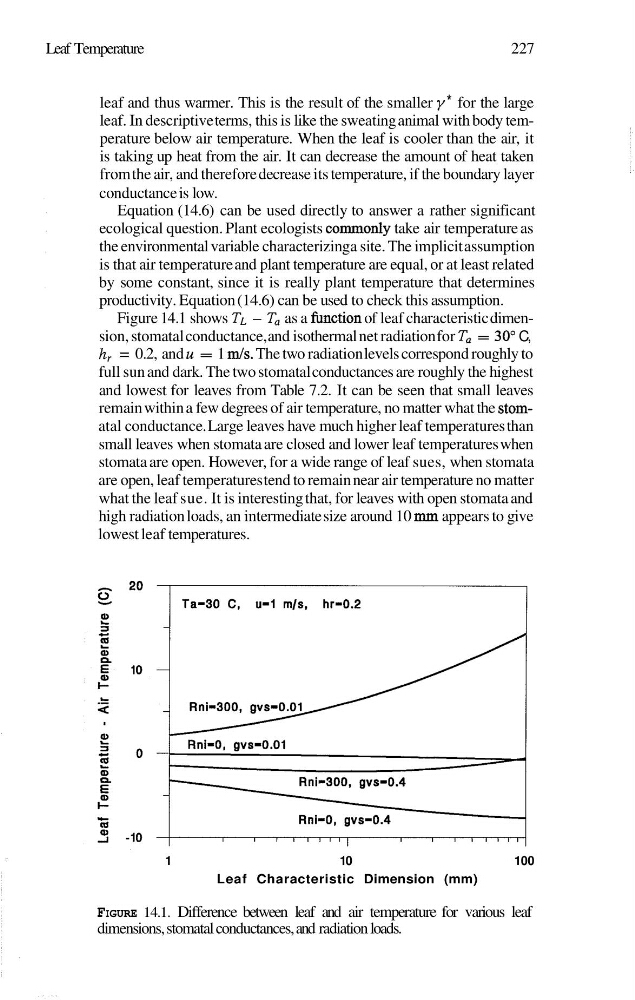
Figure 14.1 shows TL - T, as a h c t i o n of leaf characteristic dimension, stomatal conductance, and isothermal net radiation for T, = 30" C,
h, = 0.2, and u = 1 m/s. The two radiation levels correspond roughly to
full sun and dark. The two stomatal conductances are roughly the highest
and lowest for leaves from Table 7.2. It can be seen that small leaves
remain within a few degrees of air temperature, no matter what the stomatal conductance. Large leaves have much higher leaf temperatures than
small leaves when stomata are closed and lower leaf temperatures when
stomata are open. However, for a wide range of leaf sues, when stomata
are open, leaf temperatures tend to remain near air temperature no matter
what the leaf sue. It is interesting that, for leaves with open stomata and
high radiation loads, an intermediate size around 10 mm appears to give
lowest leaf temperatures.
1
10
100
Leaf Characteristic Dimension (mm)
FIGURE 14.1. Difference between leaf and air temperature for various leaf
dimensions, stomatal conductances, and radiation loads.
227
leaf and thus warmer. This is the result of the smaller y * for the large
leaf. In descriptive terms, this is like the sweating animal with body temperature below air temperature. When the leaf is cooler than the air, it
is taking up heat from the air. It can decrease the amount of heat taken
from the air, and therefore decrease its temperature, if the boundary layer
conductance is low.
Equation (14.6) can be used directly to answer a rather significant
ecological question. Plant ecologists commonly take air temperature as
the environmental variable characterizing a site. The implicit assumption
is that air temperature and plant temperature are equal, or at least related
by some constant, since it is really plant temperature that determines
productivity. Equation (14.6) can be used to check this assumption.
Figure 14.1 shows TL - T, as a h c t i o n of leaf characteristic dimension, stomatal conductance, and isothermal net radiation for T, = 30" C,
h, = 0.2, and u = 1 m/s. The two radiation levels correspond roughly to
full sun and dark. The two stomatal conductances are roughly the highest
and lowest for leaves from Table 7.2. It can be seen that small leaves
remain within a few degrees of air temperature, no matter what the stomatal conductance. Large leaves have much higher leaf temperatures than
small leaves when stomata are closed and lower leaf temperatures when
stomata are open. However, for a wide range of leaf sues, when stomata
are open, leaf temperatures tend to remain near air temperature no matter
what the leaf sue. It is interesting that, for leaves with open stomata and
high radiation loads, an intermediate size around 10 mm appears to give
lowest leaf temperatures.
1
10
100
Leaf Characteristic Dimension (mm)
FIGURE 14.1. Difference between leaf and air temperature for various leaf
dimensions, stomatal conductances, and radiation loads.