

Animals and their Environment
-40 -30 -20 -10
0
10
20
30
40
50
60
Air Temperature ( C )
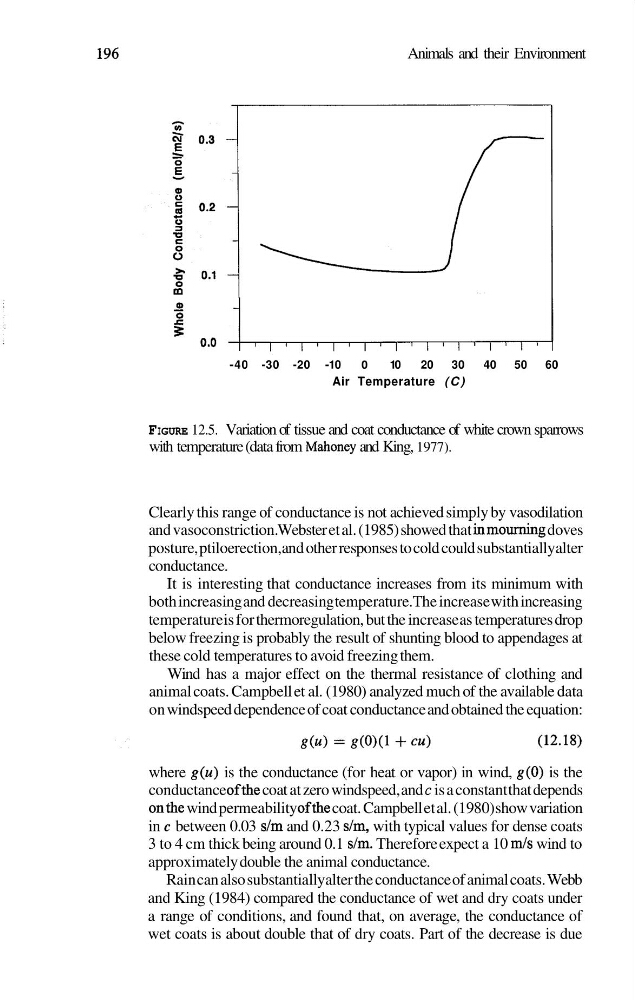
FIGURE 12.5. Variation of tissue and coat conductance of white crown sparrows
with temperature (data from Mahoney and King, 1977).
Clearly this range of conductance is not achieved simply by vasodilation
and vasoconstriction. Webster et al. (1985) showed that inmourning doves
posture, ptiloerection, and other responses to cold could substantially alter
conductance.
It is interesting that conductance increases from its minimum with
both increasing and decreasing temperature. The increase with increasing
temperature is for thermoregulation, but the increase as temperatures drop
below freezing is probably the result of shunting blood to appendages at
these cold temperatures to avoid freezing them.
Wind has a major effect on the thermal resistance of clothing and
animal coats. Campbell et al. (1980) analyzed much of the available data
on windspeed dependence of coat conductance and obtained the equation:
where g(u) is the conductance (for heat or vapor) in wind, g(0) is the
conductance ofthe coat at zero windspeed, and c is a constant that depends
onthe wind permeability ofthe coat. Campbell et al. (1980) show variation
in c between 0.03 slrn and 0.23 slrn, with typical values for dense coats
3 to 4 cm thick being around 0.1 slrn. Therefore expect a 10 d s wind to
approximately double the animal conductance.
Rain can also substantially alter the conductance of animal coats. Webb
and King (1984) compared the conductance of wet and dry coats under
a range of conditions, and found that, on average, the conductance of
wet coats is about double that of dry coats. Part of the decrease is due
-40 -30 -20 -10
0
10
20
30
40
50
60
Air Temperature ( C )
FIGURE 12.5. Variation of tissue and coat conductance of white crown sparrows
with temperature (data from Mahoney and King, 1977).
Clearly this range of conductance is not achieved simply by vasodilation
and vasoconstriction. Webster et al. (1985) showed that inmourning doves
posture, ptiloerection, and other responses to cold could substantially alter
conductance.
It is interesting that conductance increases from its minimum with
both increasing and decreasing temperature. The increase with increasing
temperature is for thermoregulation, but the increase as temperatures drop
below freezing is probably the result of shunting blood to appendages at
these cold temperatures to avoid freezing them.
Wind has a major effect on the thermal resistance of clothing and
animal coats. Campbell et al. (1980) analyzed much of the available data
on windspeed dependence of coat conductance and obtained the equation:
where g(u) is the conductance (for heat or vapor) in wind, g(0) is the
conductance ofthe coat at zero windspeed, and c is a constant that depends
onthe wind permeability ofthe coat. Campbell et al. (1980) show variation
in c between 0.03 slrn and 0.23 slrn, with typical values for dense coats
3 to 4 cm thick being around 0.1 slrn. Therefore expect a 10 d s wind to
approximately double the animal conductance.
Rain can also substantially alter the conductance of animal coats. Webb
and King (1984) compared the conductance of wet and dry coats under
a range of conditions, and found that, on average, the conductance of
wet coats is about double that of dry coats. Part of the decrease is due