

Conduction of Heat in Animal Coats and Tissue
195
200
- - radiative conductance
shrew
I squirrel
V)
a
0 lemming
+ marten
o
rabbit
E
E
w fox, dog, beaver
A reindeer, caribou
aa
u
A white fox
5 1 0 0
aa wolf, grizzly bear
0
a
+ polar bear
0
0
x dall sheep
*
m
I
-still
air conductance
0
1
2
3
4
5
6
7
8
9
Coat Depth (cm)
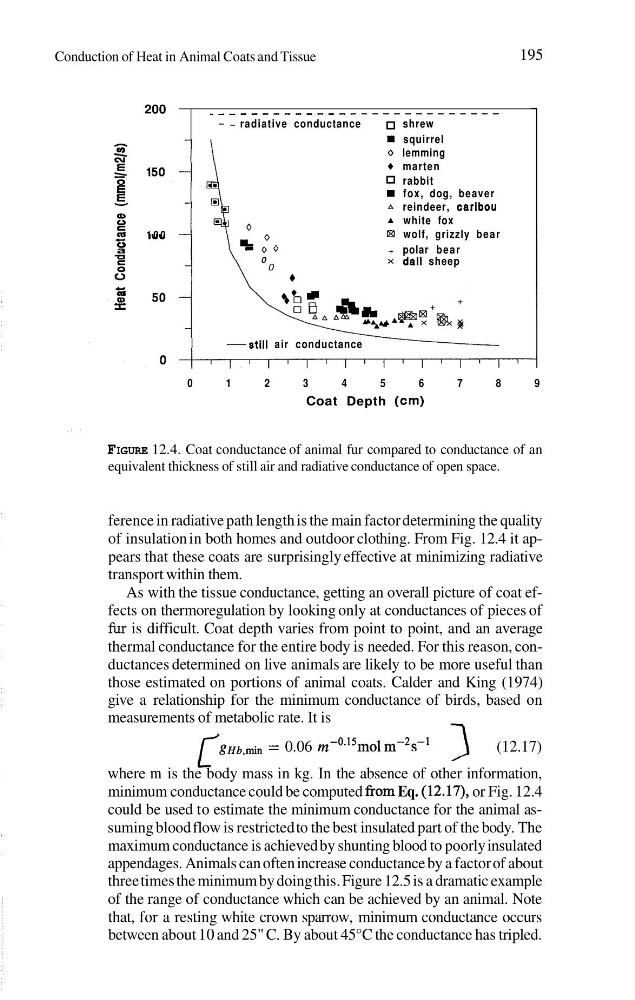
FIGURE 12.4. Coat conductance of animal fur compared to conductance of an
equivalent thickness of still air and radiative conductance of open space.
ference in radiative path length is the main factor determining the quality
of insulation in both homes and outdoor clothing. From Fig. 12.4 it appears that these coats are surprisingly effective at minimizing radiative
transport within them.
As with the tissue conductance, getting an overall picture of coat effects on thermoregulation by looking only at conductances of pieces of
fur is difficult. Coat depth varies from point to point, and an average
thermal conductance for the entire body is needed. For this reason, conductances determined on live animals are likely to be more useful than
those estimated on portions of animal coats. Calder and King (1974)
give a relationship for the minimum conductance of birds, based on
measurements of metabolic rate. It is
r g H b , f i n = 0.06 rn-0.15m~l m-'swl
) (12.17)
L
where m is the body mass in kg. In the absence of other information,
minimum conductance could be computed from Eq. (12.17), or Fig. 12.4
could be used to estimate the minimum conductance for the animal assuming blood flow is restricted to the best insulated part of the body. The
maximum conductance is achieved by shunting blood to poorly insulated
appendages. Animals can often increase conductance by a factor of about
three times the minimum by doing this. Figure 12.5 is a dramatic example
of the range of conductance which can be achieved by an animal. Note
that, for a resting white crown sparrow, minimum conductance occurs
between about 10 and 25" C. By about 45°C the conductance has tripled.
195
200
- - radiative conductance
shrew
I squirrel
V)
a
0 lemming
+ marten
o
rabbit
E
E
w fox, dog, beaver
A reindeer, caribou
aa
u
A white fox
5 1 0 0
aa wolf, grizzly bear
0
a
+ polar bear
0
0
x dall sheep
*
m
I
-still
air conductance
0
1
2
3
4
5
6
7
8
9
Coat Depth (cm)
FIGURE 12.4. Coat conductance of animal fur compared to conductance of an
equivalent thickness of still air and radiative conductance of open space.
ference in radiative path length is the main factor determining the quality
of insulation in both homes and outdoor clothing. From Fig. 12.4 it appears that these coats are surprisingly effective at minimizing radiative
transport within them.
As with the tissue conductance, getting an overall picture of coat effects on thermoregulation by looking only at conductances of pieces of
fur is difficult. Coat depth varies from point to point, and an average
thermal conductance for the entire body is needed. For this reason, conductances determined on live animals are likely to be more useful than
those estimated on portions of animal coats. Calder and King (1974)
give a relationship for the minimum conductance of birds, based on
measurements of metabolic rate. It is
r g H b , f i n = 0.06 rn-0.15m~l m-'swl
) (12.17)
L
where m is the body mass in kg. In the absence of other information,
minimum conductance could be computed from Eq. (12.17), or Fig. 12.4
could be used to estimate the minimum conductance for the animal assuming blood flow is restricted to the best insulated part of the body. The
maximum conductance is achieved by shunting blood to poorly insulated
appendages. Animals can often increase conductance by a factor of about
three times the minimum by doing this. Figure 12.5 is a dramatic example
of the range of conductance which can be achieved by an animal. Note
that, for a resting white crown sparrow, minimum conductance occurs
between about 10 and 25" C. By about 45°C the conductance has tripled.