

Qualitative Analysis of Animal Thermal Response
197
to decreased coat thickness, but a more important part is the latent heat
transport.
12.5 Qualitative Analysis of Animal Thermal
Response
Now that you have a general understanding of the behavior of the various
terms in the energy balance equation, we return to Eq. (12.11) and relate
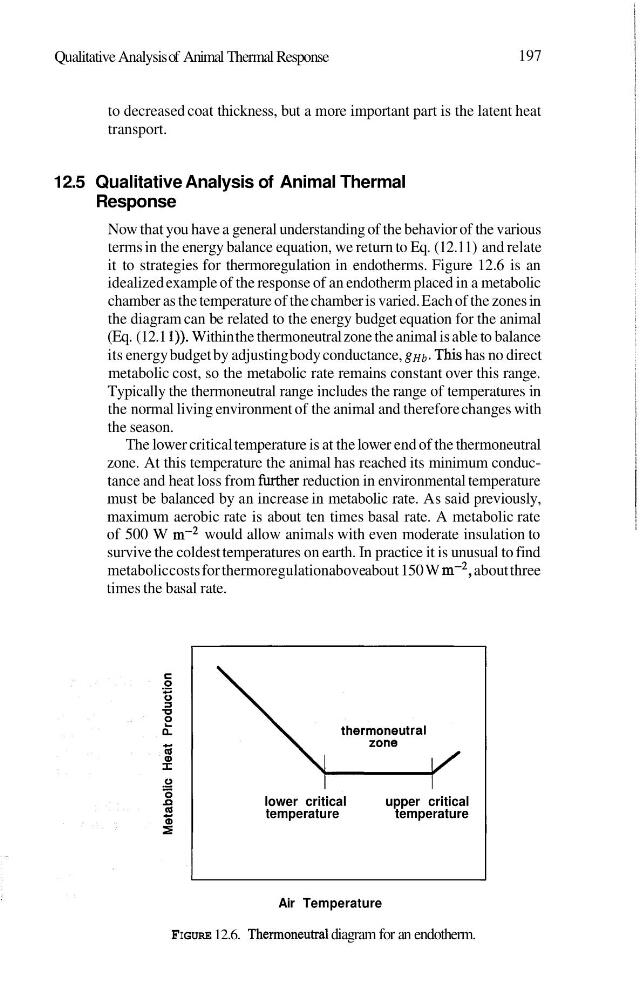
it to strategies for thermoregulation in endotherms. Figure 12.6 is an
idealized example of the response of an endotherm placed in a metabolic
chamber as the temperature of the chamber is varied. Each of the zones in
the diagram can be related to the energy budget equation for the animal
(Eq. (12.1 1)). Within the thermoneutral zone the animal is able to balance
its energy budget by adjusting body conductance, g ~ b .
This has no direct
metabolic cost, so the metabolic rate remains constant over this range.
Typically the thermoneutral range includes the range of temperatures in
the normal living environment of the animal and therefore changes with
the season.
The lower critical temperature is at the lower end of the thermoneutral
zone. At this temperature the animal has reached its minimum conductance and heat loss from further reduction in environmental temperature
must be balanced by an increase in metabolic rate. As said previously,
maximum aerobic rate is about ten times basal rate. A metabolic rate
of 500 W m-2 would allow animals with even moderate insulation to
survive the coldest temperatures on earth. In practice it is unusual to find
metabolic costs for thermoregulationabove about 150 W m-2, about three
times the basal rate.
lower critical
upper critical
temperature
temperature
I
Air Temperature
FIGURE 12.6. Thermoneutral diagram for an endotherm.
197
to decreased coat thickness, but a more important part is the latent heat
transport.
12.5 Qualitative Analysis of Animal Thermal
Response
Now that you have a general understanding of the behavior of the various
terms in the energy balance equation, we return to Eq. (12.11) and relate
it to strategies for thermoregulation in endotherms. Figure 12.6 is an
idealized example of the response of an endotherm placed in a metabolic
chamber as the temperature of the chamber is varied. Each of the zones in
the diagram can be related to the energy budget equation for the animal
(Eq. (12.1 1)). Within the thermoneutral zone the animal is able to balance
its energy budget by adjusting body conductance, g ~ b .
This has no direct
metabolic cost, so the metabolic rate remains constant over this range.
Typically the thermoneutral range includes the range of temperatures in
the normal living environment of the animal and therefore changes with
the season.
The lower critical temperature is at the lower end of the thermoneutral
zone. At this temperature the animal has reached its minimum conductance and heat loss from further reduction in environmental temperature
must be balanced by an increase in metabolic rate. As said previously,
maximum aerobic rate is about ten times basal rate. A metabolic rate
of 500 W m-2 would allow animals with even moderate insulation to
survive the coldest temperatures on earth. In practice it is unusual to find
metabolic costs for thermoregulationabove about 150 W m-2, about three
times the basal rate.
lower critical
upper critical
temperature
temperature
I
Air Temperature
FIGURE 12.6. Thermoneutral diagram for an endotherm.