

Absorptivities for Thermal and Solar Radiation
TABLE 11.3. Long-wave or thermal emissivities (and
absorptivities) for leaves, animals, and other surfaces
Surface
maize leaf
tobacco leaf
bean leaf
cotton leaf
sugar cane leaf
poplar leaf
cactus
polished chrome
bright aluminum
foil
Emissivity
Surface
human skin
snowshoe hare
caribou
gray wolf
gray squirrel
window glass
concrete
soil
water
Emissivity
sivity is reduced from above 0.9 to below 0.05, thus almost eliminating
radiative exchange between the inner and outer bottle surfaces.
In Ch. 10 we discuss the computation of absorptivities for radiation
and indicate that the absorptivity for a particular source of radiation is
the normalized integral of spectral absorptivity weighted by the spectral
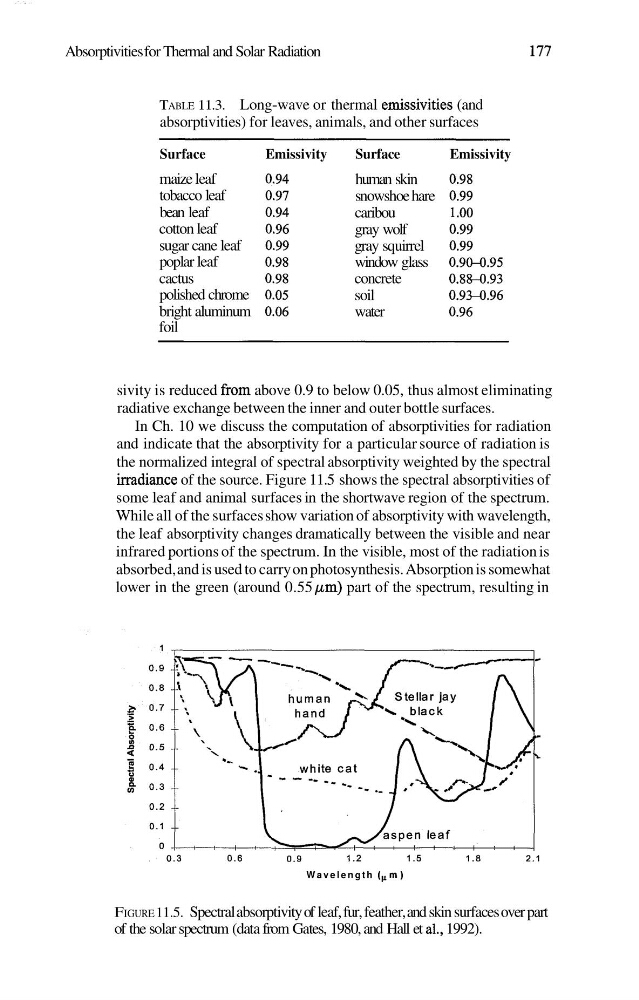
irradiance of the source. Figure 11.5 shows the spectral absorptivities of
some leaf and animal surfaces in the shortwave region of the spectrum.
While all of the surfaces show variation of absorptivity with wavelength,
the leaf absorptivity changes dramatically between the visible and near
infrared portions of the spectrum. In the visible, most of the radiation is
absorbed, and is used to carry on photosynthesis. Absorption is somewhat
lower in the green (around 0.55 pm) part of the spectrum, resulting in
W a v e l e n g t h (prn)
FIGURE 1 1.5. Spectral absorptivity of leaf, fur, feather, and skin surfaces over part
of the solar spectrum (data from Gates, 1980, and Hall et al., 1992).
TABLE 11.3. Long-wave or thermal emissivities (and
absorptivities) for leaves, animals, and other surfaces
Surface
maize leaf
tobacco leaf
bean leaf
cotton leaf
sugar cane leaf
poplar leaf
cactus
polished chrome
bright aluminum
foil
Emissivity
Surface
human skin
snowshoe hare
caribou
gray wolf
gray squirrel
window glass
concrete
soil
water
Emissivity
sivity is reduced from above 0.9 to below 0.05, thus almost eliminating
radiative exchange between the inner and outer bottle surfaces.
In Ch. 10 we discuss the computation of absorptivities for radiation
and indicate that the absorptivity for a particular source of radiation is
the normalized integral of spectral absorptivity weighted by the spectral
irradiance of the source. Figure 11.5 shows the spectral absorptivities of
some leaf and animal surfaces in the shortwave region of the spectrum.
While all of the surfaces show variation of absorptivity with wavelength,
the leaf absorptivity changes dramatically between the visible and near
infrared portions of the spectrum. In the visible, most of the radiation is
absorbed, and is used to carry on photosynthesis. Absorption is somewhat
lower in the green (around 0.55 pm) part of the spectrum, resulting in
W a v e l e n g t h (prn)
FIGURE 1 1.5. Spectral absorptivity of leaf, fur, feather, and skin surfaces over part
of the solar spectrum (data from Gates, 1980, and Hall et al., 1992).