

178
Radiation Fluxes in Natural Environments
TABLE 11.4. Shortwave absorptivities of leaves and
animals (from Gates, 1980).
Leaves
silver maple
american beach
sunflower
cottonwood
cottonwood (yellow)
Birds
Stellar's jay
sparrow (dorsal)
quail (dorsal)
quail egg
white swan
Mammals
bison
wolf
cat (white)
bobcat
Reptiles
alligator
lizard
Humans
Eurasian
Negroid
the characteristic green color of vegetation, but overall, approximately
85 percent of the incident visible radiation is absorbed while about 15
percent of the NIR is absorbed. The NIR wavelengths are not useful for
biochemical processes and are largely reflected or transmitted by the leaf.
Integration of data like that shown in Fig. 1 1.5, with weighting according to the solar spectrum (Fig. 10.5), results in the shortwave absorptivitiy
for solar radiation. Table 11.2 shows solar reflectivities for various types
of ground cover. Since all of the incident radiation is either reflected or absorbed, the absorptivity of these surfaces can be computed as as = 1 - p,
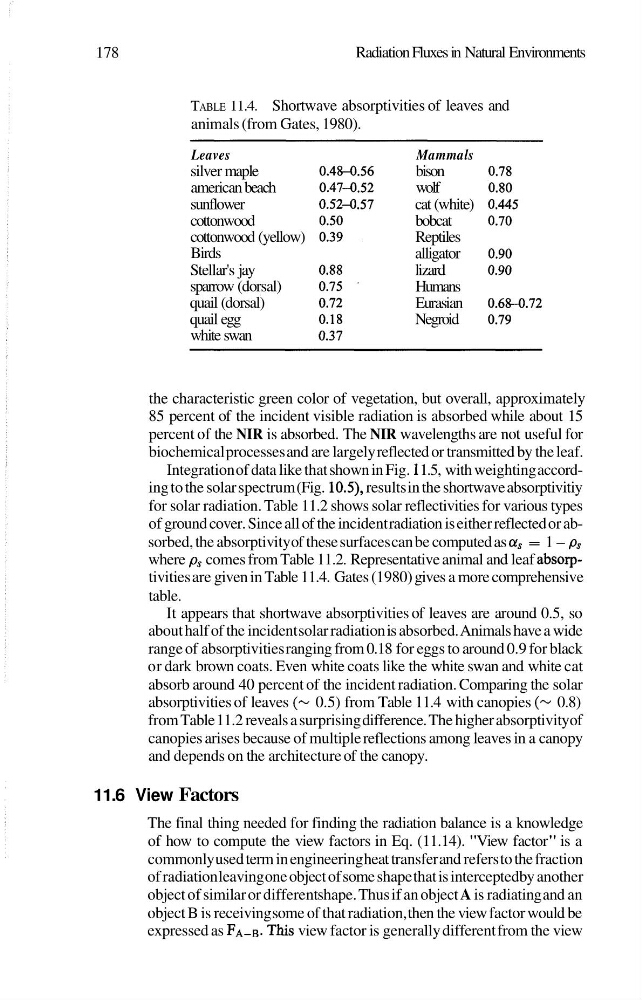
where ps comes from Table 1 1.2. Representative animal and leaf absorptivities are given in Table 11.4. Gates (1980) gives a more comprehensive
table.
It appears that shortwave absorptivities of leaves are around 0.5, so
about half of the incident solar radiation is absorbed. Animals have a wide
range of absorptivities ranging from 0.18 for eggs to around 0.9 for black
or dark brown coats. Even white coats like the white swan and white cat
absorb around 40 percent of the incident radiation. Comparing the solar
absorptivities of leaves (- 0.5) from Table 11.4 with canopies (- 0.8)
from Table 11.2 reveals a surprising difference. The higher absorptivity of
canopies arises because of multiple reflections among leaves in a canopy
and depends on the architecture of the canopy.
11.6 View Factors
The final thing needed for finding the radiation balance is a knowledge
of how to compute the view factors in Eq. (1 1.14). "View factor" is a
commonly used term in engineering heat transfer and refers to the fraction
of radiation leaving one object of some shape that is intercepted by another
object of similar or different shape. Thus if an object A is radiating and an
object B is receiving some of that radiation, then the view factor would be
expressed as FA-B. This view factor is generally different from the view
Radiation Fluxes in Natural Environments
TABLE 11.4. Shortwave absorptivities of leaves and
animals (from Gates, 1980).
Leaves
silver maple
american beach
sunflower
cottonwood
cottonwood (yellow)
Birds
Stellar's jay
sparrow (dorsal)
quail (dorsal)
quail egg
white swan
Mammals
bison
wolf
cat (white)
bobcat
Reptiles
alligator
lizard
Humans
Eurasian
Negroid
the characteristic green color of vegetation, but overall, approximately
85 percent of the incident visible radiation is absorbed while about 15
percent of the NIR is absorbed. The NIR wavelengths are not useful for
biochemical processes and are largely reflected or transmitted by the leaf.
Integration of data like that shown in Fig. 1 1.5, with weighting according to the solar spectrum (Fig. 10.5), results in the shortwave absorptivitiy
for solar radiation. Table 11.2 shows solar reflectivities for various types
of ground cover. Since all of the incident radiation is either reflected or absorbed, the absorptivity of these surfaces can be computed as as = 1 - p,
where ps comes from Table 1 1.2. Representative animal and leaf absorptivities are given in Table 11.4. Gates (1980) gives a more comprehensive
table.
It appears that shortwave absorptivities of leaves are around 0.5, so
about half of the incident solar radiation is absorbed. Animals have a wide
range of absorptivities ranging from 0.18 for eggs to around 0.9 for black
or dark brown coats. Even white coats like the white swan and white cat
absorb around 40 percent of the incident radiation. Comparing the solar
absorptivities of leaves (- 0.5) from Table 11.4 with canopies (- 0.8)
from Table 11.2 reveals a surprising difference. The higher absorptivity of
canopies arises because of multiple reflections among leaves in a canopy
and depends on the architecture of the canopy.
11.6 View Factors
The final thing needed for finding the radiation balance is a knowledge
of how to compute the view factors in Eq. (1 1.14). "View factor" is a
commonly used term in engineering heat transfer and refers to the fraction
of radiation leaving one object of some shape that is intercepted by another
object of similar or different shape. Thus if an object A is radiating and an
object B is receiving some of that radiation, then the view factor would be
expressed as FA-B. This view factor is generally different from the view