

Radiation Fluxes in Natural Environments
or be dissipated to the environment by conduction, evaporation, or radiation. Since we are interested in the energy exchange between organisms
and their surroundings, we need to be able to compute the net amount of
radiant energy absorbed by the surface, and the amount emitted by the surface. The amount emitted is easily computedusing the Stefan-Boltzmann
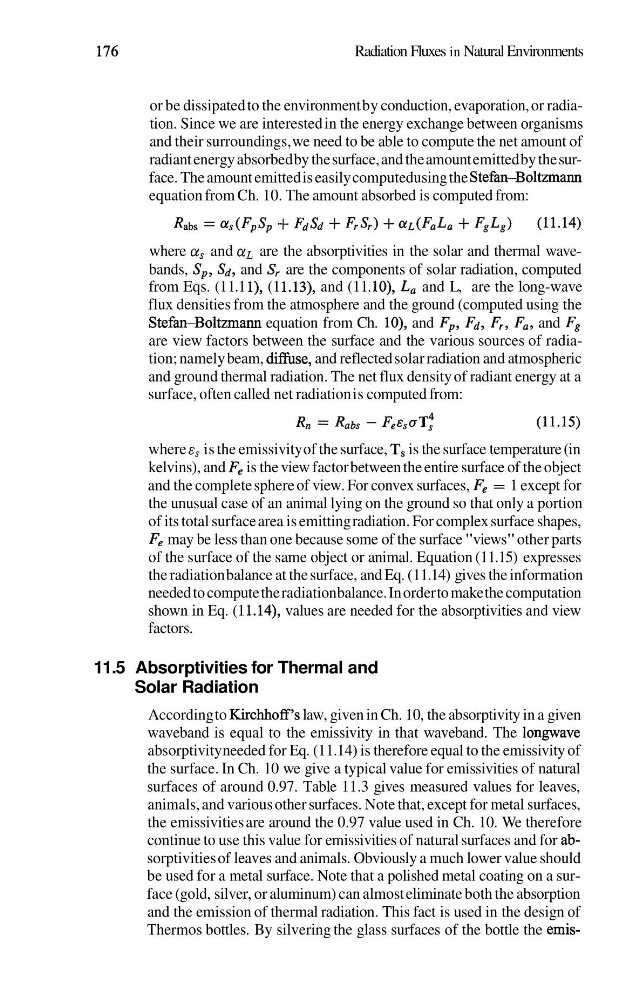
equation from Ch. 10. The amount absorbed is computed from:
where cw, and a~ are the absorptivities in the solar and thermal wavebands, S,, Sd, and S, are the components of solar radiation, computed
from Eqs. (1 1.1 I), (1 1.13), and (1 1. lo), La and L, are the long-wave
flux densities from the atmosphere and the ground (computed using the
StefmBoltzmann equation from Ch. lo), and F,, Fd, F,, Fa, and F,
are view factors between the surface and the various sources of radiation; namely beam, diffuse, and reflected solar radiation and atmospheric
and ground thermal radiation. The net flux density of radiant energy at a
surface, often called net radiation is computed from:
where E, is the emissivity of the surface, T, is the surface temperature (in
kelvins), and F, is the view factor between the entire surface of the object
and the complete sphere of view. For convex surfaces, F, = 1 except for
the unusual case of an animal lying on the ground so that only a portion
of its total surface area is emitting radiation. For complex surface shapes,
F, may be less than one because some of the surface "views" other parts
of the surface of the same object or animal. Equation (1 1.15) expresses
the radiation balance at the surface, and Eq. (1 1.14) gives the information
needed to compute the radiation balance. In order to make the computation
shown in Eq. (1 1.14), values are needed for the absorptivities and view
factors.
11.5 Absorptivities for Thermal and
Solar Radiation
According to Kirchhoff's law, given in Ch. 10, the absorptivity in a given
waveband is equal to the emissivity in that waveband. The longwave
absorptivity needed for Eq. (1 1.14) is therefore equal to the emissivity of
the surface. In Ch. 10 we give a typical value for emissivities of natural
surfaces of around 0.97. Table 11.3 gives measured values for leaves,
animals, and various other surfaces. Note that, except for metal surfaces,
the emissivities are around the 0.97 value used in Ch. 10. We therefore
continue to use this value for emissivities of natural surfaces and for absorptivities of leaves and animals. Obviously a much lower value should
be used for a metal surface. Note that a polished metal coating on a surface (gold, silver, or aluminum) can almost eliminate both the absorption
and the emission of thermal radiation. This fact is used in the design of
Thermos bottles. By silvering the glass surfaces of the bottle the emis-
or be dissipated to the environment by conduction, evaporation, or radiation. Since we are interested in the energy exchange between organisms
and their surroundings, we need to be able to compute the net amount of
radiant energy absorbed by the surface, and the amount emitted by the surface. The amount emitted is easily computedusing the Stefan-Boltzmann
equation from Ch. 10. The amount absorbed is computed from:
where cw, and a~ are the absorptivities in the solar and thermal wavebands, S,, Sd, and S, are the components of solar radiation, computed
from Eqs. (1 1.1 I), (1 1.13), and (1 1. lo), La and L, are the long-wave
flux densities from the atmosphere and the ground (computed using the
StefmBoltzmann equation from Ch. lo), and F,, Fd, F,, Fa, and F,
are view factors between the surface and the various sources of radiation; namely beam, diffuse, and reflected solar radiation and atmospheric
and ground thermal radiation. The net flux density of radiant energy at a
surface, often called net radiation is computed from:
where E, is the emissivity of the surface, T, is the surface temperature (in
kelvins), and F, is the view factor between the entire surface of the object
and the complete sphere of view. For convex surfaces, F, = 1 except for
the unusual case of an animal lying on the ground so that only a portion
of its total surface area is emitting radiation. For complex surface shapes,
F, may be less than one because some of the surface "views" other parts
of the surface of the same object or animal. Equation (1 1.15) expresses
the radiation balance at the surface, and Eq. (1 1.14) gives the information
needed to compute the radiation balance. In order to make the computation
shown in Eq. (1 1.14), values are needed for the absorptivities and view
factors.
11.5 Absorptivities for Thermal and
Solar Radiation
According to Kirchhoff's law, given in Ch. 10, the absorptivity in a given
waveband is equal to the emissivity in that waveband. The longwave
absorptivity needed for Eq. (1 1.14) is therefore equal to the emissivity of
the surface. In Ch. 10 we give a typical value for emissivities of natural
surfaces of around 0.97. Table 11.3 gives measured values for leaves,
animals, and various other surfaces. Note that, except for metal surfaces,
the emissivities are around the 0.97 value used in Ch. 10. We therefore
continue to use this value for emissivities of natural surfaces and for absorptivities of leaves and animals. Obviously a much lower value should
be used for a metal surface. Note that a polished metal coating on a surface (gold, silver, or aluminum) can almost eliminate both the absorption
and the emission of thermal radiation. This fact is used in the design of
Thermos bottles. By silvering the glass surfaces of the bottle the emis-