

Attenuation of Radiation
157
angle the sun makes with a normal to the surface need to be known.
Equation (10.3) can also be used to find the irradiance of a surface when
the radiance of the surroundings is known, as shown in the following
example.
Example 10.3. A unit area on the ground is illuminated by a hemisphere of isotropic radiation with a radiance of N W m-2 sr-' (isotropic
means that the radiance is constant for all incident directions). What is
the irradiance of the surface?
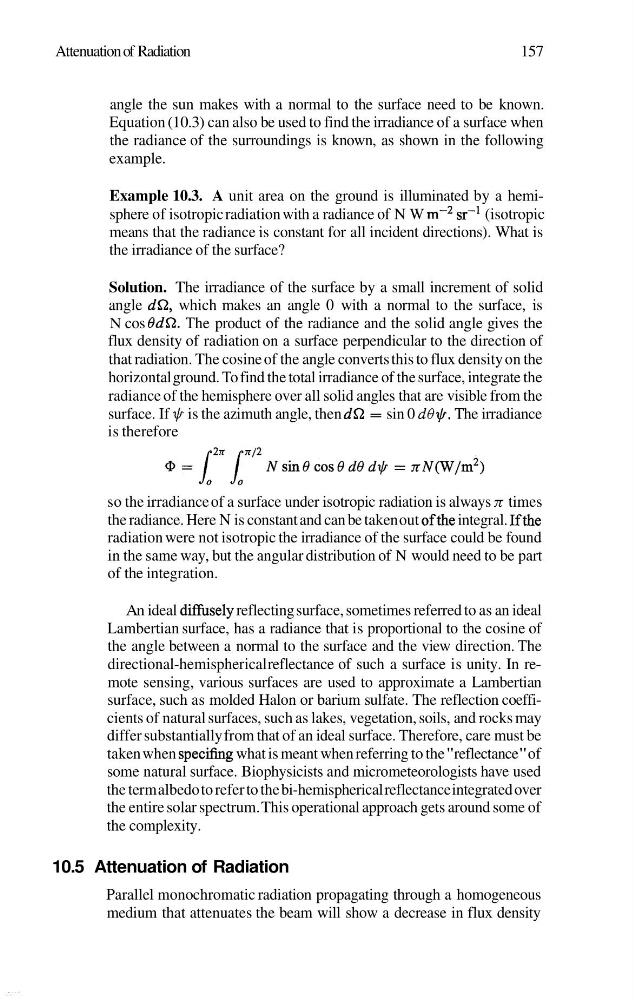
Solution. The irradiance of the surface by a small increment of solid
angle dQ, which makes an angle 0 with a normal to the surface, is
N cos 0dS2. The product of the radiance and the solid angle gives the
flux density of radiation on a surface perpendicular to the direction of
that radiation. The cosine of the angle converts this to flux density on the
horizontal ground. To find the total irradiance of the surface, integrate the
radiance of the hemisphere over all solid angles that are visible from the
surface. If 1C. is the azimuth angle, then dS2 = sin 0 de I , +. The irradiance
is therefore
so the irradiance of a surface under isotropic radiation is always n times
the radiance. Here N is constant and can be taken out ofthe integral. Ifthe
radiation were not isotropic the irradiance of the surface could be found
in the same way, but the angular distribution of N would need to be part
of the integration.
An ideal diffusely reflecting surface, sometimes referred to as an ideal
Lambertian surface, has a radiance that is proportional to the cosine of
the angle between a normal to the surface and the view direction. The
directional-hemispherical reflectance of such a surface is unity. In remote sensing, various surfaces are used to approximate a Lambertian
surface, such as molded Halon or barium sulfate. The reflection coefficients of natural surfaces, such as lakes, vegetation, soils, and rocks may
differ substantially from that of an ideal surface. Therefore, care must be
taken when specifing what is meant when referring to the "reflectance" of
some natural surface. Biophysicists and micrometeorologists have used
the term albedo to refer to the bi-hemispherical reflectance integrated over
the entire solar spectrum. This operational approach gets around some of
the complexity.
10.5 Attenuation of Radiation
Parallel monochromatic radiation propagating through a homogeneous
medium that attenuates the beam will show a decrease in flux density
157
angle the sun makes with a normal to the surface need to be known.
Equation (10.3) can also be used to find the irradiance of a surface when
the radiance of the surroundings is known, as shown in the following
example.
Example 10.3. A unit area on the ground is illuminated by a hemisphere of isotropic radiation with a radiance of N W m-2 sr-' (isotropic
means that the radiance is constant for all incident directions). What is
the irradiance of the surface?
Solution. The irradiance of the surface by a small increment of solid
angle dQ, which makes an angle 0 with a normal to the surface, is
N cos 0dS2. The product of the radiance and the solid angle gives the
flux density of radiation on a surface perpendicular to the direction of
that radiation. The cosine of the angle converts this to flux density on the
horizontal ground. To find the total irradiance of the surface, integrate the
radiance of the hemisphere over all solid angles that are visible from the
surface. If 1C. is the azimuth angle, then dS2 = sin 0 de I , +. The irradiance
is therefore
so the irradiance of a surface under isotropic radiation is always n times
the radiance. Here N is constant and can be taken out ofthe integral. Ifthe
radiation were not isotropic the irradiance of the surface could be found
in the same way, but the angular distribution of N would need to be part
of the integration.
An ideal diffusely reflecting surface, sometimes referred to as an ideal
Lambertian surface, has a radiance that is proportional to the cosine of
the angle between a normal to the surface and the view direction. The
directional-hemispherical reflectance of such a surface is unity. In remote sensing, various surfaces are used to approximate a Lambertian
surface, such as molded Halon or barium sulfate. The reflection coefficients of natural surfaces, such as lakes, vegetation, soils, and rocks may
differ substantially from that of an ideal surface. Therefore, care must be
taken when specifing what is meant when referring to the "reflectance" of
some natural surface. Biophysicists and micrometeorologists have used
the term albedo to refer to the bi-hemispherical reflectance integrated over
the entire solar spectrum. This operational approach gets around some of
the complexity.
10.5 Attenuation of Radiation
Parallel monochromatic radiation propagating through a homogeneous
medium that attenuates the beam will show a decrease in flux density