

156
Radiation Basics
radiance of a perfectly diffusely reflecting panel with identical orientation
and illumination, then the ratio of the measured radiance of the surface
and the measured radiance of the perfectly diffusing panel would be the
bi-directional reflectance factor.
10.4 The Cosine Law
If a small area is exposed to a point source of radiation, so that the rays of
light hitting the surface are nearly parallel, the irradiance of the surface
depends on its orientation with respect to the radiant beam. This is easily
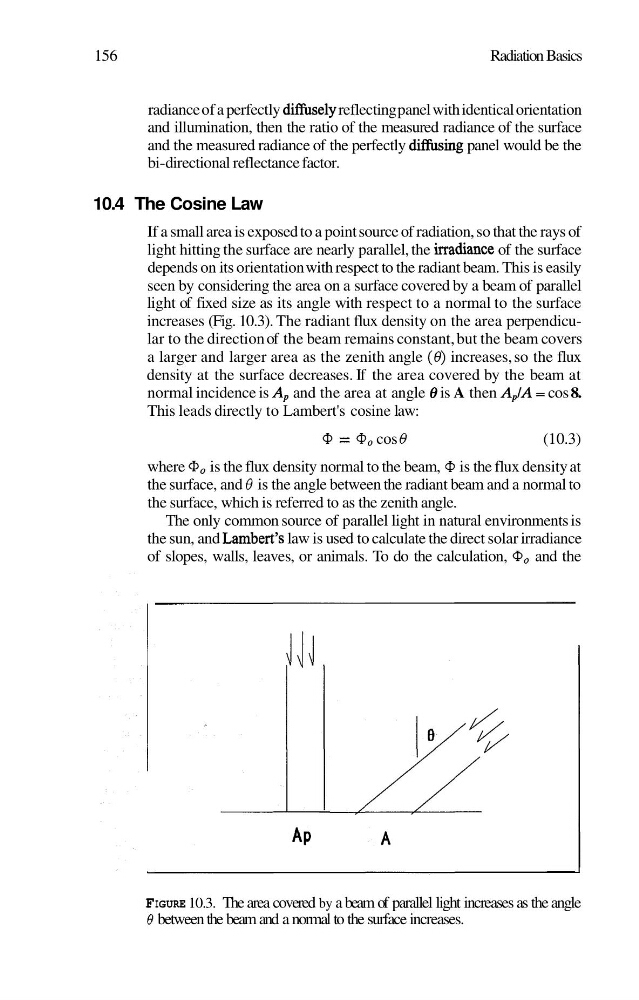
seen by considering the area on a surface covered by a beam of parallel
light of fixed size as its angle with respect to a normal to the surface
increases (Fig. 10.3). The radiant flux density on the area perpendicular to the direction of the beam remains constant, but the beam covers
a larger and larger area as the zenith angle (8) increases, so the flux
density at the surface decreases. If the area covered by the beam at
normal incidence is A, and the area at angle 8 is A then APIA = cos 8.
This leads directly to Lambert's cosine law:
@ = @, cos 8
(10.3)
where @, is the flux density normal to the beam, @ is the flux density at
the surface, and 8 is the angle between the radiant beam and a normal to
the surface, which is referred to as the zenith angle.
The only common source of parallel light in natural environments is
the sun, and Lambert's law is used to calculate the direct solar irradiance
of slopes, walls, leaves, or animals. To do the calculation, @, and the
FIGURE 10.3. The area covered by a beam of parallel light increases as the angle
8 between the beam and a normal to the surface increases.
Radiation Basics
radiance of a perfectly diffusely reflecting panel with identical orientation
and illumination, then the ratio of the measured radiance of the surface
and the measured radiance of the perfectly diffusing panel would be the
bi-directional reflectance factor.
10.4 The Cosine Law
If a small area is exposed to a point source of radiation, so that the rays of
light hitting the surface are nearly parallel, the irradiance of the surface
depends on its orientation with respect to the radiant beam. This is easily
seen by considering the area on a surface covered by a beam of parallel
light of fixed size as its angle with respect to a normal to the surface
increases (Fig. 10.3). The radiant flux density on the area perpendicular to the direction of the beam remains constant, but the beam covers
a larger and larger area as the zenith angle (8) increases, so the flux
density at the surface decreases. If the area covered by the beam at
normal incidence is A, and the area at angle 8 is A then APIA = cos 8.
This leads directly to Lambert's cosine law:
@ = @, cos 8
(10.3)
where @, is the flux density normal to the beam, @ is the flux density at
the surface, and 8 is the angle between the radiant beam and a normal to
the surface, which is referred to as the zenith angle.
The only common source of parallel light in natural environments is
the sun, and Lambert's law is used to calculate the direct solar irradiance
of slopes, walls, leaves, or animals. To do the calculation, @, and the
FIGURE 10.3. The area covered by a beam of parallel light increases as the angle
8 between the beam and a normal to the surface increases.