

158
Radiation Basics
described by Bouguer's or Beer's law:
where @, is the unattenuated flux density, z is the distance the beam
travels in the medium, and k is an extinction coefficient (m-') for the
medium. We use this law to describe light penetration in the atmosphere
and in crop canopies. The law strictly applies only for wavebands narrow
enough that k remains relatively constant over the waveband. It is often
used, however, for much broader bands of radiation. We use it to describe
the attenuation of the entire solar spectrum in the atmosphere. For broad
wavebands attenuation may not exactly follow an exponential law. If
changes in kz are not too great, however, Eq. (10.4) can still give a good
approximation of the attenuation of broadband radiation with distance.
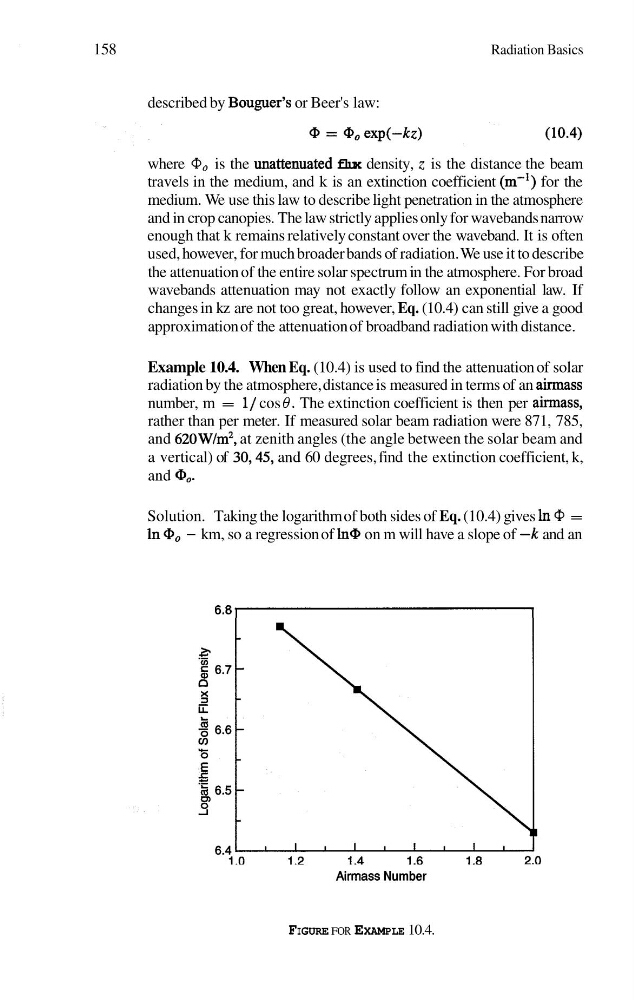
Example 10.4. When Eq. (10.4) is used to find the attenuation of solar
radiation by the atmosphere, distance is measured in terms of an airmass
number, m = 1/ cos 8. The extinction coefficient is then per airmass,
rather than per meter. If measured solar beam radiation were 871, 785,
and 620 W/m2, at zenith angles (the angle between the solar beam and
a vertical) of 30,45, and 60 degrees, find the extinction coefficient, k,
and a,.
Solution. Taking the logarithm of both sides of Eq. (10.4) gives In cP =
In @, - km, so a regression of In@ on m will have a slope of -k and an
Airmass Number
FIGURE FOR EXAMPLE 10.4.
Radiation Basics
described by Bouguer's or Beer's law:
where @, is the unattenuated flux density, z is the distance the beam
travels in the medium, and k is an extinction coefficient (m-') for the
medium. We use this law to describe light penetration in the atmosphere
and in crop canopies. The law strictly applies only for wavebands narrow
enough that k remains relatively constant over the waveband. It is often
used, however, for much broader bands of radiation. We use it to describe
the attenuation of the entire solar spectrum in the atmosphere. For broad
wavebands attenuation may not exactly follow an exponential law. If
changes in kz are not too great, however, Eq. (10.4) can still give a good
approximation of the attenuation of broadband radiation with distance.
Example 10.4. When Eq. (10.4) is used to find the attenuation of solar
radiation by the atmosphere, distance is measured in terms of an airmass
number, m = 1/ cos 8. The extinction coefficient is then per airmass,
rather than per meter. If measured solar beam radiation were 871, 785,
and 620 W/m2, at zenith angles (the angle between the solar beam and
a vertical) of 30,45, and 60 degrees, find the extinction coefficient, k,
and a,.
Solution. Taking the logarithm of both sides of Eq. (10.4) gives In cP =
In @, - km, so a regression of In@ on m will have a slope of -k and an
Airmass Number
FIGURE FOR EXAMPLE 10.4.