

Radiation Basics
infrared filters. On the red range it reads out a spectral flux density of
1.3 W mP2 nm-' . What is the irradiance in that spectral band?
Solution. Without knowing the bandwidth of the filter, it is impossible
to know the irradiance, but rough estimates can be made. From Fig. 10.1
it can be seen that the red band has a width of 130 nm. If the filter covered
the entire band, then the red irradiance would be 1.3 W m-2 nm-' x
130nm = 1 6 9 ~ m - ~ .
Radiant energy interacts with matter through reflection, transmission,
absorption, and emission. The interaction with the material may depend
on the direction of the incident radiation, the direction from which the
surface is viewed, and the wavelength of the radiation. The wavelength
dependence is recognized in the following definitions.
Absorptivity [a(A)]: The fraction of incident radiant flux at a give
wavelength that is absorbed by a material.
Emissivity [&(A)]: The fraction of blackbody emittance at a given
wavelength emitted by a material.
Reflectivity [p(A)]: The fraction of incident radiant flux at a given
wavelength reflected by a material.
Transmissivity [t (A)]: The fraction of incident radiant flux at a given
wavelength transmitted by a material.
Once radiant energy arrives at a receiver it is either absorbed, transmitted, or reflected. Since all of the energy must be partitioned between
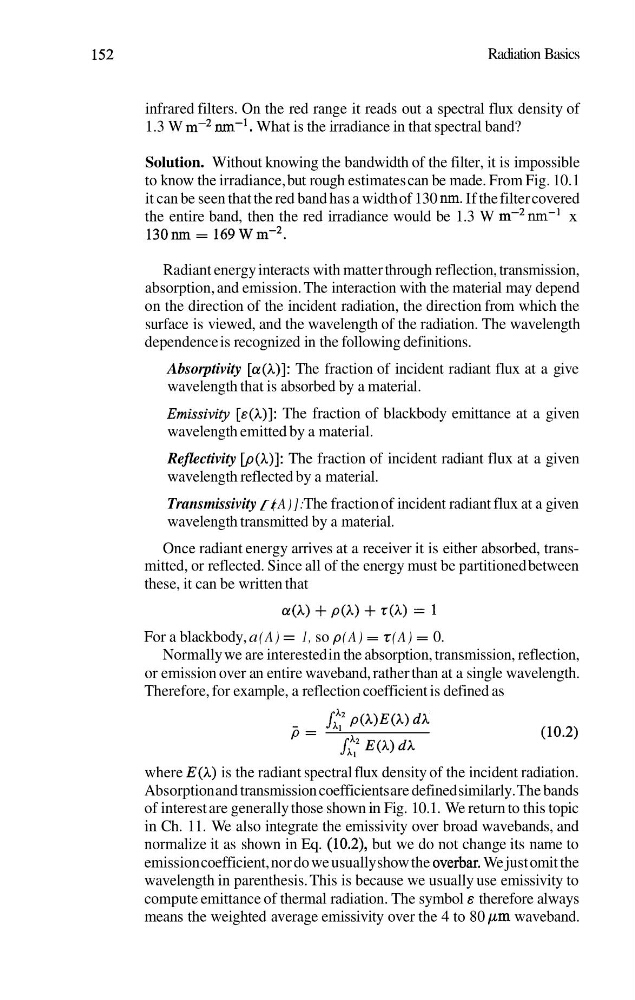
these, it can be written that
For a blackbody, a (A) = 1, so p (A) = t (A) = 0.
Normally we are interested in the absorption, transmission, reflection,
or emission over an entire waveband, rather than at a single wavelength.
Therefore, for example, a reflection coefficient is defined as
where E ( A ) is the radiant spectral flux density of the incident radiation.
Absorption and transmission coefficients are defined similarly. The bands
of interest are generally those shown in Fig. 10.1. We return to this topic
in Ch. 11. We also integrate the emissivity over broad wavebands, and
normalize it as shown in Eq. (10.2), but we do not change its name to
emission coefficient, nor do we usually show the overbar. We just omit the
wavelength in parenthesis. This is because we usually use emissivity to
compute emittance of thermal radiation. The symbol E therefore always
means the weighted average emissivity over the 4 to 80 pm waveband.
infrared filters. On the red range it reads out a spectral flux density of
1.3 W mP2 nm-' . What is the irradiance in that spectral band?
Solution. Without knowing the bandwidth of the filter, it is impossible
to know the irradiance, but rough estimates can be made. From Fig. 10.1
it can be seen that the red band has a width of 130 nm. If the filter covered
the entire band, then the red irradiance would be 1.3 W m-2 nm-' x
130nm = 1 6 9 ~ m - ~ .
Radiant energy interacts with matter through reflection, transmission,
absorption, and emission. The interaction with the material may depend
on the direction of the incident radiation, the direction from which the
surface is viewed, and the wavelength of the radiation. The wavelength
dependence is recognized in the following definitions.
Absorptivity [a(A)]: The fraction of incident radiant flux at a give
wavelength that is absorbed by a material.
Emissivity [&(A)]: The fraction of blackbody emittance at a given
wavelength emitted by a material.
Reflectivity [p(A)]: The fraction of incident radiant flux at a given
wavelength reflected by a material.
Transmissivity [t (A)]: The fraction of incident radiant flux at a given
wavelength transmitted by a material.
Once radiant energy arrives at a receiver it is either absorbed, transmitted, or reflected. Since all of the energy must be partitioned between
these, it can be written that
For a blackbody, a (A) = 1, so p (A) = t (A) = 0.
Normally we are interested in the absorption, transmission, reflection,
or emission over an entire waveband, rather than at a single wavelength.
Therefore, for example, a reflection coefficient is defined as
where E ( A ) is the radiant spectral flux density of the incident radiation.
Absorption and transmission coefficients are defined similarly. The bands
of interest are generally those shown in Fig. 10.1. We return to this topic
in Ch. 11. We also integrate the emissivity over broad wavebands, and
normalize it as shown in Eq. (10.2), but we do not change its name to
emission coefficient, nor do we usually show the overbar. We just omit the
wavelength in parenthesis. This is because we usually use emissivity to
compute emittance of thermal radiation. The symbol E therefore always
means the weighted average emissivity over the 4 to 80 pm waveband.