

Definitions
151
and an azimuth angle of 180" (pointed due South) and its IFOV may be
10". Thus the measured radiance, which for such an infrared thermometer
is probably contained in the wavelength band 8 to 14pm, is appropriate
for zenith angles from approximately 45 to 55", and azimuth angles from
175 to 185".
Clearly, if enough radiance measurements of a surface are made, integration of these radiance measurements over all the appropriate angles
provides an estimate of the radiant flux density. Usually this is not done
because of the considerable difficulty associated with making all the
directional radiance measurements.
In environmental biophysics we often want to relate remote sensing
observations to measurements of radiant or heat fluxes from animals
or vegetation. For example, measurements of directional radiometric
temperature from an infrared thermometer may provide an estimate of
"surface temperature" useful in characterizing the energy budget of a
crop. However, great care must be taken in mixing hemispherical and directional quantities, because directional quantities may depend strongly
on view angle and have complex relations to hemispherical quantities. In
this book, we are mainly concerned with hemispherical quantities.
The most important terms for organism energy balance are the radiant
emittance and irradiance. Sets of terms similar to those in Fig. 10.2 are
also defined for just the visible portion of the spectrum. When the fluxes
are weighted according to the human eye response they are referred to as
photometric units, and when they are weighted according to the photosynthetic or quantum response they are referred to as photosynthetic photon
flux units. The photometric term corresponding to irradiance is the illuminance, and has units of lumens/m 2 or lux. The photosynthetic term is the
photosynthetic photon flux density (PPFD) and has units of mol quanta
m-2 s-' . As with photosynthesis, one can convert between irradiance and
illuminance. The conversion factor depends on the spectral distribution
of the radiation, as it does with PAR. For the solar spectrum, 1 mmol
m-2 s -1 -- 5 1 lux. Gates (1980) shows how to do these conversions.
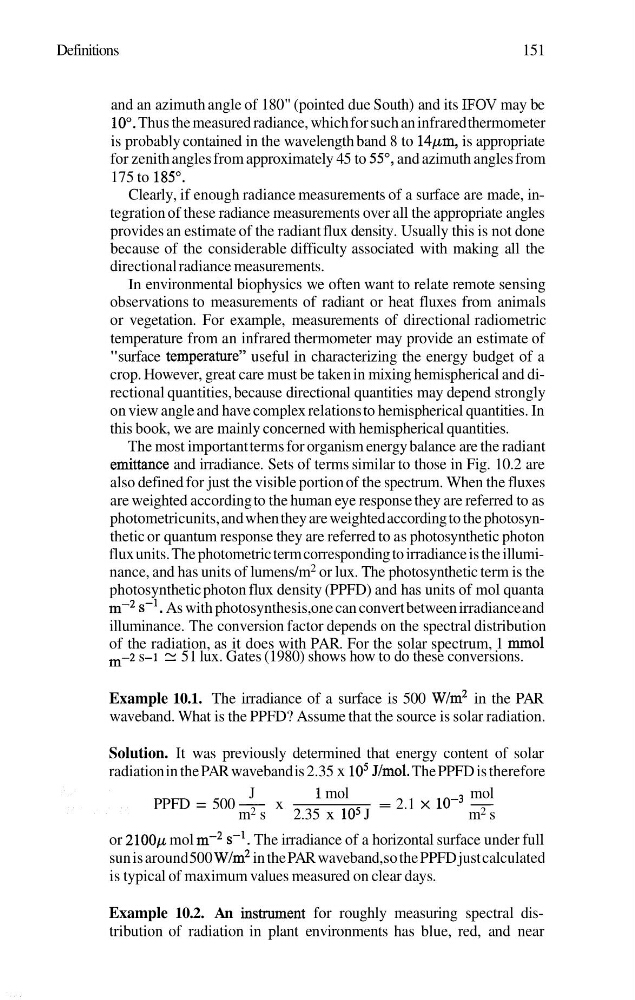
Example 10.1. The irradiance of a surface is 500 w/m2 in the PAR
waveband. What is the PPFD? Assume that the source is solar radiation.
Solution. It was previously determined that energy content of solar
radiation in the PAR waveband is 2.35 x lo5 Jlmol. The PPFD is therefore
J
1 mol
mol
PPFD = 500 - x
= 2.1
-
m 2 s
2.35 x lo5 J
m 2 s
or 2 1 0 0 ~
mol m-2 s-' . The irradiance of a horizontal surface under full
sun is around 500 w/m2 in the PAR waveband, so the PPFD just calculated
is typical of maximum values measured on clear days.
Example 10.2. An instrument for roughly measuring spectral distribution of radiation in plant environments has blue, red, and near
151
and an azimuth angle of 180" (pointed due South) and its IFOV may be
10". Thus the measured radiance, which for such an infrared thermometer
is probably contained in the wavelength band 8 to 14pm, is appropriate
for zenith angles from approximately 45 to 55", and azimuth angles from
175 to 185".
Clearly, if enough radiance measurements of a surface are made, integration of these radiance measurements over all the appropriate angles
provides an estimate of the radiant flux density. Usually this is not done
because of the considerable difficulty associated with making all the
directional radiance measurements.
In environmental biophysics we often want to relate remote sensing
observations to measurements of radiant or heat fluxes from animals
or vegetation. For example, measurements of directional radiometric
temperature from an infrared thermometer may provide an estimate of
"surface temperature" useful in characterizing the energy budget of a
crop. However, great care must be taken in mixing hemispherical and directional quantities, because directional quantities may depend strongly
on view angle and have complex relations to hemispherical quantities. In
this book, we are mainly concerned with hemispherical quantities.
The most important terms for organism energy balance are the radiant
emittance and irradiance. Sets of terms similar to those in Fig. 10.2 are
also defined for just the visible portion of the spectrum. When the fluxes
are weighted according to the human eye response they are referred to as
photometric units, and when they are weighted according to the photosynthetic or quantum response they are referred to as photosynthetic photon
flux units. The photometric term corresponding to irradiance is the illuminance, and has units of lumens/m 2 or lux. The photosynthetic term is the
photosynthetic photon flux density (PPFD) and has units of mol quanta
m-2 s-' . As with photosynthesis, one can convert between irradiance and
illuminance. The conversion factor depends on the spectral distribution
of the radiation, as it does with PAR. For the solar spectrum, 1 mmol
m-2 s -1 -- 5 1 lux. Gates (1980) shows how to do these conversions.
Example 10.1. The irradiance of a surface is 500 w/m2 in the PAR
waveband. What is the PPFD? Assume that the source is solar radiation.
Solution. It was previously determined that energy content of solar
radiation in the PAR waveband is 2.35 x lo5 Jlmol. The PPFD is therefore
J
1 mol
mol
PPFD = 500 - x
= 2.1
-
m 2 s
2.35 x lo5 J
m 2 s
or 2 1 0 0 ~
mol m-2 s-' . The irradiance of a horizontal surface under full
sun is around 500 w/m2 in the PAR waveband, so the PPFD just calculated
is typical of maximum values measured on clear days.
Example 10.2. An instrument for roughly measuring spectral distribution of radiation in plant environments has blue, red, and near