

Radiation Basics
Irradiance (w/m2): Radiant flux density incident on a surface.
Radiant spectral JEux density (E(h),W m-2 pm-'): Radiant flux
density per unit wavelength interval.
Radiant intensity (I, Wlsr): Flux emanating from a surface per unit
solid angle.
Radiance (N, W m-2 s f 1 ) : The radiant flux density emanating from
a surface per unit solid angle.
Spectral radiance (W m-2 sr-' ,urn-') Radiance per unit wavelength
interval.
Radiant emittance (W/m 2 ): Radiant flux density emitted by a surface.
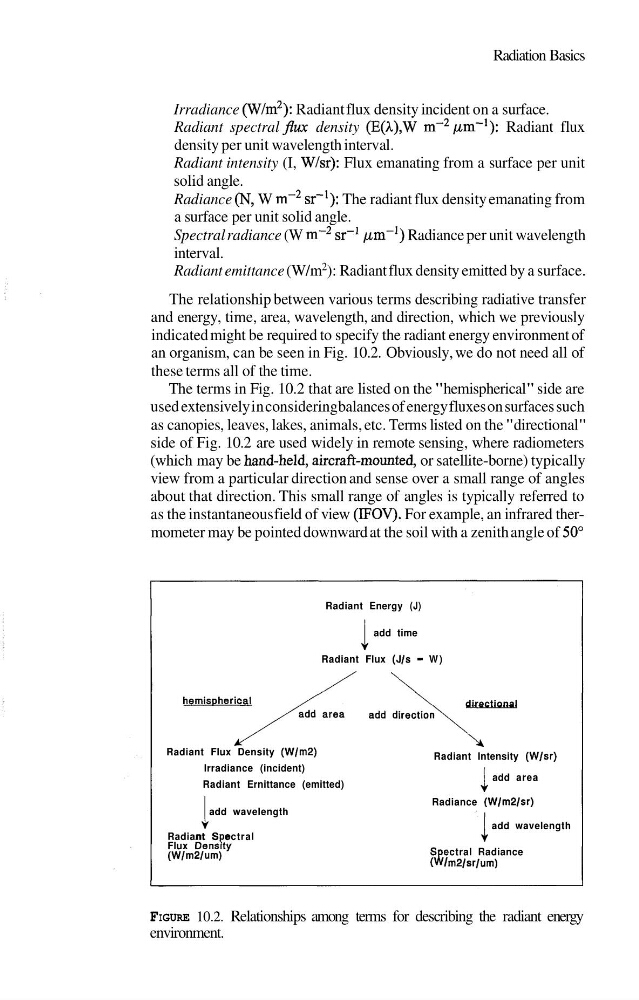
The relationship between various terms describing radiative transfer
and energy, time, area, wavelength, and direction, which we previously
indicated might be required to specify the radiant energy environment of
an organism, can be seen in Fig. 10.2. Obviously, we do not need all of
these terms all of the time.
The terms in Fig. 10.2 that are listed on the "hemispherical" side are
used extensively in considering balances of energy fluxes on surfaces such
as canopies, leaves, lakes, animals, etc. Terms listed on the "directional"
side of Fig. 10.2 are used widely in remote sensing, where radiometers
(which may be handheld, aircraft-mounted, or satellite-borne) typically
view from a particular direction and sense over a small range of angles
about that direction. This small range of angles is typically referred to
as the instantaneous field of view (IFOV). For example, an infrared thermometer may be pointed downward at the soil with a zenith angle of 50"
I
Radiant Energy (J)
I
add time
Radiant Flux (Jls - W)
Radiant Flux Density (Wlrn2)
lrradiance (incident)
Radiant Ernittance (emitted)
add wavelength
Radiant S ectral
Flux ~ e n s r t y
(WlmPlum)
directional
L
Radiant Intensity (Wlsr)
1 add area
Radiance (WlmPlsr)
1 add wavelength
S ectral Radiance
(&I rn2/sr/urn)
FIGURE 10.2. Relationships among terms for describing the radiant energy
environment.
Irradiance (w/m2): Radiant flux density incident on a surface.
Radiant spectral JEux density (E(h),W m-2 pm-'): Radiant flux
density per unit wavelength interval.
Radiant intensity (I, Wlsr): Flux emanating from a surface per unit
solid angle.
Radiance (N, W m-2 s f 1 ) : The radiant flux density emanating from
a surface per unit solid angle.
Spectral radiance (W m-2 sr-' ,urn-') Radiance per unit wavelength
interval.
Radiant emittance (W/m 2 ): Radiant flux density emitted by a surface.
The relationship between various terms describing radiative transfer
and energy, time, area, wavelength, and direction, which we previously
indicated might be required to specify the radiant energy environment of
an organism, can be seen in Fig. 10.2. Obviously, we do not need all of
these terms all of the time.
The terms in Fig. 10.2 that are listed on the "hemispherical" side are
used extensively in considering balances of energy fluxes on surfaces such
as canopies, leaves, lakes, animals, etc. Terms listed on the "directional"
side of Fig. 10.2 are used widely in remote sensing, where radiometers
(which may be handheld, aircraft-mounted, or satellite-borne) typically
view from a particular direction and sense over a small range of angles
about that direction. This small range of angles is typically referred to
as the instantaneous field of view (IFOV). For example, an infrared thermometer may be pointed downward at the soil with a zenith angle of 50"
I
Radiant Energy (J)
I
add time
Radiant Flux (Jls - W)
Radiant Flux Density (Wlrn2)
lrradiance (incident)
Radiant Ernittance (emitted)
add wavelength
Radiant S ectral
Flux ~ e n s r t y
(WlmPlum)
directional
L
Radiant Intensity (Wlsr)
1 add area
Radiance (WlmPlsr)
1 add wavelength
S ectral Radiance
(&I rn2/sr/urn)
FIGURE 10.2. Relationships among terms for describing the radiant energy
environment.