

Water Flow in Soil
because of the attraction of the matrix for the water. We were able to determine a matric potential at which drainage was considered negligible,
but this came from the dependence of conductivity on matric potential,
not from the attraction of the matrix for the water. The second point is that
a sealed, semi-infinite soil column will continue to drain until it reaches
zero water content. There is no point at which drainage ceases. We can
therefore think of the soil as a leaky bucket. The size of the leak, however,
decreases as the bucket empties.
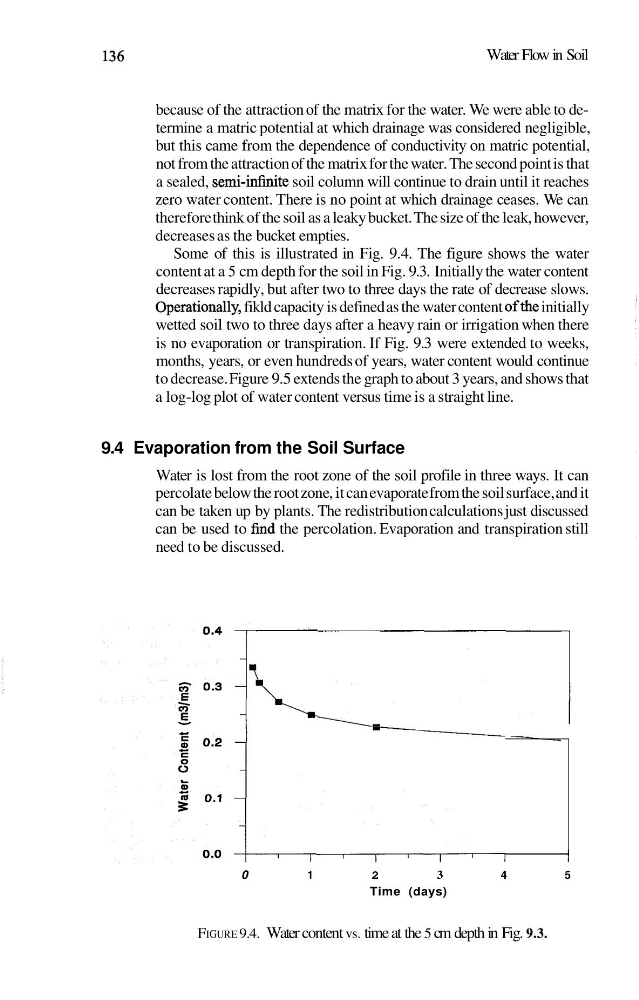
Some of this is illustrated in Fig. 9.4. The figure shows the water
content at a 5 cm depth for the soil in Fig. 9.3. Initially the water content
decreases rapidly, but after two to three days the rate of decrease slows.
~ ~ e r a t i o n a l i ~ ,
fikld capacity is defined as the water content ofthe initially
wetted soil two to three days after a heavy rain or irrigation when there
is no evaporation or transpiration. If Fig. 9.3 were extended to weeks,
months, years, or even hundreds of years, water content would continue
to decrease. Figure 9.5 extends the graph to about 3 years, and shows that
a log-log plot of water content versus time is a straight line.
9.4 Evaporation from the Soil Surface
Water is lost from the root zone of the soil profile in three ways. It can
percolate below the root zone, it can evaporate from the soil surface, and it
can be taken up by plants. The redistribution calculations just discussed
can be used to find the percolation. Evaporation and transpiration still
need to be discussed.
0
1
2
3
4
5
Time (days)
FIGURE 9.4. Water content vs. time at the 5 cm depth in Fig. 9.3.
because of the attraction of the matrix for the water. We were able to determine a matric potential at which drainage was considered negligible,
but this came from the dependence of conductivity on matric potential,
not from the attraction of the matrix for the water. The second point is that
a sealed, semi-infinite soil column will continue to drain until it reaches
zero water content. There is no point at which drainage ceases. We can
therefore think of the soil as a leaky bucket. The size of the leak, however,
decreases as the bucket empties.
Some of this is illustrated in Fig. 9.4. The figure shows the water
content at a 5 cm depth for the soil in Fig. 9.3. Initially the water content
decreases rapidly, but after two to three days the rate of decrease slows.
~ ~ e r a t i o n a l i ~ ,
fikld capacity is defined as the water content ofthe initially
wetted soil two to three days after a heavy rain or irrigation when there
is no evaporation or transpiration. If Fig. 9.3 were extended to weeks,
months, years, or even hundreds of years, water content would continue
to decrease. Figure 9.5 extends the graph to about 3 years, and shows that
a log-log plot of water content versus time is a straight line.
9.4 Evaporation from the Soil Surface
Water is lost from the root zone of the soil profile in three ways. It can
percolate below the root zone, it can evaporate from the soil surface, and it
can be taken up by plants. The redistribution calculations just discussed
can be used to find the percolation. Evaporation and transpiration still
need to be discussed.
0
1
2
3
4
5
Time (days)
FIGURE 9.4. Water content vs. time at the 5 cm depth in Fig. 9.3.