

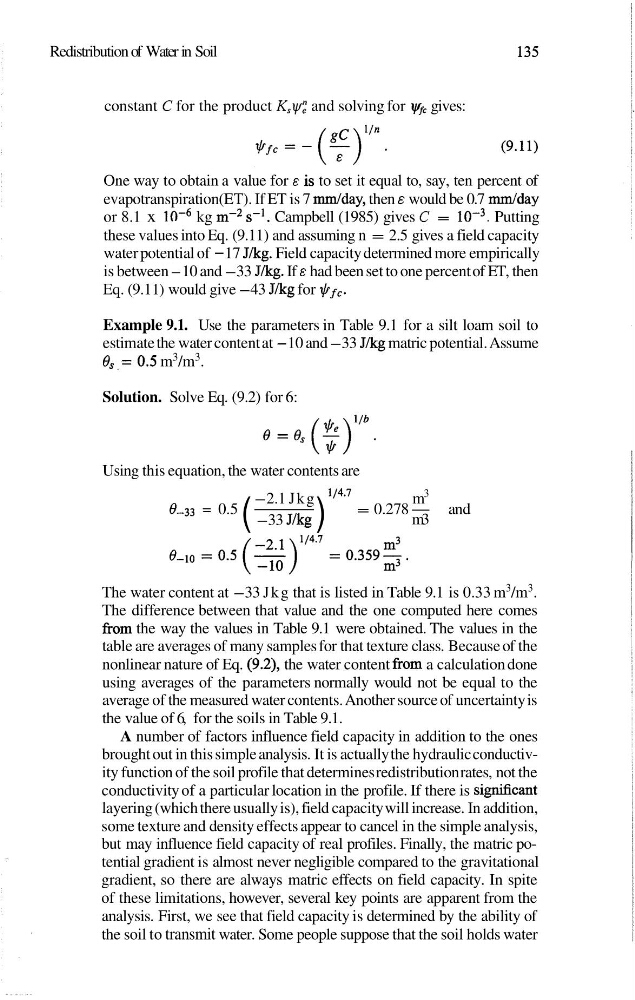
Redistribution of Water in Soil
constant C for the product K,@ and solving for &f gives:
One way to obtain a value for E is to set it equal to, say, ten percent of
evapotranspiration (ET). If ET is 7 mrnlday, then E would be 0.7 &day
or 8.1 x
kg m-2 s-'. Campbell (1985) gives C =
Putting
these values into Eq. (9.11) and assuming n = 2.5 gives a field capacity
water potential of - 17 Jkg. Field capacity determined more empirically
is between - 10 and -33 Jkg. If E had been set to one percent of ET, then
Eq. (9.1 1) would give -43 Jkg for 'IFfc.
Example 9.1. Use the parameters in Table 9.1 for a silt loam soil to
estimate the water content at - 10 and -33 Jkg matric potential. Assume
6, ,= 0.5 m
3
/m
3 .
Solution. Solve Eq. (9.2) for 6:
Using this equation, the water contents are
-2.1 Jkg 1' 4.7
m
3
9-33 = 0.5
( -33 Jikg )
= 0.278- and
m3
The water content at -33 Jkg that is listed in Table 9.1 is 0.33 m
3 /m
3 .
The difference between that value and the one computed here comes
fiom the way the values in Table 9.1 were obtained. The values in the
table are averages of many samples for that texture class. Because of the
nonlinear nature of Eq. (9.2), the water content from a calculation done
using averages of the parameters normally would not be equal to the
average of the measured water contents. Another source of uncertainty is
the value of 6, for the soils in Table 9.1.
A number of factors influence field capacity in addition to the ones
brought out in this simple analysis. It is actually the hydraulic conductivity function of the soil profile that determines redistribution rates, not the
conductivity of a particular location in the profile. If there is sigmficant
layering (which there usually is), field capacity will increase. In addition,
some texture and density effects appear to cancel in the simple analysis,
but may influence field capacity of real profiles. Finally, the matric potential gradient is almost never negligible compared to the gravitational
gradient, so there are always matric effects on field capacity. In spite
of these limitations, however, several key points are apparent from the
analysis. First, we see that field capacity is determined by the ability of
the soil to transmit water. Some people suppose that the soil holds water
constant C for the product K,@ and solving for &f gives:
One way to obtain a value for E is to set it equal to, say, ten percent of
evapotranspiration (ET). If ET is 7 mrnlday, then E would be 0.7 &day
or 8.1 x
kg m-2 s-'. Campbell (1985) gives C =
Putting
these values into Eq. (9.11) and assuming n = 2.5 gives a field capacity
water potential of - 17 Jkg. Field capacity determined more empirically
is between - 10 and -33 Jkg. If E had been set to one percent of ET, then
Eq. (9.1 1) would give -43 Jkg for 'IFfc.
Example 9.1. Use the parameters in Table 9.1 for a silt loam soil to
estimate the water content at - 10 and -33 Jkg matric potential. Assume
6, ,= 0.5 m
3
/m
3 .
Solution. Solve Eq. (9.2) for 6:
Using this equation, the water contents are
-2.1 Jkg 1' 4.7
m
3
9-33 = 0.5
( -33 Jikg )
= 0.278- and
m3
The water content at -33 Jkg that is listed in Table 9.1 is 0.33 m
3 /m
3 .
The difference between that value and the one computed here comes
fiom the way the values in Table 9.1 were obtained. The values in the
table are averages of many samples for that texture class. Because of the
nonlinear nature of Eq. (9.2), the water content from a calculation done
using averages of the parameters normally would not be equal to the
average of the measured water contents. Another source of uncertainty is
the value of 6, for the soils in Table 9.1.
A number of factors influence field capacity in addition to the ones
brought out in this simple analysis. It is actually the hydraulic conductivity function of the soil profile that determines redistribution rates, not the
conductivity of a particular location in the profile. If there is sigmficant
layering (which there usually is), field capacity will increase. In addition,
some texture and density effects appear to cancel in the simple analysis,
but may influence field capacity of real profiles. Finally, the matric potential gradient is almost never negligible compared to the gravitational
gradient, so there are always matric effects on field capacity. In spite
of these limitations, however, several key points are apparent from the
analysis. First, we see that field capacity is determined by the ability of
the soil to transmit water. Some people suppose that the soil holds water