

Heat Flow in the Soil
Mineral soil admittances are also three to five times greater than those
for organic soils.
8.5 Heat Transfer from Animals to a Substrate
Equation (8.3) can be solved with a different set of initial and boundary
conditions to obtain another result of interest to environmental biophysicists. The practical problem is that of estimating conduction heat loss or
heat gain when an animal with body temperature Tb comes in contact with
soil or another substrate with initial temperature To. The mathematical
problem which approximates this is to find temperature as a function of
depth and time for a semi-infinite medium of difisivity K , and initial
temperature To when the surface is instantaneously raised to a temperature Tb at time zero. The solution can be found in standard texts on heat
transfer. It is:
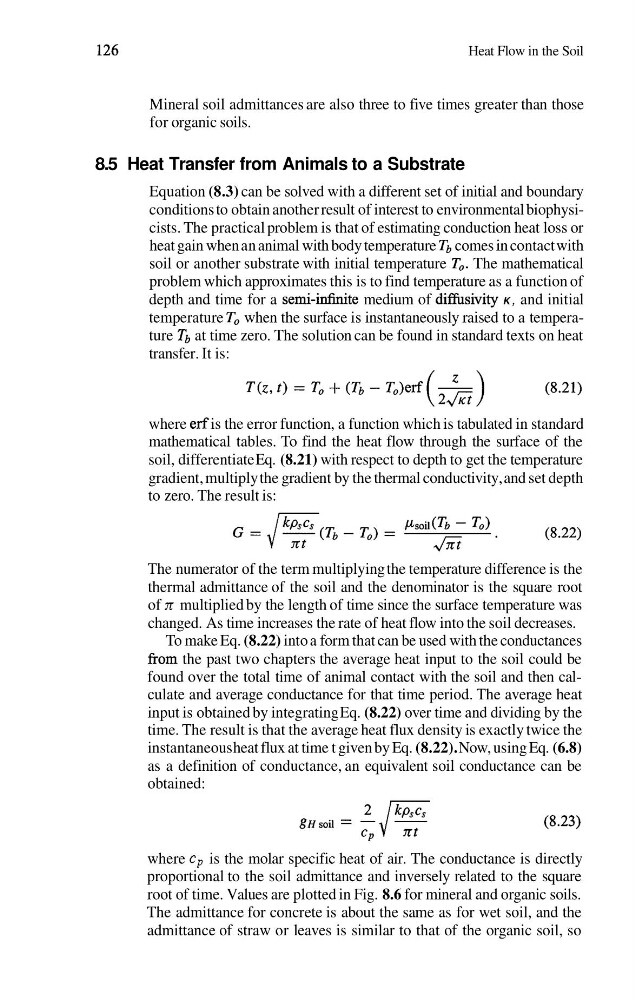
where erf is the error function, a function which is tabulated in standard
mathematical tables. To find the heat flow through the surface of the
soil, differentiate Eq. (8.21) with respect to depth to get the temperature
gradient, multiply the gradient by the thermal conductivity, and set depth
to zero. The result is:
The numerator of the term multiplying the temperature difference is the
thermal admittance of the soil and the denominator is the square root
of n multiplied by the length of time since the surface temperature was
changed. As time increases the rate of heat flow into the soil decreases.
To make Eq. (8.22) into a form that can be used with the conductances
from the past two chapters the average heat input to the soil could be
found over the total time of animal contact with the soil and then calculate and average conductance for that time period. The average heat
input is obtained by integrating Eq. (8.22) over time and dividing by the
time. The result is that the average heat flux density is exactly twice the
instantaneous heat flux at time t given by Eq. (8.22). Now, using Eq. (6.8)
as a definition of conductance, an equivalent soil conductance can be
obtained:
where c, is the molar specific heat of air. The conductance is directly
proportional to the soil admittance and inversely related to the square
root of time. Values are plotted in Fig. 8.6 for mineral and organic soils.
The admittance for concrete is about the same as for wet soil, and the
admittance of straw or leaves is similar to that of the organic soil, so
Mineral soil admittances are also three to five times greater than those
for organic soils.
8.5 Heat Transfer from Animals to a Substrate
Equation (8.3) can be solved with a different set of initial and boundary
conditions to obtain another result of interest to environmental biophysicists. The practical problem is that of estimating conduction heat loss or
heat gain when an animal with body temperature Tb comes in contact with
soil or another substrate with initial temperature To. The mathematical
problem which approximates this is to find temperature as a function of
depth and time for a semi-infinite medium of difisivity K , and initial
temperature To when the surface is instantaneously raised to a temperature Tb at time zero. The solution can be found in standard texts on heat
transfer. It is:
where erf is the error function, a function which is tabulated in standard
mathematical tables. To find the heat flow through the surface of the
soil, differentiate Eq. (8.21) with respect to depth to get the temperature
gradient, multiply the gradient by the thermal conductivity, and set depth
to zero. The result is:
The numerator of the term multiplying the temperature difference is the
thermal admittance of the soil and the denominator is the square root
of n multiplied by the length of time since the surface temperature was
changed. As time increases the rate of heat flow into the soil decreases.
To make Eq. (8.22) into a form that can be used with the conductances
from the past two chapters the average heat input to the soil could be
found over the total time of animal contact with the soil and then calculate and average conductance for that time period. The average heat
input is obtained by integrating Eq. (8.22) over time and dividing by the
time. The result is that the average heat flux density is exactly twice the
instantaneous heat flux at time t given by Eq. (8.22). Now, using Eq. (6.8)
as a definition of conductance, an equivalent soil conductance can be
obtained:
where c, is the molar specific heat of air. The conductance is directly
proportional to the soil admittance and inversely related to the square
root of time. Values are plotted in Fig. 8.6 for mineral and organic soils.
The admittance for concrete is about the same as for wet soil, and the
admittance of straw or leaves is similar to that of the organic soil, so