

Heat Transfer from Animals to a Substrate
127
wet soil
dry soil
organic
1
10
Time (hrs)
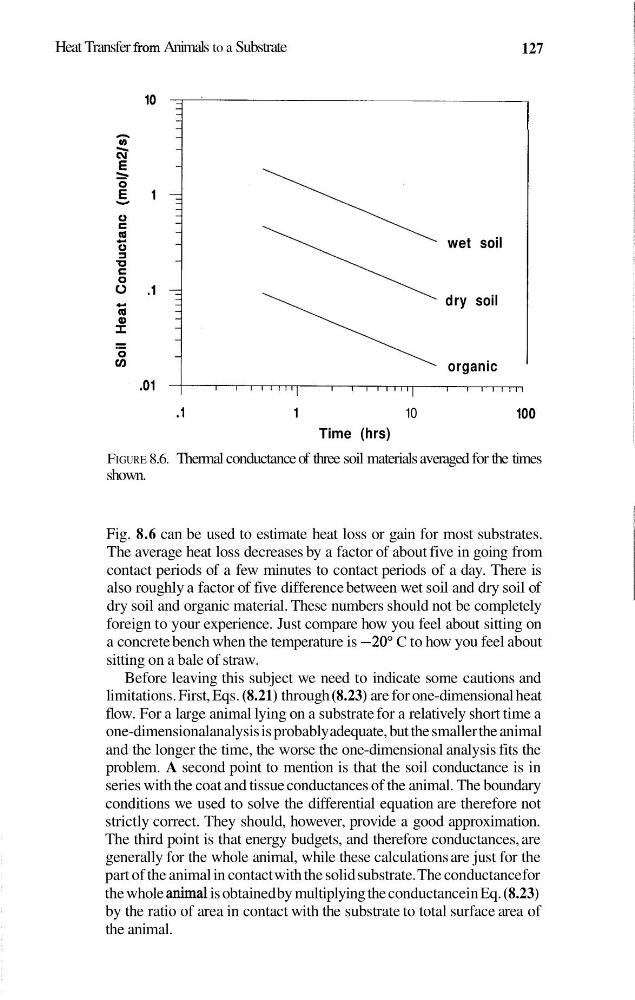
FIGURE 8.6. Thermal conductance of three soil materials averaged for the times
shown.
Fig. 8.6 can be used to estimate heat loss or gain for most substrates.
The average heat loss decreases by a factor of about five in going from
contact periods of a few minutes to contact periods of a day. There is
also roughly a factor of five difference between wet soil and dry soil of
dry soil and organic material. These numbers should not be completely
foreign to your experience. Just compare how you feel about sitting on
a concrete bench when the temperature is -20" C to how you feel about
sitting on a bale of straw.
Before leaving this subject we need to indicate some cautions and
limitations. First, Eqs. (8.21) through (8.23) are for one-dimensional heat
flow. For a large animal lying on a substrate for a relatively short time a
one-dimensional analysis is probably adequate, but the smaller the animal
and the longer the time, the worse the one-dimensional analysis fits the
problem. A second point to mention is that the soil conductance is in
series with the coat and tissue conductances of the animal. The boundary
conditions we used to solve the differential equation are therefore not
strictly correct. They should, however, provide a good approximation.
The third point is that energy budgets, and therefore conductances, are
generally for the whole animal, while these calculations are just for the
part of the animal in contact with the solid substrate. The conductance for
the whole animal is obtained by multiplying the conductance in Eq. (8.23)
by the ratio of area in contact with the substrate to total surface area of
the animal.
127
wet soil
dry soil
organic
1
10
Time (hrs)
FIGURE 8.6. Thermal conductance of three soil materials averaged for the times
shown.
Fig. 8.6 can be used to estimate heat loss or gain for most substrates.
The average heat loss decreases by a factor of about five in going from
contact periods of a few minutes to contact periods of a day. There is
also roughly a factor of five difference between wet soil and dry soil of
dry soil and organic material. These numbers should not be completely
foreign to your experience. Just compare how you feel about sitting on
a concrete bench when the temperature is -20" C to how you feel about
sitting on a bale of straw.
Before leaving this subject we need to indicate some cautions and
limitations. First, Eqs. (8.21) through (8.23) are for one-dimensional heat
flow. For a large animal lying on a substrate for a relatively short time a
one-dimensional analysis is probably adequate, but the smaller the animal
and the longer the time, the worse the one-dimensional analysis fits the
problem. A second point to mention is that the soil conductance is in
series with the coat and tissue conductances of the animal. The boundary
conditions we used to solve the differential equation are therefore not
strictly correct. They should, however, provide a good approximation.
The third point is that energy budgets, and therefore conductances, are
generally for the whole animal, while these calculations are just for the
part of the animal in contact with the solid substrate. The conductance for
the whole animal is obtained by multiplying the conductance in Eq. (8.23)
by the ratio of area in contact with the substrate to total surface area of
the animal.