

Thermal Diffusivity and Admittance of Soils
be less than lo C, so, using Eq. (8.6)
We assume that the soil is moist for most of the year. The annual damping
depth is therefore
Solving for z gives
The same type of calculation could be used to find the average temperature
over a diurnal cycle. It would also be roughly three times the damping
depth, or about 30 cm.
As previously discussed, the thermal admittance, or ability of the soil
to store heat when temperature varies over a specified range, is the square
root of the product of thermal conductivity and volumetric heat capacity.
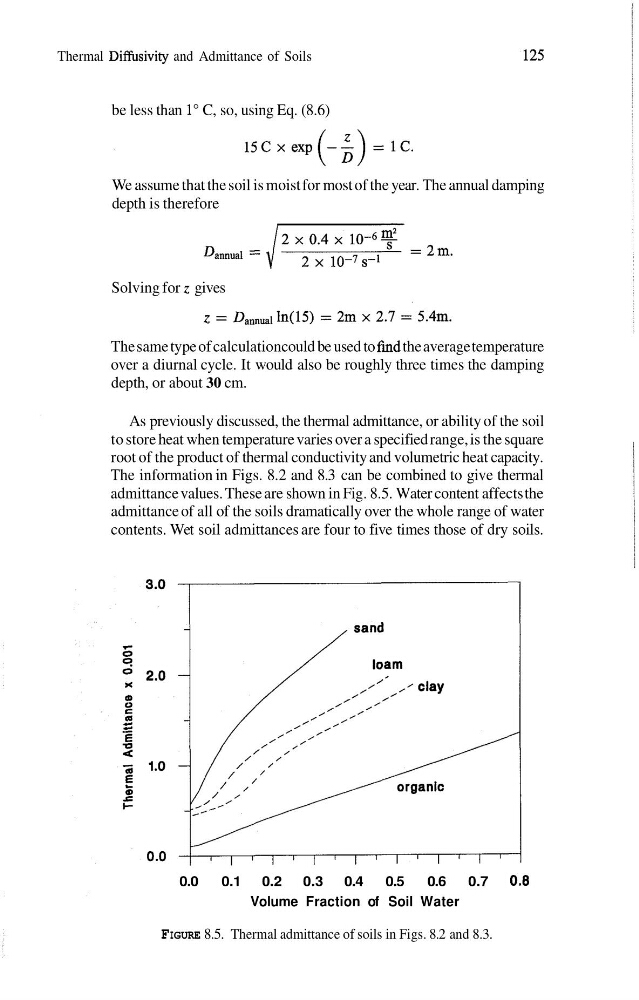
The information in Figs. 8.2 and 8.3 can be combined to give thermal
admittance values. These are shown in Fig. 8.5. Water content affects the
admittance of all of the soils dramatically over the whole range of water
contents. Wet soil admittances are four to five times those of dry soils.
0.0
0.1
0.2
0.3
0.4
0.5
0.6
0.7
0.8
Volume Fraction of Soil Water
FIGURE 8.5. Thermal admittance of soils in Figs. 8.2 and 8.3.
be less than lo C, so, using Eq. (8.6)
We assume that the soil is moist for most of the year. The annual damping
depth is therefore
Solving for z gives
The same type of calculation could be used to find the average temperature
over a diurnal cycle. It would also be roughly three times the damping
depth, or about 30 cm.
As previously discussed, the thermal admittance, or ability of the soil
to store heat when temperature varies over a specified range, is the square
root of the product of thermal conductivity and volumetric heat capacity.
The information in Figs. 8.2 and 8.3 can be combined to give thermal
admittance values. These are shown in Fig. 8.5. Water content affects the
admittance of all of the soils dramatically over the whole range of water
contents. Wet soil admittances are four to five times those of dry soils.
0.0
0.1
0.2
0.3
0.4
0.5
0.6
0.7
0.8
Volume Fraction of Soil Water
FIGURE 8.5. Thermal admittance of soils in Figs. 8.2 and 8.3.