

Heat Flow in the Soil
Temperature (C)
Depth (m)
Time of Day
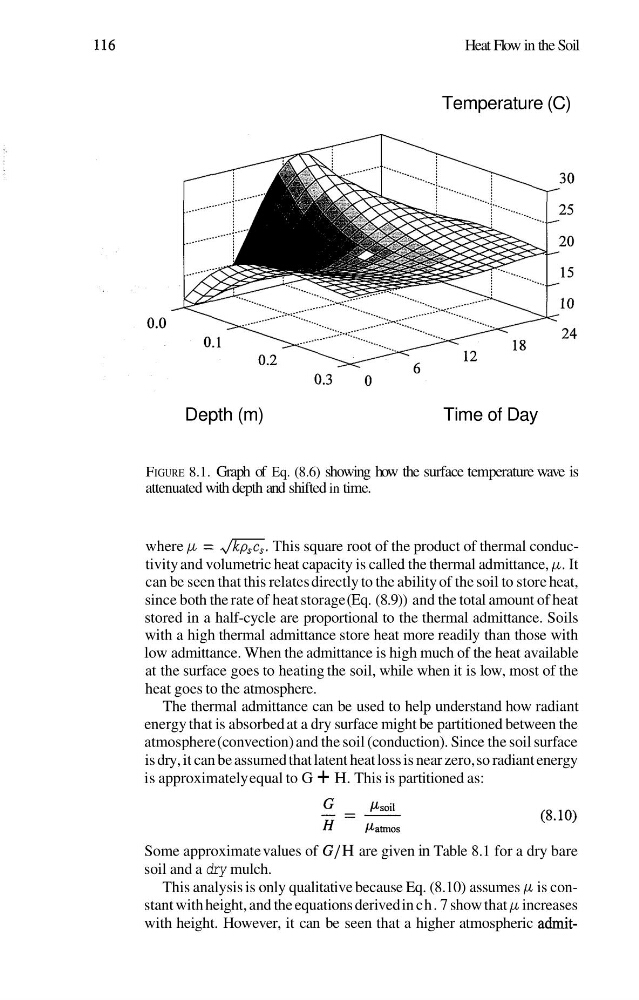
FIGURE 8.1. Graph of Eq. (8.6) showing how the surface temperature wave is
attenuated with depth and shifted in time.
where p = =.
This square root of the product of thermal conductivity and volumetric heat capacity is called the thermal admittance, p. It
can be seen that this relates directly to the ability of the soil to store heat,
since both the rate of heat storage (Eq. (8.9)) and the total amount of heat
stored in a half-cycle are proportional to the thermal admittance. Soils
with a high thermal admittance store heat more readily than those with
low admittance. When the admittance is high much of the heat available
at the surface goes to heating the soil, while when it is low, most of the
heat goes to the atmosphere.
The thermal admittance can be used to help understand how radiant
energy that is absorbed at a dry surface might be partitioned between the
atmosphere (convection) and the soil (conduction). Since the soil surface
is dry, it can be assumed that latent heat loss is near zero, so radiant energy
is approximately equal to G + H. This is partitioned as:
Some approximate values of G I H are given in Table 8.1 for a dry bare
soil and a dry mulch.
This analysis is only qualitative because Eq. (8.10) assumes p is constant with height, and the equations derived in ch. 7 show that p increases
with height. However, it can be seen that a higher atmospheric admit-
Temperature (C)
Depth (m)
Time of Day
FIGURE 8.1. Graph of Eq. (8.6) showing how the surface temperature wave is
attenuated with depth and shifted in time.
where p = =.
This square root of the product of thermal conductivity and volumetric heat capacity is called the thermal admittance, p. It
can be seen that this relates directly to the ability of the soil to store heat,
since both the rate of heat storage (Eq. (8.9)) and the total amount of heat
stored in a half-cycle are proportional to the thermal admittance. Soils
with a high thermal admittance store heat more readily than those with
low admittance. When the admittance is high much of the heat available
at the surface goes to heating the soil, while when it is low, most of the
heat goes to the atmosphere.
The thermal admittance can be used to help understand how radiant
energy that is absorbed at a dry surface might be partitioned between the
atmosphere (convection) and the soil (conduction). Since the soil surface
is dry, it can be assumed that latent heat loss is near zero, so radiant energy
is approximately equal to G + H. This is partitioned as:
Some approximate values of G I H are given in Table 8.1 for a dry bare
soil and a dry mulch.
This analysis is only qualitative because Eq. (8.10) assumes p is constant with height, and the equations derived in ch. 7 show that p increases
with height. However, it can be seen that a higher atmospheric admit-