

Thermal Properties of Soils: Volumetric Heat Capacity
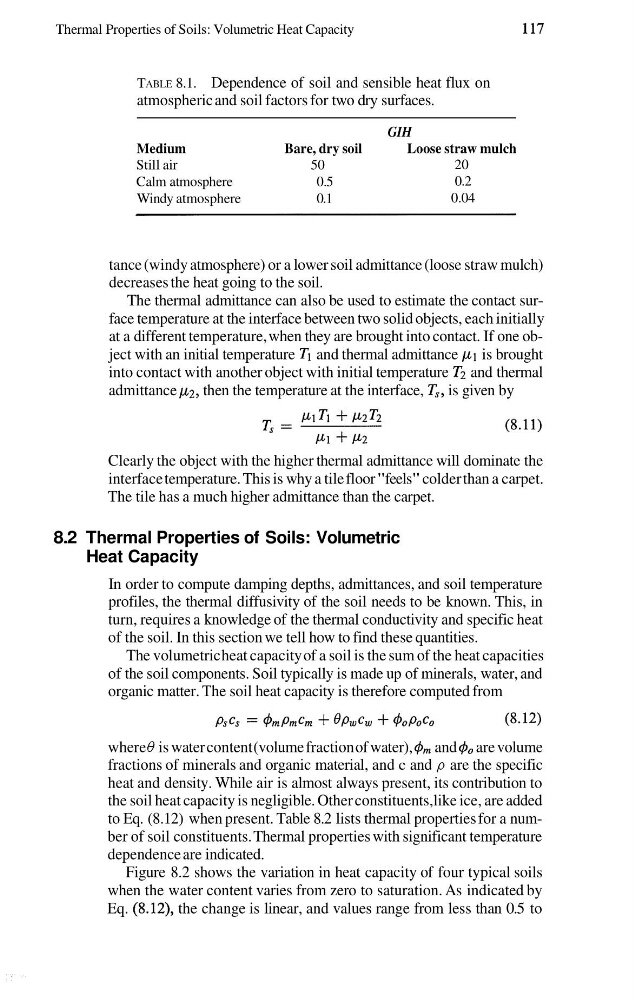
TABLE 8.1. Dependence of soil and sensible heat flux on
atmospheric and soil factors for two dry surfaces.
GIH
Medium
Bare, dry soil
Loose straw mulch
Still air
50
20
Calm atmosphere
0.5
0.2
Windy atmosphere
0.1
0.04
tance (windy atmosphere) or a lower soil admittance (loose straw mulch)
decreases the heat going to the soil.
The thermal admittance can also be used to estimate the contact surface temperature at the interface between two solid objects, each initially
at a different temperature, when they are brought into contact. If one object with an initial temperature Tl and thermal admittance p1 is brought
into contact with another object with initial temperature T2 and thermal
admittance ~ 2 ,
then the temperature at the interface, T,, is given by
Clearly the object with the higher thermal admittance will dominate the
interface temperature. This is why a tile floor "feels" colder than a carpet.
The tile has a much higher admittance than the carpet.
8.2 Thermal Properties of Soils: Volumetric
Heat Capacity
In order to compute damping depths, admittances, and soil temperature
profiles, the thermal diffusivity of the soil needs to be known. This, in
turn, requires a knowledge of the thermal conductivity and specific heat
of the soil. In this section we tell how to find these quantities.
The volumetric heat capacity of a soil is the sum of the heat capacities
of the soil components. Soil typically is made up of minerals, water, and
organic matter. The soil heat capacity is therefore computed from
where 0 is water content (volume fraction of water), 4, and 4, are volume
fractions of minerals and organic material, and c and p are the specific
heat and density. While air is almost always present, its contribution to
the soil heat capacity is negligible. Other constituents, like ice, are added
to Eq. (8.12) when present. Table 8.2 lists thermal properties for a number of soil constituents. Thermal properties with significant temperature
dependence are indicated.
Figure 8.2 shows the variation in heat capacity of four typical soils
when the water content varies from zero to saturation. As indicated by
Eq. (8.12), the change is linear, and values range from less than 0.5 to
TABLE 8.1. Dependence of soil and sensible heat flux on
atmospheric and soil factors for two dry surfaces.
GIH
Medium
Bare, dry soil
Loose straw mulch
Still air
50
20
Calm atmosphere
0.5
0.2
Windy atmosphere
0.1
0.04
tance (windy atmosphere) or a lower soil admittance (loose straw mulch)
decreases the heat going to the soil.
The thermal admittance can also be used to estimate the contact surface temperature at the interface between two solid objects, each initially
at a different temperature, when they are brought into contact. If one object with an initial temperature Tl and thermal admittance p1 is brought
into contact with another object with initial temperature T2 and thermal
admittance ~ 2 ,
then the temperature at the interface, T,, is given by
Clearly the object with the higher thermal admittance will dominate the
interface temperature. This is why a tile floor "feels" colder than a carpet.
The tile has a much higher admittance than the carpet.
8.2 Thermal Properties of Soils: Volumetric
Heat Capacity
In order to compute damping depths, admittances, and soil temperature
profiles, the thermal diffusivity of the soil needs to be known. This, in
turn, requires a knowledge of the thermal conductivity and specific heat
of the soil. In this section we tell how to find these quantities.
The volumetric heat capacity of a soil is the sum of the heat capacities
of the soil components. Soil typically is made up of minerals, water, and
organic matter. The soil heat capacity is therefore computed from
where 0 is water content (volume fraction of water), 4, and 4, are volume
fractions of minerals and organic material, and c and p are the specific
heat and density. While air is almost always present, its contribution to
the soil heat capacity is negligible. Other constituents, like ice, are added
to Eq. (8.12) when present. Table 8.2 lists thermal properties for a number of soil constituents. Thermal properties with significant temperature
dependence are indicated.
Figure 8.2 shows the variation in heat capacity of four typical soils
when the water content varies from zero to saturation. As indicated by
Eq. (8.12), the change is linear, and values range from less than 0.5 to