

102
Conductances for Heat and Mass Transfer
7.8 Cylinders, Spheres and Animal Shapes
The relationships for conductance and resistance that were just presented
can be derived from hndamental principles, but they apply only for transport from one side of a rectangular plate. With suitable adjustments in
d, these could be used for leaves, but they would not necessarily apply
for other surface shapes. So far it has not been possible to derive similar
relationships from fundamental principles for objects like cylinders and
spheres, so these relationships have been obtained empirically. Monteith
and Unsworth (1990) and Simonson (1975) give examples of these relationships which are typical of those found in books on heat transfer.
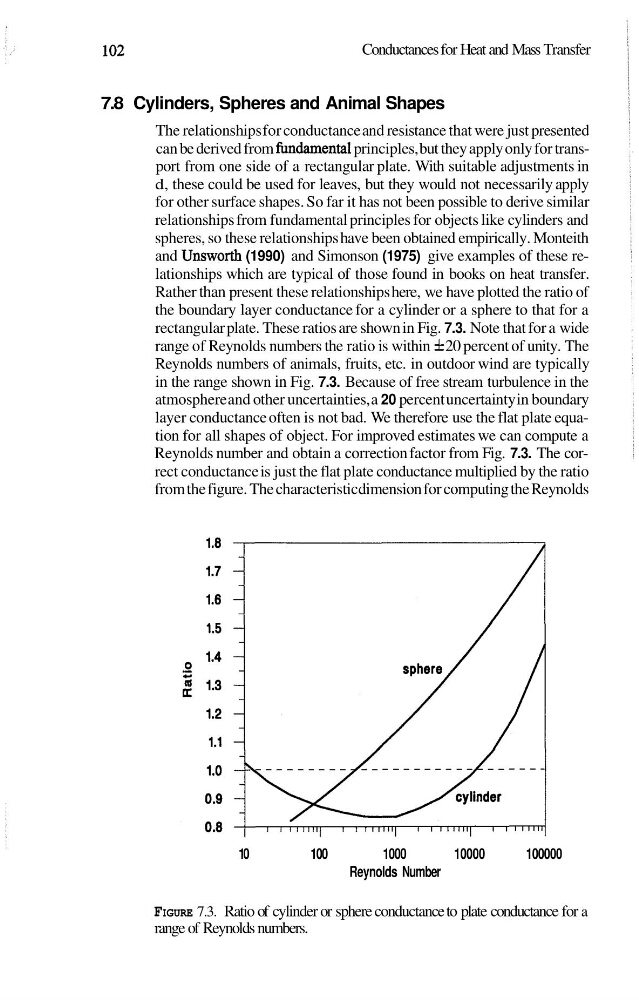
Rather than present these relationships here, we have plotted the ratio of
the boundary layer conductance for a cylinder or a sphere to that for a
rectangular plate. These ratios are shown in Fig. 7.3. Note that for a wide
range of Reynolds numbers the ratio is within f 20 percent of unity. The
Reynolds numbers of animals, fruits, etc. in outdoor wind are typically
in the range shown in Fig. 7.3. Because of free stream turbulence in the
atmosphere and other uncertainties, a 20 percent uncertainty in boundary
layer conductance often is not bad. We therefore use the flat plate equation for all shapes of object. For improved estimates we can compute a
Reynolds number and obtain a correction factor from Fig. 7.3. The correct conductance is just the flat plate conductance multiplied by the ratio
from the figure. The characteristic dimension for computing the Reynolds
10
100
1000
10000
100000
Reynolds Number
FIGURE 7.3. Ratio of cylinder or sphere conductance to plate conductance for a
range of Reynolds numbers.
Conductances for Heat and Mass Transfer
7.8 Cylinders, Spheres and Animal Shapes
The relationships for conductance and resistance that were just presented
can be derived from hndamental principles, but they apply only for transport from one side of a rectangular plate. With suitable adjustments in
d, these could be used for leaves, but they would not necessarily apply
for other surface shapes. So far it has not been possible to derive similar
relationships from fundamental principles for objects like cylinders and
spheres, so these relationships have been obtained empirically. Monteith
and Unsworth (1990) and Simonson (1975) give examples of these relationships which are typical of those found in books on heat transfer.
Rather than present these relationships here, we have plotted the ratio of
the boundary layer conductance for a cylinder or a sphere to that for a
rectangular plate. These ratios are shown in Fig. 7.3. Note that for a wide
range of Reynolds numbers the ratio is within f 20 percent of unity. The
Reynolds numbers of animals, fruits, etc. in outdoor wind are typically
in the range shown in Fig. 7.3. Because of free stream turbulence in the
atmosphere and other uncertainties, a 20 percent uncertainty in boundary
layer conductance often is not bad. We therefore use the flat plate equation for all shapes of object. For improved estimates we can compute a
Reynolds number and obtain a correction factor from Fig. 7.3. The correct conductance is just the flat plate conductance multiplied by the ratio
from the figure. The characteristic dimension for computing the Reynolds
10
100
1000
10000
100000
Reynolds Number
FIGURE 7.3. Ratio of cylinder or sphere conductance to plate conductance for a
range of Reynolds numbers.