

Conductances for Heat and Mass Transfer in Laminar Forced Convection
101
fluid as it is heated or cooled by the exchange surface. The boundary layer
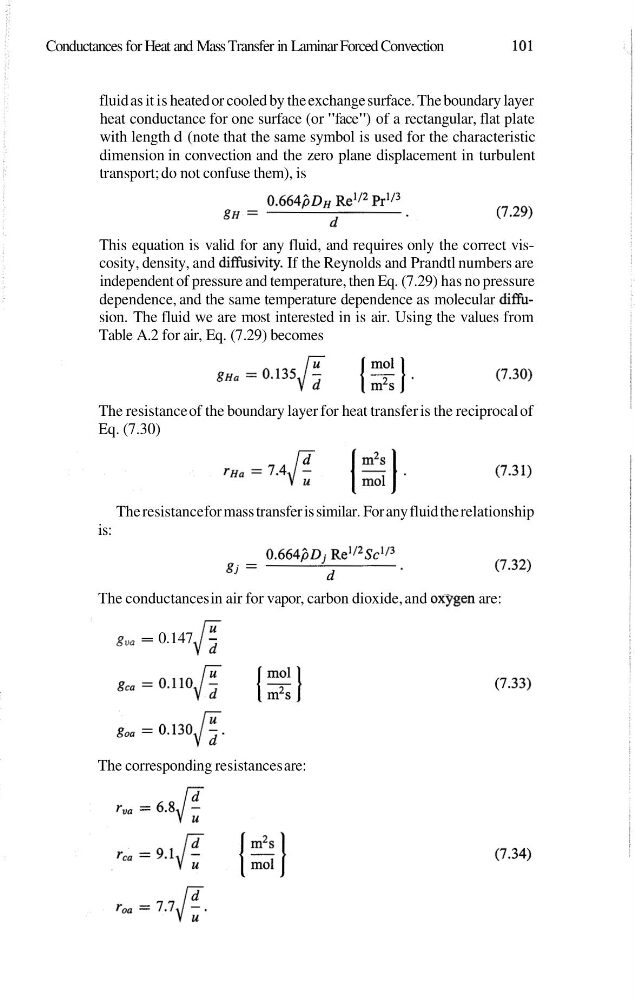
heat conductance for one surface (or "face") of a rectangular, flat plate
with length d (note that the same symbol is used for the characteristic
dimension in convection and the zero plane displacement in turbulent
transport; do not confuse them), is
This equation is valid for any fluid, and requires only the correct viscosity, density, and difisivity. If the Reynolds and Prandtl numbers are
independent of pressure and temperature, then Eq. (7.29) has no pressure
dependence, and the same temperature dependence as molecular d i f i -
sion. The fluid we are most interested in is air. Using the values from
Table A.2 for air, Eq. (7.29) becomes
The resistance of the boundary layer for heat transfer is the reciprocal of
Eq. (7.30)
The resistance for mass transfer is similar. For any fluid the relationship
is:
The conductances in air for vapor, carbon dioxide, and oxBen are:
g,, = 0.147 -
J:
The corresponding resistances are:
101
fluid as it is heated or cooled by the exchange surface. The boundary layer
heat conductance for one surface (or "face") of a rectangular, flat plate
with length d (note that the same symbol is used for the characteristic
dimension in convection and the zero plane displacement in turbulent
transport; do not confuse them), is
This equation is valid for any fluid, and requires only the correct viscosity, density, and difisivity. If the Reynolds and Prandtl numbers are
independent of pressure and temperature, then Eq. (7.29) has no pressure
dependence, and the same temperature dependence as molecular d i f i -
sion. The fluid we are most interested in is air. Using the values from
Table A.2 for air, Eq. (7.29) becomes
The resistance of the boundary layer for heat transfer is the reciprocal of
Eq. (7.30)
The resistance for mass transfer is similar. For any fluid the relationship
is:
The conductances in air for vapor, carbon dioxide, and oxBen are:
g,, = 0.147 -
J:
The corresponding resistances are: