

Conductances in Free Convection
103
number or for computing the conductance is the diameter of the cylinder
or the sphere. If the wind is blowing parallel to the axis of the cylinder,
then it acts just like a flat plate, and the characteristic dimension is its
length.
Another approach was taken by Mitchell (1976). When comparing
measured conductances for animal shapes with the conductance of a
sphere, it was found that conductances of shapes and sizes ranging from
spiders and insects to cows were well represented by the relationship
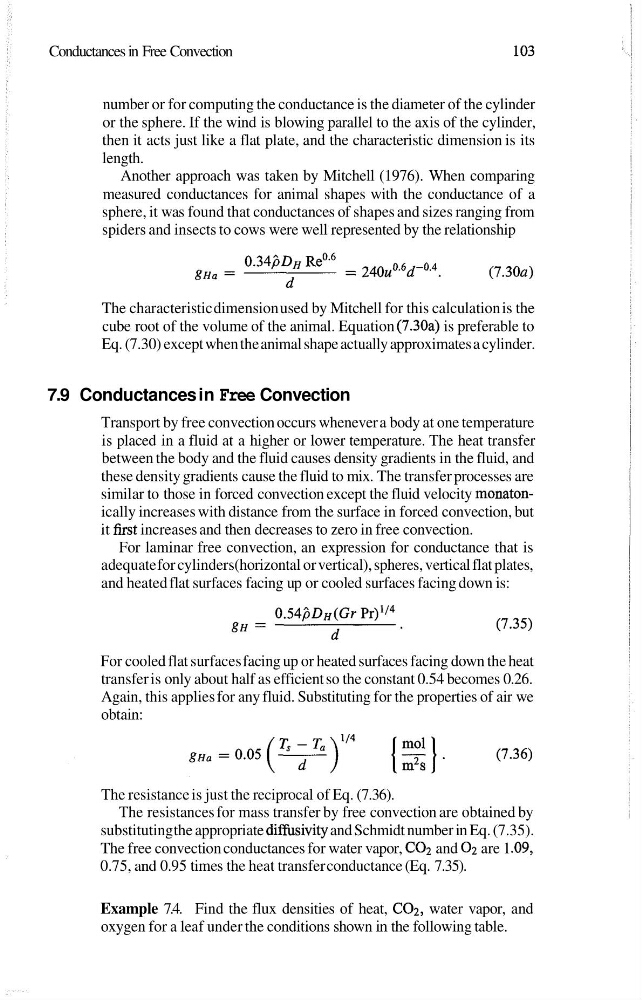
The characteristic dimension used by Mitchell for this calculation is the
cube root of the volume of the animal. Equation (7.30a) is preferable to
Eq. (7.30) except when the animal shape actually approximates a cylinder.
7.9 Conductances in Free Convection
Transport by free convection occurs whenever a body at one temperature
is placed in a fluid at a higher or lower temperature. The heat transfer
between the body and the fluid causes density gradients in the fluid, and
these density gradients cause the fluid to mix. The transfer processes are
similar to those in forced convection except the fluid velocity monatonically increases with distance from the surface in forced convection, but
it first increases and then decreases to zero in free convection.
For laminar free convection, an expression for conductance that is
adequate for cylinders (horizontal or vertical), spheres, vertical flat plates,
and heated flat surfaces facing up or cooled surfaces facing down is:
For cooled flat surfaces facing up or heated surfaces facing down the heat
transfer is only about half as efficient so the constant 0.54 becomes 0.26.
Again, this applies for any fluid. Substituting for the properties of air we
obtain:
The resistance is just the reciprocal of Eq. (7.36).
The resistances for mass transfer by free convection are obtained by
substituting the appropriate diffusivity and Schmidt number in Eq. (7.35).
The free convection conductances for water vapor, C02 and 0 2 are 1 .O9,
0.75, and 0.95 times the heat transfer conductance (Eq. 7.35).
Example 7.4. Find the flux densities of heat, CO2, water vapor, and
oxygen for a leaf under the conditions shown in the following table.
103
number or for computing the conductance is the diameter of the cylinder
or the sphere. If the wind is blowing parallel to the axis of the cylinder,
then it acts just like a flat plate, and the characteristic dimension is its
length.
Another approach was taken by Mitchell (1976). When comparing
measured conductances for animal shapes with the conductance of a
sphere, it was found that conductances of shapes and sizes ranging from
spiders and insects to cows were well represented by the relationship
The characteristic dimension used by Mitchell for this calculation is the
cube root of the volume of the animal. Equation (7.30a) is preferable to
Eq. (7.30) except when the animal shape actually approximates a cylinder.
7.9 Conductances in Free Convection
Transport by free convection occurs whenever a body at one temperature
is placed in a fluid at a higher or lower temperature. The heat transfer
between the body and the fluid causes density gradients in the fluid, and
these density gradients cause the fluid to mix. The transfer processes are
similar to those in forced convection except the fluid velocity monatonically increases with distance from the surface in forced convection, but
it first increases and then decreases to zero in free convection.
For laminar free convection, an expression for conductance that is
adequate for cylinders (horizontal or vertical), spheres, vertical flat plates,
and heated flat surfaces facing up or cooled surfaces facing down is:
For cooled flat surfaces facing up or heated surfaces facing down the heat
transfer is only about half as efficient so the constant 0.54 becomes 0.26.
Again, this applies for any fluid. Substituting for the properties of air we
obtain:
The resistance is just the reciprocal of Eq. (7.36).
The resistances for mass transfer by free convection are obtained by
substituting the appropriate diffusivity and Schmidt number in Eq. (7.35).
The free convection conductances for water vapor, C02 and 0 2 are 1 .O9,
0.75, and 0.95 times the heat transfer conductance (Eq. 7.35).
Example 7.4. Find the flux densities of heat, CO2, water vapor, and
oxygen for a leaf under the conditions shown in the following table.