

Conductances for Heat and Mass Transfer
corresponding resistances are 3.3 and 100 m
2 slmol. The resistance of
the stomata plus pubescence is therefore 4.3 m
2 slmol for open stomata
and 101 m
2 slmol for closed stomata. The pubescence could therefore
decrease transpiration by about 25 percent when stomata are open, but
would have a negligible effect when stomata are closed.
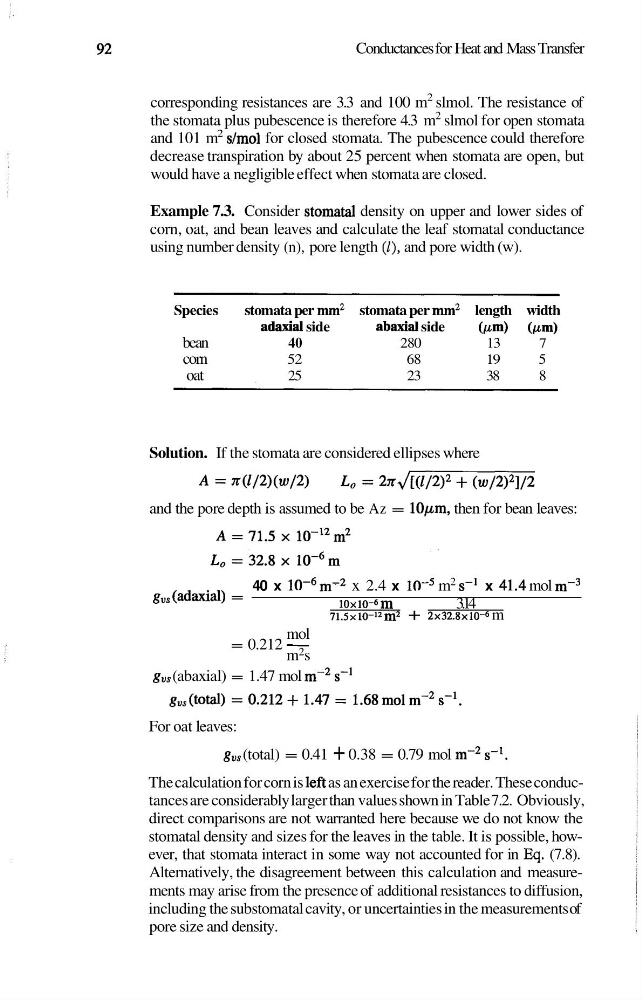
Example 7.3. Consider stomatal density on upper and lower sides of
corn, oat, and bean leaves and calculate the leaf stomatal conductance
using number density (n), pore length (l), and pore width (w).
Species
stomata per nun2 stomata per m d length width
adaxial side
abaxial side
(pm) (pm)
bean
40
280
13
7
corn
52
68
19
5
oat
25
23
38
8
Solution. If the stomata are considered ellipses where
and the pore depth is assumed to be Az = lOpm, then for bean leaves:
40 x
m-2 x 2.4 x lou5 m 2 s-' x 41.4 mol mP3
g,,(adaxial) =
lox lo-6 m
3. 14
n . 5 ~ 1 0 - 1 2 m2 + 2x32.8~10-~ m
mol
= 0.212 -
m 2 s
g,, (abaxial) = 1.47 mol mF2 s-'
For oat leaves:
g,, (total) = 0.41 + 0.38 = 0.79 mol m-2 s-'.
The calculation for corn is left as an exercise for the reader. These conductances are considerably larger than values shown in Table 7.2. Obviously,
direct comparisons are not warranted here because we do not know the
stomatal density and sizes for the leaves in the table. It is possible, however, that stomata interact in some way not accounted for in Eq. (7.8).
Alternatively, the disagreement between this calculation and measurements may arise from the presence of additional resistances to diffusion,
including the substomatal cavity, or uncertainties in the measurements of
pore size and density.
corresponding resistances are 3.3 and 100 m
2 slmol. The resistance of
the stomata plus pubescence is therefore 4.3 m
2 slmol for open stomata
and 101 m
2 slmol for closed stomata. The pubescence could therefore
decrease transpiration by about 25 percent when stomata are open, but
would have a negligible effect when stomata are closed.
Example 7.3. Consider stomatal density on upper and lower sides of
corn, oat, and bean leaves and calculate the leaf stomatal conductance
using number density (n), pore length (l), and pore width (w).
Species
stomata per nun2 stomata per m d length width
adaxial side
abaxial side
(pm) (pm)
bean
40
280
13
7
corn
52
68
19
5
oat
25
23
38
8
Solution. If the stomata are considered ellipses where
and the pore depth is assumed to be Az = lOpm, then for bean leaves:
40 x
m-2 x 2.4 x lou5 m 2 s-' x 41.4 mol mP3
g,,(adaxial) =
lox lo-6 m
3. 14
n . 5 ~ 1 0 - 1 2 m2 + 2x32.8~10-~ m
mol
= 0.212 -
m 2 s
g,, (abaxial) = 1.47 mol mF2 s-'
For oat leaves:
g,, (total) = 0.41 + 0.38 = 0.79 mol m-2 s-'.
The calculation for corn is left as an exercise for the reader. These conductances are considerably larger than values shown in Table 7.2. Obviously,
direct comparisons are not warranted here because we do not know the
stomatal density and sizes for the leaves in the table. It is possible, however, that stomata interact in some way not accounted for in Eq. (7.8).
Alternatively, the disagreement between this calculation and measurements may arise from the presence of additional resistances to diffusion,
including the substomatal cavity, or uncertainties in the measurements of
pore size and density.