

Turbulent Transport
93
7.4 Turbulent Transport
We return now to the subject of Ch. 5 and consider the transport of heat
and mass in the atmosphere by turbulence. The fluctuations, or eddies,
in the atmosphere are, in a sense, like molecules in a gas. They bounce
about with random motion, but are carried along with the wind. It is these
fluctuations that transport heat, water, momentum, etc. in the atmosphere.
If a packet of air at one level, with a given temperature and momentum,
jumps to a different level in the atmosphere, the old heat and momentum
are carried to the new level. This is analogous to the diffusion process in
a gas, except that diffusion involves jumps of single molecules. Because
heat, momentum, and mass are transported by the jumps between layers
of these packets of air, the flux can be measured by averaging the product
of fluctuations of temperature, horizontal wind, or mass, and vertical
wind. This method of measuring fluxes is called eddy correlation or eddy
covariance. The equations for determining the fluxes are:
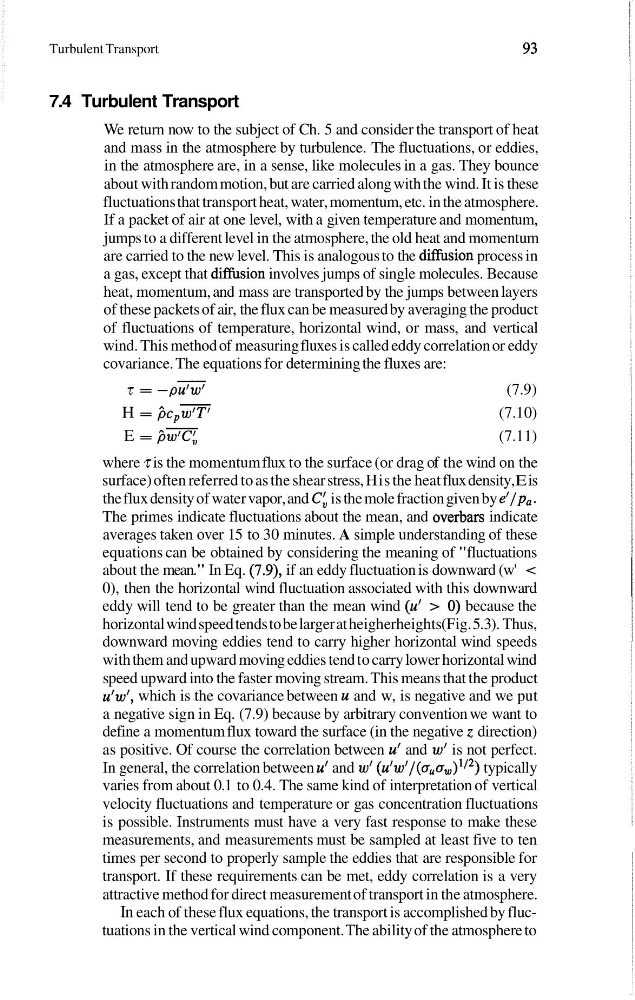
-
t = -PU'W'
(7.9)
-
H = ficpwlT'
(7.10)
-
E = fiw1C;
(7.11)
where z is the momentum flux to the surface (or drag of the wind on the
surface) often referred to as the shear stress, His the heat flux density, E is
the flux density of water vapor, and C: is the mole fraction given by e'lp,.
The primes indicate fluctuations about the mean, and overbars indicate
averages taken over 15 to 30 minutes. A simple understanding of these
equations can be obtained by considering the meaning of "fluctuations
about the mean." In Eq. (7.9), if an eddy fluctuation is downward (w' c
0), then the horizontal wind fluctuation associated with this downward
eddy will tend to be greater than the mean wind (u' > 0) because the
horizontal wind speed tends to be larger at heigherheights (Fig. 5.3). Thus,
downward moving eddies tend to carry higher horizontal wind speeds
with them and upward moving eddies tend to carry lower horizontal wind
speed upward into the faster moving stream. This means that the product
u'w', which is the covariance between u and w, is negative and we put
a negative sign in Eq. (7.9) because by arbitrary convention we want to
define a momentum flux toward the surface (in the negative z direction)
as positive. Of course the correlation between u' and w' is not perfect.
In general, the correlation between u' and w' (~'w'/(a,a,)'/~) typically
varies from about 0.1 to 0.4. The same kind of interpretation of vertical
velocity fluctuations and temperature or gas concentration fluctuations
is possible. Instruments must have a very fast response to make these
measurements, and measurements must be sampled at least five to ten
times per second to properly sample the eddies that are responsible for
transport. If these requirements can be met, eddy correlation is a very
attractive method for direct measurement of transport in the atmosphere.
In each of these flux equations, the transport is accomplished by fluctuations in the vertical wind component. The ability of the atmosphere to
93
7.4 Turbulent Transport
We return now to the subject of Ch. 5 and consider the transport of heat
and mass in the atmosphere by turbulence. The fluctuations, or eddies,
in the atmosphere are, in a sense, like molecules in a gas. They bounce
about with random motion, but are carried along with the wind. It is these
fluctuations that transport heat, water, momentum, etc. in the atmosphere.
If a packet of air at one level, with a given temperature and momentum,
jumps to a different level in the atmosphere, the old heat and momentum
are carried to the new level. This is analogous to the diffusion process in
a gas, except that diffusion involves jumps of single molecules. Because
heat, momentum, and mass are transported by the jumps between layers
of these packets of air, the flux can be measured by averaging the product
of fluctuations of temperature, horizontal wind, or mass, and vertical
wind. This method of measuring fluxes is called eddy correlation or eddy
covariance. The equations for determining the fluxes are:
-
t = -PU'W'
(7.9)
-
H = ficpwlT'
(7.10)
-
E = fiw1C;
(7.11)
where z is the momentum flux to the surface (or drag of the wind on the
surface) often referred to as the shear stress, His the heat flux density, E is
the flux density of water vapor, and C: is the mole fraction given by e'lp,.
The primes indicate fluctuations about the mean, and overbars indicate
averages taken over 15 to 30 minutes. A simple understanding of these
equations can be obtained by considering the meaning of "fluctuations
about the mean." In Eq. (7.9), if an eddy fluctuation is downward (w' c
0), then the horizontal wind fluctuation associated with this downward
eddy will tend to be greater than the mean wind (u' > 0) because the
horizontal wind speed tends to be larger at heigherheights (Fig. 5.3). Thus,
downward moving eddies tend to carry higher horizontal wind speeds
with them and upward moving eddies tend to carry lower horizontal wind
speed upward into the faster moving stream. This means that the product
u'w', which is the covariance between u and w, is negative and we put
a negative sign in Eq. (7.9) because by arbitrary convention we want to
define a momentum flux toward the surface (in the negative z direction)
as positive. Of course the correlation between u' and w' is not perfect.
In general, the correlation between u' and w' (~'w'/(a,a,)'/~) typically
varies from about 0.1 to 0.4. The same kind of interpretation of vertical
velocity fluctuations and temperature or gas concentration fluctuations
is possible. Instruments must have a very fast response to make these
measurements, and measurements must be sampled at least five to ten
times per second to properly sample the eddies that are responsible for
transport. If these requirements can be met, eddy correlation is a very
attractive method for direct measurement of transport in the atmosphere.
In each of these flux equations, the transport is accomplished by fluctuations in the vertical wind component. The ability of the atmosphere to