

Diffusive Conductance of the Integument
9 1
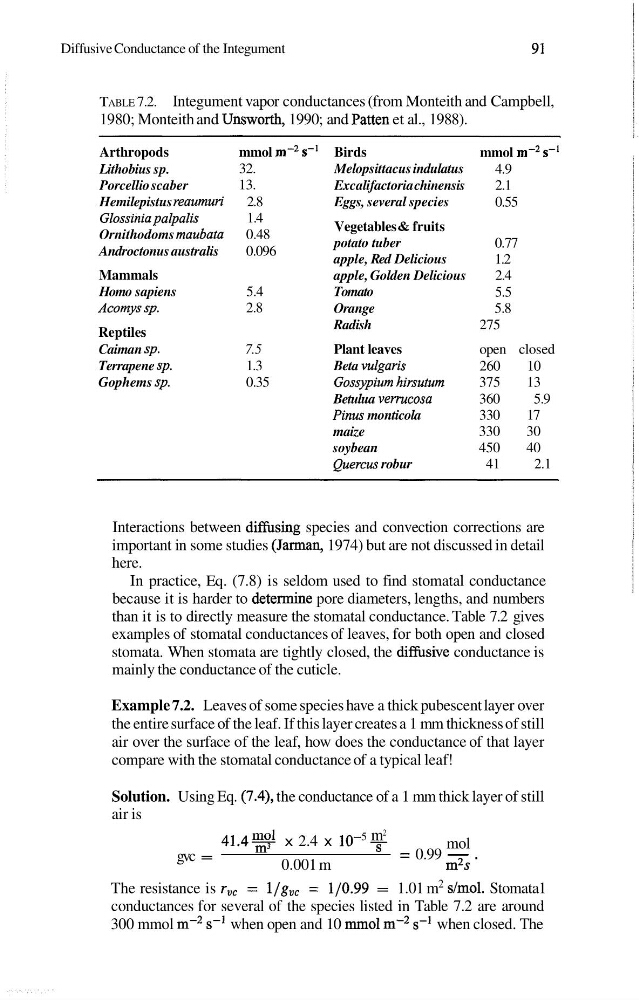
TABLE 7.2. Integument vapor conductances (from Monteith and Campbell,
1980; Monteith and Unsworth, 1990; and Patten et al., 1988).
Arthropods
Lithobius sp.
Porcellio scaber
Hemilepistus reaumuri
Glossinia palpalis
Ornithodoms maubata
Androctonus australis
Mammals
Homo sapiens
Acomys sp.
Reptiles
Caiman sp.
Terrapene sp.
Gophems sp.
mmol m-2 s-I
32.
13.
2.8
1.4
0.48
0.096
5.4
2.8
7.5
1.3
0.35
Birds
Melopsittacus indulatus
Excalifactoria chinensis
Eggs, several species
Vegetables & fruits
potato tuber
apple, Red Delicious
apple, Golden Delicious
Tomato
Orange
Radish
Plant leaves
Beta vulgaris
Gossypium hirsutum
Betulua vermcosa
Pinus monticola
maize
soybean
Quercus robur
mmol m-2 s-I
4.9
2.1
0.55
0.77
1.2
2.4
5.5
5.8
275
open closed
260
10
375
13
360
5.9
330
17
330
30
450
40
41
2.1
Interactions between diffusing species and convection corrections are
important in some studies (Jarman, 1974) but are not discussed in detail
here.
In practice, Eq. (7.8) is seldom used to find stomatal conductance
because it is harder to determine pore diameters, lengths, and numbers
than it is to directly measure the stomatal conductance. Table 7.2 gives
examples of stomatal conductances of leaves, for both open and closed
stomata. When stomata are tightly closed, the diffusive conductance is
mainly the conductance of the cuticle.
Example 7.2. Leaves of some species have a thick pubescent layer over
the entire surface of the leaf. If this layer creates a 1 mm thickness of still
air over the surface of the leaf, how does the conductance of that layer
compare with the stomatal conductance of a typical leaf!
Solution. Using Eq. (7.4), the conductance of a 1 mm thick layer of still
air is
mol
5 m
2
41.4=
x 2.4 x 10mol
gvc =
= 0.99 - .
0.001 m
m2s
The resistance is rUc = l/gv, = 1/0.99 = 1.01 m 2 slmol. Stomata1
conductances for several of the species listed in Table 7.2 are around
300 mmol m-2 s-' when open and 10 rnrnol m-2 s-' when closed. The
9 1
TABLE 7.2. Integument vapor conductances (from Monteith and Campbell,
1980; Monteith and Unsworth, 1990; and Patten et al., 1988).
Arthropods
Lithobius sp.
Porcellio scaber
Hemilepistus reaumuri
Glossinia palpalis
Ornithodoms maubata
Androctonus australis
Mammals
Homo sapiens
Acomys sp.
Reptiles
Caiman sp.
Terrapene sp.
Gophems sp.
mmol m-2 s-I
32.
13.
2.8
1.4
0.48
0.096
5.4
2.8
7.5
1.3
0.35
Birds
Melopsittacus indulatus
Excalifactoria chinensis
Eggs, several species
Vegetables & fruits
potato tuber
apple, Red Delicious
apple, Golden Delicious
Tomato
Orange
Radish
Plant leaves
Beta vulgaris
Gossypium hirsutum
Betulua vermcosa
Pinus monticola
maize
soybean
Quercus robur
mmol m-2 s-I
4.9
2.1
0.55
0.77
1.2
2.4
5.5
5.8
275
open closed
260
10
375
13
360
5.9
330
17
330
30
450
40
41
2.1
Interactions between diffusing species and convection corrections are
important in some studies (Jarman, 1974) but are not discussed in detail
here.
In practice, Eq. (7.8) is seldom used to find stomatal conductance
because it is harder to determine pore diameters, lengths, and numbers
than it is to directly measure the stomatal conductance. Table 7.2 gives
examples of stomatal conductances of leaves, for both open and closed
stomata. When stomata are tightly closed, the diffusive conductance is
mainly the conductance of the cuticle.
Example 7.2. Leaves of some species have a thick pubescent layer over
the entire surface of the leaf. If this layer creates a 1 mm thickness of still
air over the surface of the leaf, how does the conductance of that layer
compare with the stomatal conductance of a typical leaf!
Solution. Using Eq. (7.4), the conductance of a 1 mm thick layer of still
air is
mol
5 m
2
41.4=
x 2.4 x 10mol
gvc =
= 0.99 - .
0.001 m
m2s
The resistance is rUc = l/gv, = 1/0.99 = 1.01 m 2 slmol. Stomata1
conductances for several of the species listed in Table 7.2 are around
300 mmol m-2 s-' when open and 10 rnrnol m-2 s-' when closed. The