

Conductances for Heat and Mass Transfer
Using Eq. (7.4) the conductance of a similar thickness of still air in a
plane can be computed. The conductance is 0.177 mol m-2 s-', about
80 percent of the cylindrical value, so curving the insulation around the
finger results in 20 percent more heat loss than if the material were flat.
This is one reason why a mitten keeps fingers warmer than a glove. The
actual conductance of a fiber layer like this can be more than twice the
conductance of a similar thickness of still air because of radiative and
convective transport within the material, but the conduction through the
air provides a good starting point for the calculation of overall conductance. We return to this subject later after developing the tools to analyze
these other modes of heat transport.
7.3 Diffusive Conductance of the Integument
The waterproof coating that covers most forms of terrestrial life plays
a key role in maintaining a favorable water balance. The most effective
of these coatings are made up of lipids or waxes, but layers of hair and
other dry materials also impede evaporation. We consider three situations
involving gas diffusion through the integument. The first is diffusion
through a layer of still air, such as an animal coat. The second is diffusion
through a cuticle made up of lipid layers. The third is diffusion through
pores in a cuticle.
The first case is one that clearly involves diffusion of gases in air, so
the equations just derived apply. The presence of the hair tends to keep
the air still and impede convection, but the fraction of volume taken up
by the hair has little effect on the area available for diffusion. In the
second case, the water is not diffusing in air, but through the lipid layers
of the cuticle. The proper diffusivity to use is therefore not the one for air,
but the one for the membrane through which diffusion is occurring. The
driving forces, however, are the same as those for diffusion in air, and
conductances are obtained simply by using measured rates of water loss
and vapor concentration differences. We are not able to derive equations
to compute values for these conductances, but their values tend to be
conservative (i.e., do not change with ambient conditions) so observed
values are useful for calculations. Table 7.2 gives a sample of values for
arthropod, animal, and plant surfaces.
An example of the third case is the transport of gases through stomata
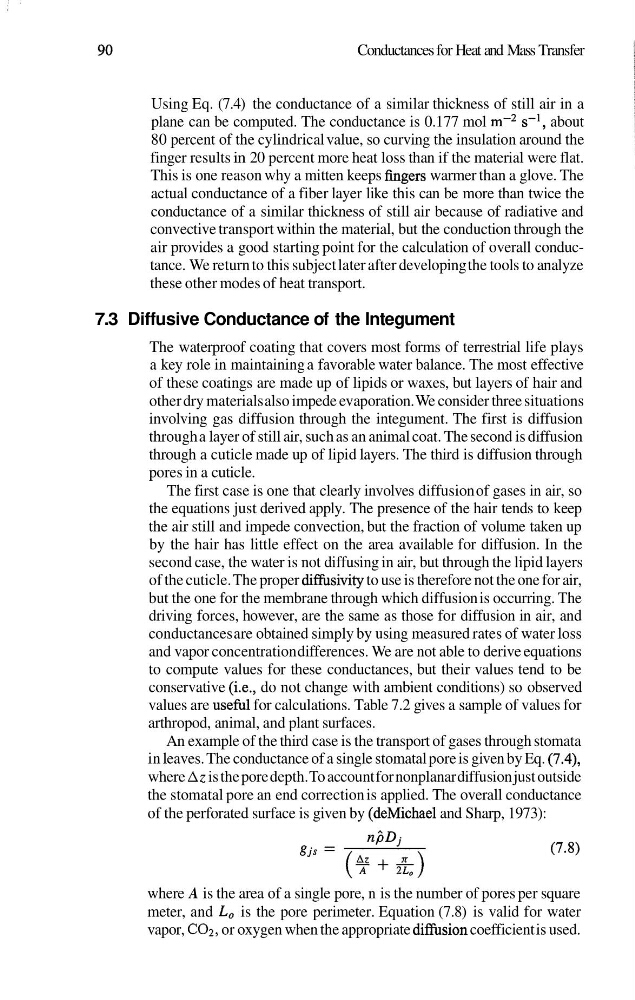
in leaves. The conductance of a single stomatal pore is given by Eq. (7.4),
where Az is the pore depth. To account for nonplanar diffusion just outside
the stomatal pore an end correction is applied. The overall conductance
of the perforated surface is given by (deMichael and Sharp, 1973):
where A is the area of a single pore, n is the number of pores per square
meter, and Lo is the pore perimeter. Equation (7.8) is valid for water
vapor, COz, or oxygen when the appropriate diffusion coefficient is used.
Using Eq. (7.4) the conductance of a similar thickness of still air in a
plane can be computed. The conductance is 0.177 mol m-2 s-', about
80 percent of the cylindrical value, so curving the insulation around the
finger results in 20 percent more heat loss than if the material were flat.
This is one reason why a mitten keeps fingers warmer than a glove. The
actual conductance of a fiber layer like this can be more than twice the
conductance of a similar thickness of still air because of radiative and
convective transport within the material, but the conduction through the
air provides a good starting point for the calculation of overall conductance. We return to this subject later after developing the tools to analyze
these other modes of heat transport.
7.3 Diffusive Conductance of the Integument
The waterproof coating that covers most forms of terrestrial life plays
a key role in maintaining a favorable water balance. The most effective
of these coatings are made up of lipids or waxes, but layers of hair and
other dry materials also impede evaporation. We consider three situations
involving gas diffusion through the integument. The first is diffusion
through a layer of still air, such as an animal coat. The second is diffusion
through a cuticle made up of lipid layers. The third is diffusion through
pores in a cuticle.
The first case is one that clearly involves diffusion of gases in air, so
the equations just derived apply. The presence of the hair tends to keep
the air still and impede convection, but the fraction of volume taken up
by the hair has little effect on the area available for diffusion. In the
second case, the water is not diffusing in air, but through the lipid layers
of the cuticle. The proper diffusivity to use is therefore not the one for air,
but the one for the membrane through which diffusion is occurring. The
driving forces, however, are the same as those for diffusion in air, and
conductances are obtained simply by using measured rates of water loss
and vapor concentration differences. We are not able to derive equations
to compute values for these conductances, but their values tend to be
conservative (i.e., do not change with ambient conditions) so observed
values are useful for calculations. Table 7.2 gives a sample of values for
arthropod, animal, and plant surfaces.
An example of the third case is the transport of gases through stomata
in leaves. The conductance of a single stomatal pore is given by Eq. (7.4),
where Az is the pore depth. To account for nonplanar diffusion just outside
the stomatal pore an end correction is applied. The overall conductance
of the perforated surface is given by (deMichael and Sharp, 1973):
where A is the area of a single pore, n is the number of pores per square
meter, and Lo is the pore perimeter. Equation (7.8) is valid for water
vapor, COz, or oxygen when the appropriate diffusion coefficient is used.