

Molecular Difisivities
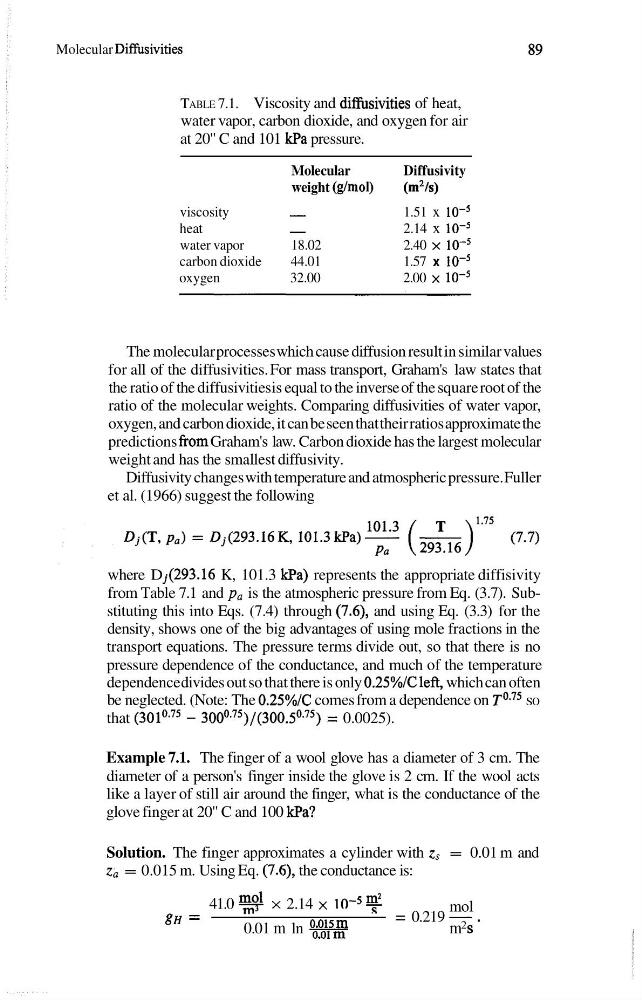
TABLE 7.1. Viscosity and difksivities of heat,
water vapor, carbon dioxide, and oxygen for air
at 20" C and 10 1 kPa pressure.
Molecular
Diffusivity
weight (glmol)
(m2/s)
viscosity
-
1.51 x
heat
-
2.14 x
water vapor
18.02
2.40 lo4
carbon dioxide
44.01
1.57 x lo-'
oxygen
32.00
2.00 lo4
The molecular processes which cause diffusion result in similar values
for all of the diffusivities. For mass transport, Graham's law states that
the ratio of the diffusivities is equal to the inverse of the square root of the
ratio of the molecular weights. Comparing diffusivities of water vapor,
oxygen, and carbon dioxide, it can be seen that their ratios approximate the
predictions from Graham's law. Carbon dioxide has the largest molecular
weight and has the smallest diffusivity.
Diffusivity changes with temperature and atmospheric pressure. Fuller
et al. (1966) suggest the following
where D j(293.16 K, 101.3 kPa) represents the appropriate diffisivity
from Table 7.1 and pa is the atmospheric pressure from Eq. (3.7). Substituting this into Eqs. (7.4) through (7.6), and using Eq. (3.3) for the
density, shows one of the big advantages of using mole fractions in the
transport equations. The pressure terms divide out, so that there is no
pressure dependence of the conductance, and much of the temperature
dependence divides out so that there is only 0.25%/C left, which can often
be neglected. (Note: The 0.25%/C comes from a dependence on T ~ . ~ ~
SO
that (301O.~~ - 3 0 0 ~ . ~ ~ ) / ( 3 0 0 . 5 ~ . ~ ~ )
= 0.0025).
Example 7.1. The finger of a wool glove has a diameter of 3 cm. The
diameter of a person's finger inside the glove is 2 cm. If the wool acts
like a layer of still air around the finger, what is the conductance of the
glove finger at 20" C and 100 kPa?
Solution. The finger approximates a cylinder with z, = 0.01 m and
za = 0.015 m. Using Eq. (7.6), the conductance is:
41.0 3 x 2.14 x 10-I $
mol
g~ =
= 0.219 - .
0.01 m ln
m 2 s
TABLE 7.1. Viscosity and difksivities of heat,
water vapor, carbon dioxide, and oxygen for air
at 20" C and 10 1 kPa pressure.
Molecular
Diffusivity
weight (glmol)
(m2/s)
viscosity
-
1.51 x
heat
-
2.14 x
water vapor
18.02
2.40 lo4
carbon dioxide
44.01
1.57 x lo-'
oxygen
32.00
2.00 lo4
The molecular processes which cause diffusion result in similar values
for all of the diffusivities. For mass transport, Graham's law states that
the ratio of the diffusivities is equal to the inverse of the square root of the
ratio of the molecular weights. Comparing diffusivities of water vapor,
oxygen, and carbon dioxide, it can be seen that their ratios approximate the
predictions from Graham's law. Carbon dioxide has the largest molecular
weight and has the smallest diffusivity.
Diffusivity changes with temperature and atmospheric pressure. Fuller
et al. (1966) suggest the following
where D j(293.16 K, 101.3 kPa) represents the appropriate diffisivity
from Table 7.1 and pa is the atmospheric pressure from Eq. (3.7). Substituting this into Eqs. (7.4) through (7.6), and using Eq. (3.3) for the
density, shows one of the big advantages of using mole fractions in the
transport equations. The pressure terms divide out, so that there is no
pressure dependence of the conductance, and much of the temperature
dependence divides out so that there is only 0.25%/C left, which can often
be neglected. (Note: The 0.25%/C comes from a dependence on T ~ . ~ ~
SO
that (301O.~~ - 3 0 0 ~ . ~ ~ ) / ( 3 0 0 . 5 ~ . ~ ~ )
= 0.0025).
Example 7.1. The finger of a wool glove has a diameter of 3 cm. The
diameter of a person's finger inside the glove is 2 cm. If the wool acts
like a layer of still air around the finger, what is the conductance of the
glove finger at 20" C and 100 kPa?
Solution. The finger approximates a cylinder with z, = 0.01 m and
za = 0.015 m. Using Eq. (7.6), the conductance is:
41.0 3 x 2.14 x 10-I $
mol
g~ =
= 0.219 - .
0.01 m ln
m 2 s