

Conductances for Heat and Mass Transfer
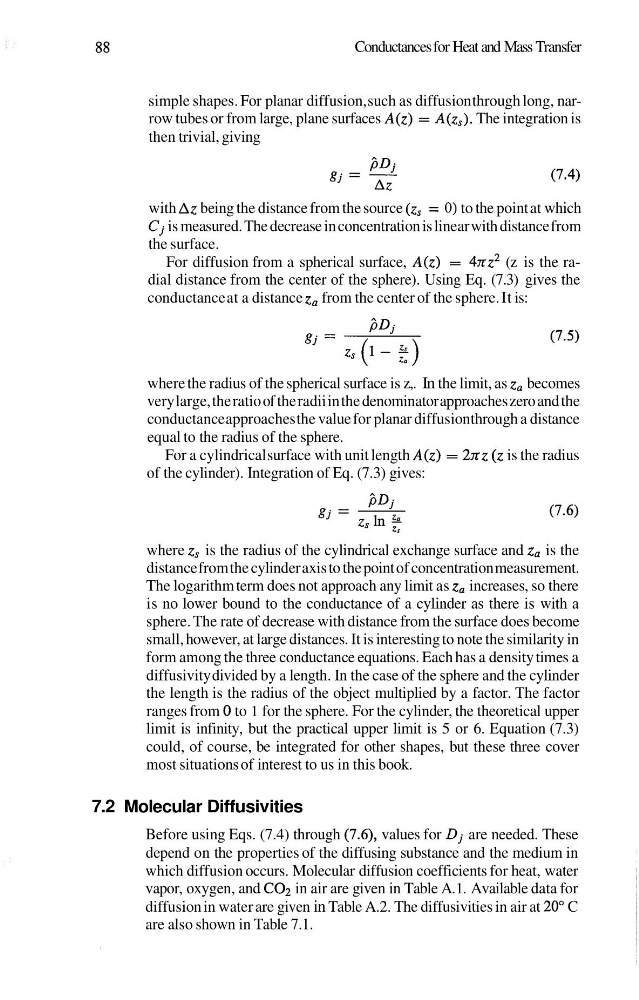
simple shapes. For planar diffusion, such as diffusion through long, narrow tubes or from large, plane surfaces A(z) = A(z,). The integration is
then trivial, giving
with Az being the distance from the source (z, = 0) to the point at which
C j is measured. The decrease in concentration is linear with distance from
the surface.
For diffusion from a spherical surface, A(z) = 4nz2 (z is the radial distance from the center of the sphere). Using Eq. (7.3) gives the
conductance at a distance za from the center of the sphere. It is:
where the radius of the spherical surface is z,. In the limit, as z, becomes
very large, the ratio of the radii in the denominator approaches zero and the
conductance approaches the value for planar diffusion through a distance
equal to the radius of the sphere.
For a cylindrical surface with unit length A(z) = 2nz (z is the radius
of the cylinder). Integration of Eq. (7.3) gives:
where z, is the radius of the cylindrical exchange surface and za is the
distance from the cylinder axis to the point of concentration measurement.
The logarithm term does not approach any limit as Z, increases, so there
is no lower bound to the conductance of a cylinder as there is with a
sphere. The rate of decrease with distance from the surface does become
small, however, at large distances. It is interesting to note the similarity in
form among the three conductance equations. Each has a density times a
diffusivity divided by a length. In the case of the sphere and the cylinder
the length is the radius of the object multiplied by a factor. The factor
ranges from 0 to 1 for the sphere. For the cylinder, the theoretical upper
limit is infinity, but the practical upper limit is 5 or 6. Equation (7.3)
could, of course, be integrated for other shapes, but these three cover
most situations of interest to us in this book.
7.2 Molecular Diffusivities
Before using Eqs. (7.4) through (7.6), values for Dj are needed. These
depend on the properties of the diffusing substance and the medium in
which diffusion occurs. Molecular diffusion coefficients for heat, water
vapor, oxygen, and C02 in air are given in Table A. 1. Available data for
diffusion in water are given in Table A.2. The diffusivities in air at 20" C
are also shown in Table 7.1.
simple shapes. For planar diffusion, such as diffusion through long, narrow tubes or from large, plane surfaces A(z) = A(z,). The integration is
then trivial, giving
with Az being the distance from the source (z, = 0) to the point at which
C j is measured. The decrease in concentration is linear with distance from
the surface.
For diffusion from a spherical surface, A(z) = 4nz2 (z is the radial distance from the center of the sphere). Using Eq. (7.3) gives the
conductance at a distance za from the center of the sphere. It is:
where the radius of the spherical surface is z,. In the limit, as z, becomes
very large, the ratio of the radii in the denominator approaches zero and the
conductance approaches the value for planar diffusion through a distance
equal to the radius of the sphere.
For a cylindrical surface with unit length A(z) = 2nz (z is the radius
of the cylinder). Integration of Eq. (7.3) gives:
where z, is the radius of the cylindrical exchange surface and za is the
distance from the cylinder axis to the point of concentration measurement.
The logarithm term does not approach any limit as Z, increases, so there
is no lower bound to the conductance of a cylinder as there is with a
sphere. The rate of decrease with distance from the surface does become
small, however, at large distances. It is interesting to note the similarity in
form among the three conductance equations. Each has a density times a
diffusivity divided by a length. In the case of the sphere and the cylinder
the length is the radius of the object multiplied by a factor. The factor
ranges from 0 to 1 for the sphere. For the cylinder, the theoretical upper
limit is infinity, but the practical upper limit is 5 or 6. Equation (7.3)
could, of course, be integrated for other shapes, but these three cover
most situations of interest to us in this book.
7.2 Molecular Diffusivities
Before using Eqs. (7.4) through (7.6), values for Dj are needed. These
depend on the properties of the diffusing substance and the medium in
which diffusion occurs. Molecular diffusion coefficients for heat, water
vapor, oxygen, and C02 in air are given in Table A. 1. Available data for
diffusion in water are given in Table A.2. The diffusivities in air at 20" C
are also shown in Table 7.1.