

64
WORLD ATLAS OF CORAL REEFS
Table 2.2: Major types of direct physical damage to coral reefs
Activity
Ship grounding
Blast fishing
Weapons testing
Reef walking
Diver damage
Direct smothering
Anchor damage
Reef mining
Dredging/construction
Land reclamation
Notes
Direct impact on relatively small areas of shallow reef
Individual blasts may only impact a few square meters, but can be frequent
Remote atolls were used in the early testing of nuclear weapons, some smallerscale damage continues in military testing grounds to the present day
Tourists and local people walking on reefs can kill coral and flatten the reef matrix
Coral breakage or death from frequent handling, only a major problem on very
popular dive sites
Solid waste, and thicker elements of spilled oil can kill corals through direct
contact and smothering
Apart from initial impact, anchors may drag and anchor chains sweep over wide
arcs, smashing corals over large areas
Includes direct removal of coral, sand and aggregate for construction purposes
Dredging of channels and lagoons for ships' passage is common in many reef
areas, also construction of deep water channels with the blasting of reefs, and the
construction of jetties or roads over the reef flat
Perhaps the most complete and irreversible destruction of wide areas of reef, as
reef flats and shallow lagoons are infilled and converted to land
two years, but then in 1983 the Diadema die-off (see page
61 ) killed the majority of these sea urchins in the waters
all around Jamaica and much of the rest of the Caribbean.
Jamaica was particularly impacted by the loss of these
herbivores, as the other large herbivores - fish - had
already been drastically reduced. Algal cover on the reefs
increased dramatically, smothering and killing some of
the remainmg coral cover. It appeared that a new stable
state had been established. Hurricane Gilbert impacted
the islands in 1988 and further reduced coral cover, while
the algae regenerated rapidly. Fleshy macroalgae covered
92 percent of surveyed "reefs" m the early 1990s. It has
been suggested that a return to a coral-dominated
community would require a major increase in herbivory
and may be impossible in the short to medium term.
Reports of degradation of the world's reefs are
widespread from all parts of the ocean, but a detailed
assessment of the scale and distribution of these losses
remains impossible. Many reports are anecdotal, while
vast areas of the world's reefs are beyond the reach of
scientists to produce even irregular assessments. Various
efforts are now underway to improve the levels of
available information. ReefCheck is a global coral reef
monitoring scheme which has been using volunteer divers
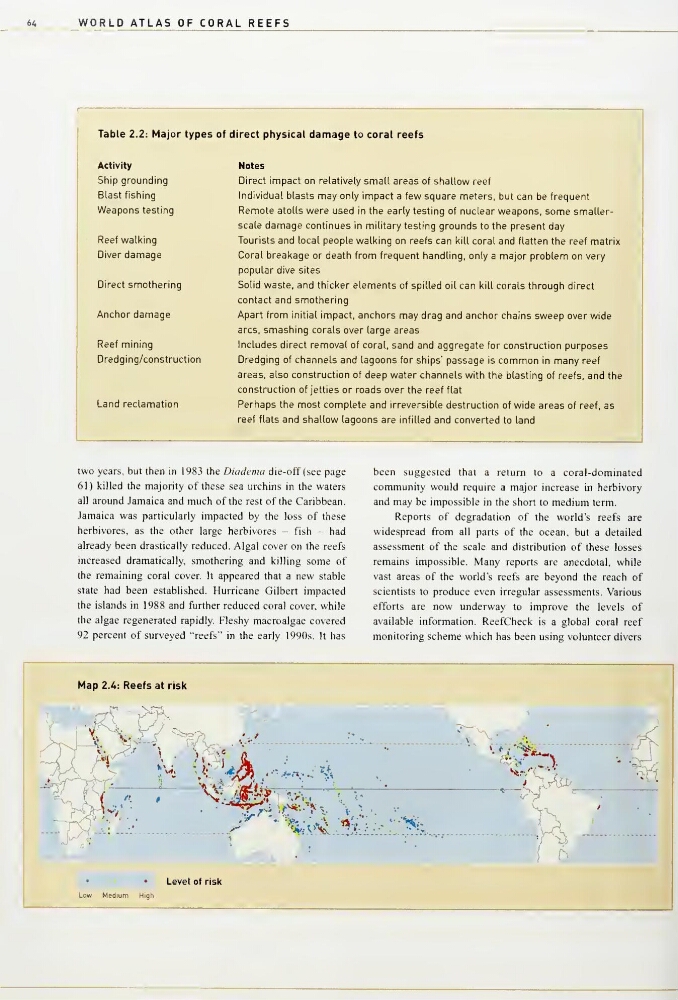
Map Z.it: Reefs at risk
-/\
'JVi.VNel,
*-''r-*fe^"'
-
=}-4
^X
•
•
Level of risk
Low
Medium
High
WORLD ATLAS OF CORAL REEFS
Table 2.2: Major types of direct physical damage to coral reefs
Activity
Ship grounding
Blast fishing
Weapons testing
Reef walking
Diver damage
Direct smothering
Anchor damage
Reef mining
Dredging/construction
Land reclamation
Notes
Direct impact on relatively small areas of shallow reef
Individual blasts may only impact a few square meters, but can be frequent
Remote atolls were used in the early testing of nuclear weapons, some smallerscale damage continues in military testing grounds to the present day
Tourists and local people walking on reefs can kill coral and flatten the reef matrix
Coral breakage or death from frequent handling, only a major problem on very
popular dive sites
Solid waste, and thicker elements of spilled oil can kill corals through direct
contact and smothering
Apart from initial impact, anchors may drag and anchor chains sweep over wide
arcs, smashing corals over large areas
Includes direct removal of coral, sand and aggregate for construction purposes
Dredging of channels and lagoons for ships' passage is common in many reef
areas, also construction of deep water channels with the blasting of reefs, and the
construction of jetties or roads over the reef flat
Perhaps the most complete and irreversible destruction of wide areas of reef, as
reef flats and shallow lagoons are infilled and converted to land
two years, but then in 1983 the Diadema die-off (see page
61 ) killed the majority of these sea urchins in the waters
all around Jamaica and much of the rest of the Caribbean.
Jamaica was particularly impacted by the loss of these
herbivores, as the other large herbivores - fish - had
already been drastically reduced. Algal cover on the reefs
increased dramatically, smothering and killing some of
the remainmg coral cover. It appeared that a new stable
state had been established. Hurricane Gilbert impacted
the islands in 1988 and further reduced coral cover, while
the algae regenerated rapidly. Fleshy macroalgae covered
92 percent of surveyed "reefs" m the early 1990s. It has
been suggested that a return to a coral-dominated
community would require a major increase in herbivory
and may be impossible in the short to medium term.
Reports of degradation of the world's reefs are
widespread from all parts of the ocean, but a detailed
assessment of the scale and distribution of these losses
remains impossible. Many reports are anecdotal, while
vast areas of the world's reefs are beyond the reach of
scientists to produce even irregular assessments. Various
efforts are now underway to improve the levels of
available information. ReefCheck is a global coral reef
monitoring scheme which has been using volunteer divers
Map Z.it: Reefs at risk
-/\
'JVi.VNel,
*-''r-*fe^"'
-
=}-4
^X
•
•
Level of risk
Low
Medium
High