

Signs of Change
63
impacts of direct diver and anchor damage at popular dive
sites may reduce the real economic value of those sites in
the longer term. Land reclamation probably has the most
significant impact in terms of the total area of reef
destroyed and is one of the few activities that genuinely
leads to a change in absolute reef area. Building on coral
reefs has been widespread in many countries, including
Egypt, the Seychelles, the Maldives, Singapore and a
number of the smaller Pacific atolls.
Aside from urban or industrial activities, military
activities have had a major impact on many coral reefs.
Military installations exist in a number of coral reef areas,
including several remote coral islands and atolls. Weapons
testing grounds and military dumps have also been located
in such areas. These facilities can have significant impacts
on the surrounding coral reefs. The reefs of Vieques off
Puerto Rico and Fallaron de Medinilla in the Northern
Mariana Islands are still regularly used by the US military
for target practice, with significant impacts on the
surrounding reefs. Many other facilities have reclaimed
areas of reef flat for construction, or have dredged or
blasted channels for boats. Johnston Atoll has been used as
a dump for large quantities of hazardous waste, while a
number of other remote Pacific atolls have been used,
historically, as testing grounds for nuclear weapons, and in
a few, high levels of radiation remain.
Compounded problems
The different human-induced stresses that impinge on
coral reefs rarely act in isolation. Climate change appears
set to produce changes over wide areas of the planet.
Sedimentation and pollution are often found together,
resulting from coastal development and changes in
landuse. The risk of overfishing is equally widespread
in all areas where human populations are growing. Even
a single activity, such as the development of a new
tourist resort, can create such a combination of threats.
Sedimentation may arise during the clearance of vegetation and building works; to.xic and nutrient pollution
may result from wastewaters: direct physical damage from
the construction of jetties or the impacts of boat anchors;
and fish populations may be impacted in the provision of
food for guests, staff and dependents.
Natural impacts, particularly storms, often exacerbate
these human-induced problems. In Jamaica a number of
coral reefs have lost so much coral cover that it may no
longer be accurate to call them coral reefs. Although there
are records suggesting that chronic overfishing had been
occurring on these reefs since at least the 1960s (and some
authors have suggested since the previous century), the
reefs still maintained high coral cover until Hurricane
Allen swept over the island in 1980, reducing much of the
coral to rubble. There was some recovery over the next
sudden susceptibility of acroporids to white band
disease is unknown, it was dramatic. Such a shift had
not occurred in the previous U 000 years.
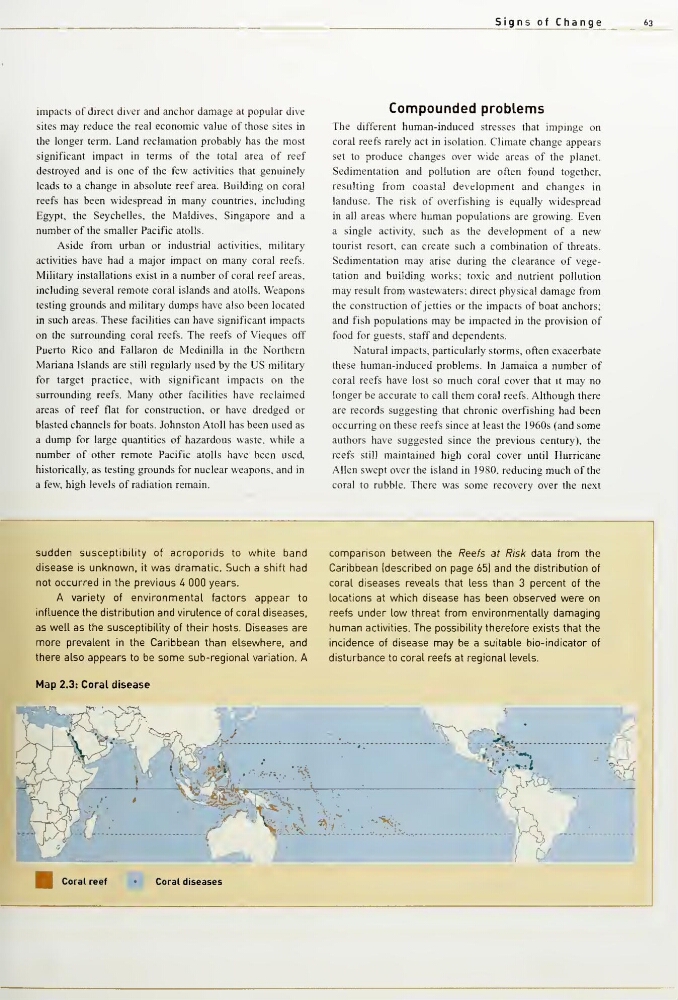
A variety of environmental factors appear to
influence the distribution and virulence of coral diseases,
as well as the susceptibility of their hosts. Diseases are
more prevalent in the Caribbean than elsewhere, and
there also appears to be some sub-regional variation. A
comparison between the Reefs at Risk data from the
Caribbean (described on page 651 and the distribution of
coral diseases reveals that less than 3 percent of the
locations at which disease has been observed were on
reefs under low threat from environmentally damaging
human activities. The possibility therefore exists that the
incidence of disease may be a suitable bio-indicator of
disturbance to coral reefs at regional levels.
Map 2.3: Coral disease
i /
y
'.
'i&'S --U
%s^..^^:Coral reef
•
Coral diseases
63
impacts of direct diver and anchor damage at popular dive
sites may reduce the real economic value of those sites in
the longer term. Land reclamation probably has the most
significant impact in terms of the total area of reef
destroyed and is one of the few activities that genuinely
leads to a change in absolute reef area. Building on coral
reefs has been widespread in many countries, including
Egypt, the Seychelles, the Maldives, Singapore and a
number of the smaller Pacific atolls.
Aside from urban or industrial activities, military
activities have had a major impact on many coral reefs.
Military installations exist in a number of coral reef areas,
including several remote coral islands and atolls. Weapons
testing grounds and military dumps have also been located
in such areas. These facilities can have significant impacts
on the surrounding coral reefs. The reefs of Vieques off
Puerto Rico and Fallaron de Medinilla in the Northern
Mariana Islands are still regularly used by the US military
for target practice, with significant impacts on the
surrounding reefs. Many other facilities have reclaimed
areas of reef flat for construction, or have dredged or
blasted channels for boats. Johnston Atoll has been used as
a dump for large quantities of hazardous waste, while a
number of other remote Pacific atolls have been used,
historically, as testing grounds for nuclear weapons, and in
a few, high levels of radiation remain.
Compounded problems
The different human-induced stresses that impinge on
coral reefs rarely act in isolation. Climate change appears
set to produce changes over wide areas of the planet.
Sedimentation and pollution are often found together,
resulting from coastal development and changes in
landuse. The risk of overfishing is equally widespread
in all areas where human populations are growing. Even
a single activity, such as the development of a new
tourist resort, can create such a combination of threats.
Sedimentation may arise during the clearance of vegetation and building works; to.xic and nutrient pollution
may result from wastewaters: direct physical damage from
the construction of jetties or the impacts of boat anchors;
and fish populations may be impacted in the provision of
food for guests, staff and dependents.
Natural impacts, particularly storms, often exacerbate
these human-induced problems. In Jamaica a number of
coral reefs have lost so much coral cover that it may no
longer be accurate to call them coral reefs. Although there
are records suggesting that chronic overfishing had been
occurring on these reefs since at least the 1960s (and some
authors have suggested since the previous century), the
reefs still maintained high coral cover until Hurricane
Allen swept over the island in 1980, reducing much of the
coral to rubble. There was some recovery over the next
sudden susceptibility of acroporids to white band
disease is unknown, it was dramatic. Such a shift had
not occurred in the previous U 000 years.
A variety of environmental factors appear to
influence the distribution and virulence of coral diseases,
as well as the susceptibility of their hosts. Diseases are
more prevalent in the Caribbean than elsewhere, and
there also appears to be some sub-regional variation. A
comparison between the Reefs at Risk data from the
Caribbean (described on page 651 and the distribution of
coral diseases reveals that less than 3 percent of the
locations at which disease has been observed were on
reefs under low threat from environmentally damaging
human activities. The possibility therefore exists that the
incidence of disease may be a suitable bio-indicator of
disturbance to coral reefs at regional levels.
Map 2.3: Coral disease
i /
y
'.
'i&'S --U
%s^..^^:Coral reef
•
Coral diseases