

WORLD ATLAS OF CORAL REEFS
Crown-of-thorns starfish
^^^^^^p^
^^^^^^w ^^^"'^^
SffiH
^^1
^^^ S^HB
H ^B^^^^B^^^H ^^eT'.'. . ^ME
W^S^MH0^^^^^m
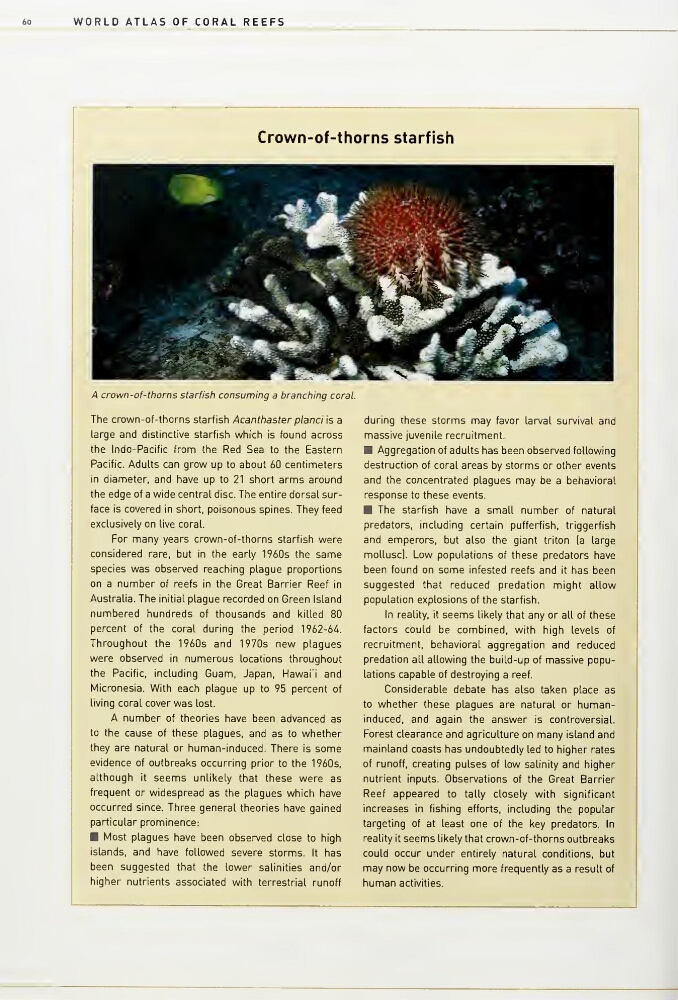
A crown-of-thorns starfish consuming a branching coral.
The crown-of-thorns starfish Acanthaster planci is a
large and distinctive starfish which is found across
the Indo-Paclfic from the Red Sea to the Eastern
Pacific. Adults can grow up to about 60 centlnneters
in diameter, and have up to 21 short arms around
the edge of a wide central disc. The entire dorsal surface is covered in short, poisonous spines. They feed
exclusively on live coral.
For many years crown-of-thorns starfish were
considered rare, but in the early 1960s the same
species was observed reaching plague proportions
on a number of reefs in the Great Barrier Reef In
Australia. The Initial plague recorded on Green Island
numbered hundreds of thousands and killed 80
percent of the coral during the period 1962-64.
Throughout the 1960s and 1970s new plagues
were observed In numerous locations throughout
the Pacific, Including Guam, Japan, Hawaii and
Micronesia. With each plague up to 95 percent of
living coral cover was lost.
A number of theories have been advanced as
to the cause of these plagues, and as to whether
they are natural or human-Induced. There is some
evidence of outbreaks occurring prior to the 1960s,
although It seems unlikely that these were as
frequent or widespread as the plagues which have
occurred since. Three general theories have gained
particular prominence:
Most plagues have been observed close to high
Islands, and have followed severe storms. It has
been suggested that the lower salinities and/or
higher nutrients associated with terrestrial runoff
during these storms may favor larval survival and
massive juvenile recruitment.
Aggregation of adults has been observed following
destruction of coral areas by storms or other events
and the concentrated plagues may be a behavioral
response to these events.
The starfish have a small number of natural
predators. Including certain pufferflsh. triggerfish
and emperors, but also the giant triton (a large
mollusc]. Low populations of these predators have
been found on some infested reefs and It has been
suggested that reduced predation might allow
population explosions of the starfish.
In reality. It seems likely that any or all of these
factors could be combined, with high levels of
recruitment, behavioral aggregation and reduced
predation all allowing the build-up of massive populations capable of destroying a reef.
Considerable debate has also taken place as
to whether these plagues are natural or humaninduced, and again the answer is controversial.
Forest clearance and agriculture on many island and
mainland coasts has undoubtedly led to higher rates
of runoff, creating pulses of low salinity and higher
nutrient Inputs. Observations of the Great Barrier
Reef appeared to tally closely with significant
Increases In fishing efforts, including the popular
targeting of at least one of the key predators. In
reality It seems likely that crown-of-thorns outbreaks
could occur under entirely natural conditions, but
may now be occurring more frequently as a result of
human activities.
Crown-of-thorns starfish
^^^^^^p^
^^^^^^w ^^^"'^^
SffiH
^^1
^^^ S^HB
H ^B^^^^B^^^H ^^eT'.'. . ^ME
W^S^MH0^^^^^m
A crown-of-thorns starfish consuming a branching coral.
The crown-of-thorns starfish Acanthaster planci is a
large and distinctive starfish which is found across
the Indo-Paclfic from the Red Sea to the Eastern
Pacific. Adults can grow up to about 60 centlnneters
in diameter, and have up to 21 short arms around
the edge of a wide central disc. The entire dorsal surface is covered in short, poisonous spines. They feed
exclusively on live coral.
For many years crown-of-thorns starfish were
considered rare, but in the early 1960s the same
species was observed reaching plague proportions
on a number of reefs in the Great Barrier Reef In
Australia. The Initial plague recorded on Green Island
numbered hundreds of thousands and killed 80
percent of the coral during the period 1962-64.
Throughout the 1960s and 1970s new plagues
were observed In numerous locations throughout
the Pacific, Including Guam, Japan, Hawaii and
Micronesia. With each plague up to 95 percent of
living coral cover was lost.
A number of theories have been advanced as
to the cause of these plagues, and as to whether
they are natural or human-Induced. There is some
evidence of outbreaks occurring prior to the 1960s,
although It seems unlikely that these were as
frequent or widespread as the plagues which have
occurred since. Three general theories have gained
particular prominence:
Most plagues have been observed close to high
Islands, and have followed severe storms. It has
been suggested that the lower salinities and/or
higher nutrients associated with terrestrial runoff
during these storms may favor larval survival and
massive juvenile recruitment.
Aggregation of adults has been observed following
destruction of coral areas by storms or other events
and the concentrated plagues may be a behavioral
response to these events.
The starfish have a small number of natural
predators. Including certain pufferflsh. triggerfish
and emperors, but also the giant triton (a large
mollusc]. Low populations of these predators have
been found on some infested reefs and It has been
suggested that reduced predation might allow
population explosions of the starfish.
In reality. It seems likely that any or all of these
factors could be combined, with high levels of
recruitment, behavioral aggregation and reduced
predation all allowing the build-up of massive populations capable of destroying a reef.
Considerable debate has also taken place as
to whether these plagues are natural or humaninduced, and again the answer is controversial.
Forest clearance and agriculture on many island and
mainland coasts has undoubtedly led to higher rates
of runoff, creating pulses of low salinity and higher
nutrient Inputs. Observations of the Great Barrier
Reef appeared to tally closely with significant
Increases In fishing efforts, including the popular
targeting of at least one of the key predators. In
reality It seems likely that crown-of-thorns outbreaks
could occur under entirely natural conditions, but
may now be occurring more frequently as a result of
human activities.