

Signs of Change
defined as occurring when the size of the adult stock is
reduced sufficiently to impair recruitment (the important
role of ex situ recruitment in the reef environment makes
this stage of overfishing difficult to identify). Ecosystem
overfishing has been reported where fishing has impacts
on the wider community structure. In the multi-species
environment of reef fisheries the concept of "fishing down
the food chain" is relatively corrimon - when stocks of the
more popular piscivorous species have been depleted
fishing effort moves down to planktivorous or herbivorous
species. One final term has been coined for the most
heavily fished reefs of all, that of Malthusian overfishing.
This is seen to occur where there are too many fishers for
any sustainable form of fishery, but fishing continues, often
for reasons of poverty or economics, to the detriment and
sometimes the complete destruction of reef communities.
Even far from human populations particular species
may be targets for fishing, and the term "target species
overfishing" has been coined to describe the focussed
removal of particular species for special markets. Some
examples of target species are listed in Table 2.1. The
key force driving many of these fisheries is economic.
Extremely high values commanded by particular products
are supporting the often illegal harvesting of even some of
the more remote coral reefs around the world. One of the
major markets is the Far East. There are records of a single
bowl of shark fin soup costing over US$100, and Hong
Kong was recorded as importing some 6 400 tons of shark
fin in 1999, equating to more than 28 million sharks.
The impacts of fishing are not simply those of overharvesting. Destructive fishing practices have reduced the
productivity of coral reefs in many areas. These include
blast fishing and the fish-driving methods of muro-anu
and paaling already mentioned. Trawling is another
practice which can affect reefs. Although trawls are not
dragged over large reef structures it seems likely that
many smaller coral communities on continental shelves
have been completely destroyed by large trawl gear in
recent years. As most of these smaller structures were
never documented the scale of this loss may never be
determined. Fishing with poisons may also damage reefs.
There is some evidence to suggest, for example, that
sodium cyanide used in the capture of live fish may have
a detrimental impact on corals.
Most of these destructive fishing methods lead to the
flattening or pulverization of the reef substrate, which
is of critical importance, providing food and shelter for
countless organisms. By limiting the surface area for coral
and algal growth and reducing topographic complexity,
many species are denied the shelter on which they depend.
Recovery of the reef structure from a single blast may take
years or decades, and m some of the worst affected areas
several blasts per hour are being recorded. Although blast
fishing has been recorded in many countries, including
parts of the Caribbean and East Africa, it is at its worst,
and remains widespread, throughout Southeast Asia.
Climate change and bleaching
Coral reefs are highly sensitive to climatic intluences and
appear to be among the most sensitive of all ecosystems to
temperature changes, exhibiting the phenomenon known
as coral bleaching when stressed by higher than normal
sea temperatures.
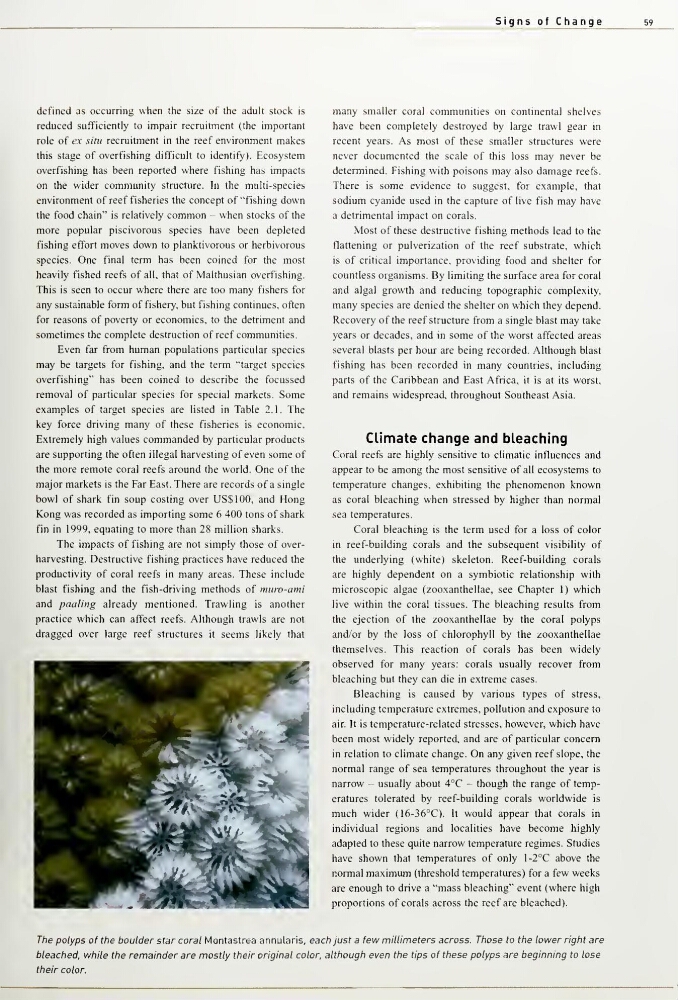
Coral bleaching is the term used for a loss of color
in reef-building corals and the subsequent visibility of
the underlying (white) skeleton. Reef-building corals
are highly dependent on a symbiotic relationship with
microscopic algae (zooxanthellae, see Chapter 1) which
live within the coral tissues. The bleaching results from
the ejection of the zooxanthellae by the coral polyps
and/or by the loss of chlorophyll by the zooxanthellae
themselves. This reaction of corals has been widely
observed for many years: corals usually recover from
bleaching but they can die in extreme cases.
Bleaching is caused by various types of stress,
including temperature extremes, pollution and exposure to
air It is temperature-related stresses, however, which have
been most widely reported, and are of particular concern
in relation to climate change. On any given reef slope, the
normal range of sea temperatures throughout the year is
narrow - usually about 4°C - though the range of temperatures tolerated by reef-building corals worldwide is
much wider (16-36°C). It would appear that corals in
individual regions and localities have become highly
adapted to these quite narrow temperature regimes. Studies
have shown that temperatures of only 1-2°C above the
normal maximum (threshold temperatures) for a few weeks
are enough to drive a "mass bleaching" event (where high
proportions of corals across the reef are bleached).
The polyps of the boulder star coral Montastrea annularis, each just a few millimeters across. Those to the tower right are
bleached, while the remainder are mostly their original color, although even the tips of these polyps are beginning to lose
their color.
defined as occurring when the size of the adult stock is
reduced sufficiently to impair recruitment (the important
role of ex situ recruitment in the reef environment makes
this stage of overfishing difficult to identify). Ecosystem
overfishing has been reported where fishing has impacts
on the wider community structure. In the multi-species
environment of reef fisheries the concept of "fishing down
the food chain" is relatively corrimon - when stocks of the
more popular piscivorous species have been depleted
fishing effort moves down to planktivorous or herbivorous
species. One final term has been coined for the most
heavily fished reefs of all, that of Malthusian overfishing.
This is seen to occur where there are too many fishers for
any sustainable form of fishery, but fishing continues, often
for reasons of poverty or economics, to the detriment and
sometimes the complete destruction of reef communities.
Even far from human populations particular species
may be targets for fishing, and the term "target species
overfishing" has been coined to describe the focussed
removal of particular species for special markets. Some
examples of target species are listed in Table 2.1. The
key force driving many of these fisheries is economic.
Extremely high values commanded by particular products
are supporting the often illegal harvesting of even some of
the more remote coral reefs around the world. One of the
major markets is the Far East. There are records of a single
bowl of shark fin soup costing over US$100, and Hong
Kong was recorded as importing some 6 400 tons of shark
fin in 1999, equating to more than 28 million sharks.
The impacts of fishing are not simply those of overharvesting. Destructive fishing practices have reduced the
productivity of coral reefs in many areas. These include
blast fishing and the fish-driving methods of muro-anu
and paaling already mentioned. Trawling is another
practice which can affect reefs. Although trawls are not
dragged over large reef structures it seems likely that
many smaller coral communities on continental shelves
have been completely destroyed by large trawl gear in
recent years. As most of these smaller structures were
never documented the scale of this loss may never be
determined. Fishing with poisons may also damage reefs.
There is some evidence to suggest, for example, that
sodium cyanide used in the capture of live fish may have
a detrimental impact on corals.
Most of these destructive fishing methods lead to the
flattening or pulverization of the reef substrate, which
is of critical importance, providing food and shelter for
countless organisms. By limiting the surface area for coral
and algal growth and reducing topographic complexity,
many species are denied the shelter on which they depend.
Recovery of the reef structure from a single blast may take
years or decades, and m some of the worst affected areas
several blasts per hour are being recorded. Although blast
fishing has been recorded in many countries, including
parts of the Caribbean and East Africa, it is at its worst,
and remains widespread, throughout Southeast Asia.
Climate change and bleaching
Coral reefs are highly sensitive to climatic intluences and
appear to be among the most sensitive of all ecosystems to
temperature changes, exhibiting the phenomenon known
as coral bleaching when stressed by higher than normal
sea temperatures.
Coral bleaching is the term used for a loss of color
in reef-building corals and the subsequent visibility of
the underlying (white) skeleton. Reef-building corals
are highly dependent on a symbiotic relationship with
microscopic algae (zooxanthellae, see Chapter 1) which
live within the coral tissues. The bleaching results from
the ejection of the zooxanthellae by the coral polyps
and/or by the loss of chlorophyll by the zooxanthellae
themselves. This reaction of corals has been widely
observed for many years: corals usually recover from
bleaching but they can die in extreme cases.
Bleaching is caused by various types of stress,
including temperature extremes, pollution and exposure to
air It is temperature-related stresses, however, which have
been most widely reported, and are of particular concern
in relation to climate change. On any given reef slope, the
normal range of sea temperatures throughout the year is
narrow - usually about 4°C - though the range of temperatures tolerated by reef-building corals worldwide is
much wider (16-36°C). It would appear that corals in
individual regions and localities have become highly
adapted to these quite narrow temperature regimes. Studies
have shown that temperatures of only 1-2°C above the
normal maximum (threshold temperatures) for a few weeks
are enough to drive a "mass bleaching" event (where high
proportions of corals across the reef are bleached).
The polyps of the boulder star coral Montastrea annularis, each just a few millimeters across. Those to the tower right are
bleached, while the remainder are mostly their original color, although even the tips of these polyps are beginning to lose
their color.