

Signs of Change
The long-spined sea urchin
In 1983 a mass mortality of the long-spined lor
black-spinedl sea urchin Diadema antillarum was
first observed In Panama. The cause of the deaths
remains unclear, although there Is evidence that
a bacterial pathogen may have been Involved. The
disease spread rapidly to almost every reef In the
Caribbean during 1983 and 198A, typically leading to
the loss of at least 93 percent of the urchins. One
year later a second wave of the disease swept
through and removed many of the surviving urchins.
The Impact of these events has been severe
across the Caribbean. Diadema was a critical
grazing herbivore on many reefs. Its loss led to
massive increases In filamentous and fleshy algae.
On reefs already impacted by coral disease Isee page
621 or hurricanes, this proliferation of algae greatly
slowed or prevented coral recruitment and recovery,
while even on healthy reefs, the growth of algae
has led to the deterioration of many coral colonies
through shading by the rapidly growing algae. It has
been suggested that overfishing of herbivorous fish
species in many areas has further encouraged algal
growth. In most areas there has been little or no
recovery of Diadema populations.
Humans have not been directly implicated In the
cause of this die-off. The sudden appearance of a
pathogen may be the result of a natural mutation,
although It could also be linked to the arrival of an
existing pathogen from another region. In the latter
case, the first appearance of the disease close to the
Panama Canal suggests that the pathogen may have
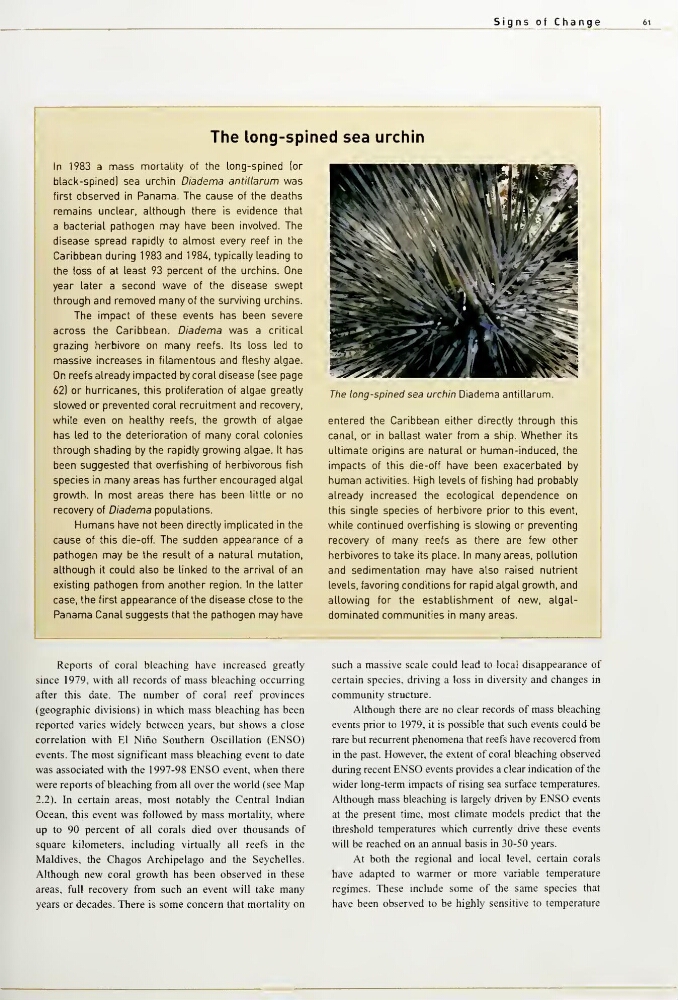
The long-spined sea urchin Diadema antillarum.
entered the Caribbean either directly through this
canal, or In ballast water from a ship. Whether its
ultimate origins are natural or human-Induced, the
impacts of this die-off have been exacerbated by
human activities. High levels of fishing had probably
already increased the ecological dependence on
this single species of herbivore prior to this event,
while continued overfishing is slowing or preventing
recovery of many reefs as there are few other
herbivores to take Its place. In many areas, pollution
and sedimentation may have also raised nutrient
levels, favoring conditions for rapid algal growth, and
allowing for the establishment of new. algaldominated communities In many areas.
Reports of coral bleaching have increased greatly
since 1979, with all records of mass bleaching occurring
after this date. The number of coral reef provinces
(geographic divisions) in which mass bleaching has been
reported varies widely between years, but shows a close
correlation with El Niiio Southern Oscillation (ENSO)
events. The most significant mass bleaching event to date
was associated with the 1997-98 ENSO event, when there
were reports of bleaching from all over the world (see Map
2.2). In certain areas, most notably the Central Indian
Ocean, this event was followed by mass mortality, where
up to 90 percent of all corals died over thousands of
square kilometers, including virtually all reefs m the
Maldives, the Chagos Archipelago and the Seychelles.
Although new coral growth has been observed in these
areas, full recovery fi-om such an event will take many
years or decades. There is some concern that mortality on
such a massive scale could lead to local disappearance of
certain species, driving a loss in diversity and changes in
community structure.
Although there are no clear records of mass bleaching
events prior to 1979, it is possible that such events could be
rare but recurrent phenomena that reefs have recovered from
in the past. However, the extent of coral bleaching observed
during recent ENSO events provides a clear indication of the
wider long-term impacts of rising sea surface temperatures.
Although mass bleaching is largely driven by ENSO events
at the present time, most climate models predict that the
threshold temperatures which currently drive these events
will be reached on an annual basis in 30-50 years.
At both the regional and local level, certain corals
have adapted to warmer or more variable temperature
regimes. These include some of the same species that
have been observed to be highly sensitive to temperature
The long-spined sea urchin
In 1983 a mass mortality of the long-spined lor
black-spinedl sea urchin Diadema antillarum was
first observed In Panama. The cause of the deaths
remains unclear, although there Is evidence that
a bacterial pathogen may have been Involved. The
disease spread rapidly to almost every reef In the
Caribbean during 1983 and 198A, typically leading to
the loss of at least 93 percent of the urchins. One
year later a second wave of the disease swept
through and removed many of the surviving urchins.
The Impact of these events has been severe
across the Caribbean. Diadema was a critical
grazing herbivore on many reefs. Its loss led to
massive increases In filamentous and fleshy algae.
On reefs already impacted by coral disease Isee page
621 or hurricanes, this proliferation of algae greatly
slowed or prevented coral recruitment and recovery,
while even on healthy reefs, the growth of algae
has led to the deterioration of many coral colonies
through shading by the rapidly growing algae. It has
been suggested that overfishing of herbivorous fish
species in many areas has further encouraged algal
growth. In most areas there has been little or no
recovery of Diadema populations.
Humans have not been directly implicated In the
cause of this die-off. The sudden appearance of a
pathogen may be the result of a natural mutation,
although It could also be linked to the arrival of an
existing pathogen from another region. In the latter
case, the first appearance of the disease close to the
Panama Canal suggests that the pathogen may have
The long-spined sea urchin Diadema antillarum.
entered the Caribbean either directly through this
canal, or In ballast water from a ship. Whether its
ultimate origins are natural or human-Induced, the
impacts of this die-off have been exacerbated by
human activities. High levels of fishing had probably
already increased the ecological dependence on
this single species of herbivore prior to this event,
while continued overfishing is slowing or preventing
recovery of many reefs as there are few other
herbivores to take Its place. In many areas, pollution
and sedimentation may have also raised nutrient
levels, favoring conditions for rapid algal growth, and
allowing for the establishment of new. algaldominated communities In many areas.
Reports of coral bleaching have increased greatly
since 1979, with all records of mass bleaching occurring
after this date. The number of coral reef provinces
(geographic divisions) in which mass bleaching has been
reported varies widely between years, but shows a close
correlation with El Niiio Southern Oscillation (ENSO)
events. The most significant mass bleaching event to date
was associated with the 1997-98 ENSO event, when there
were reports of bleaching from all over the world (see Map
2.2). In certain areas, most notably the Central Indian
Ocean, this event was followed by mass mortality, where
up to 90 percent of all corals died over thousands of
square kilometers, including virtually all reefs m the
Maldives, the Chagos Archipelago and the Seychelles.
Although new coral growth has been observed in these
areas, full recovery fi-om such an event will take many
years or decades. There is some concern that mortality on
such a massive scale could lead to local disappearance of
certain species, driving a loss in diversity and changes in
community structure.
Although there are no clear records of mass bleaching
events prior to 1979, it is possible that such events could be
rare but recurrent phenomena that reefs have recovered from
in the past. However, the extent of coral bleaching observed
during recent ENSO events provides a clear indication of the
wider long-term impacts of rising sea surface temperatures.
Although mass bleaching is largely driven by ENSO events
at the present time, most climate models predict that the
threshold temperatures which currently drive these events
will be reached on an annual basis in 30-50 years.
At both the regional and local level, certain corals
have adapted to warmer or more variable temperature
regimes. These include some of the same species that
have been observed to be highly sensitive to temperature