

Signs of Change
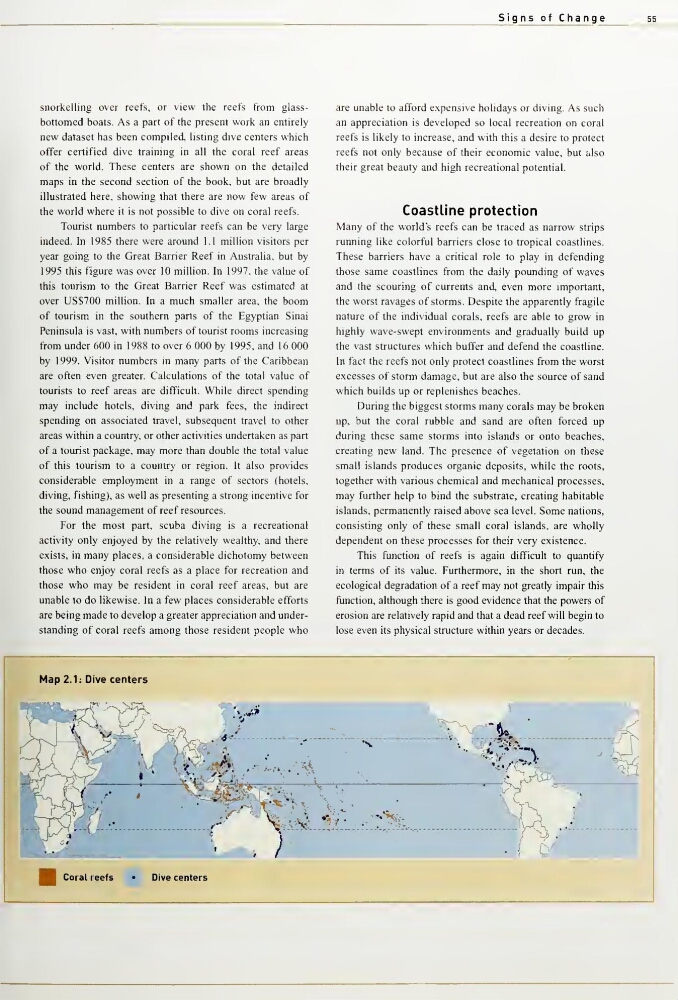
snorkelling over reefs, or view the reefs from glassbottomed boats. As a part of the present work an entirely
new dataset has been compiled, listing dive centers which
offer certified dive training in all the coral reef areas
of the world. These centers are shown on the detailed
maps in the second section of the book, but are broadly
illustrated here, showing that there are now few areas of
the world where it is not possible to dive on coral reefs.
Tourist numbers to particular reefs can be very large
indeed. In 1985 there were around 1.1 million visitors per
year going to the Great Barner Reef in Australia, but by
1995 this figure was over 10 million. In 1997, the value of
this tourism to the Great Barrier Reef was estimated at
over US$700 million. In a much smaller area, the boom
of tourism in the southern parts of the Egyptian Sinai
Peninsula is vast, with numbers of tourist rooms increasing
from under 600 in 1988 to over 6 000 by 1995, and 16 000
by 1999. Visitor numbers in many parts of the Caribbean
are often even greater Calculations of the total value of
tourists to reef areas are difficult. While direct spending
may include hotels, diving and park fees, the indirect
spending on associated travel, subsequent travel to other
areas within a country, or other activities undertaken as part
of a tourist package, may more than double the total value
of this tourism to a country or region. It also provides
considerable employment in a range of sectors (hotels,
diving, fishing), as well as presenting a strong incentive for
the sound management of reef resources.
For the most part, scuba diving is a recreational
activity only enjoyed by the relatively wealthy, and there
exists, in many places, a considerable dichotomy between
those who enjoy coral reefs as a place for recreation and
those who may be resident in coral reef areas, but are
unable to do likewise. In a few places considerable efforts
are being made to develop a greater appreciation and understanding of coral reefs among those resident people who
are unable to afford expensive holidays or diving. As such
an appreciation is developed so local recreation on coral
reefs is likely to increase, and with this a desire to protect
reefs not only because of their economic value, but also
their great beauty and high recreational potential.
Coastline protection
Many of the worlds reefs can be traced as narrow strips
running like colorful barriers close to tropical coastlines.
These barriers have a critical role to play in defending
those same coastlines from the daily pounding of waves
and the scouring of currents and, even more important,
the worst ravages of storms. Despite the apparently fragile
nature of the individual corals, reefs are able to grow in
highly wave-swept environments and gradually build up
the vast structures which buffer and defend the coastline.
In fact the reefs not only protect coastlines from the worst
excesses of storm damage, but are also the source of sand
which builds up or replenishes beaches.
During the biggest storms many corals may be broken
up, but the coral rubble and sand are often forced up
during these same storms into islands or onto beaches,
creating new land. The presence of vegetation on these
small islands produces organic deposits, while the roots,
together with various chemical and mechanical processes,
may further help to bind the substrate, creating habitable
islands, permanently raised above sea level. Some nations,
consisting only of these small coral islands, are wholly
dependent on these processes for their very existence.
This function of reefs is again difficult to quantify
in terms of its value. Furthermore, in the short run, the
ecological degradation of a reef may not greatly impair this
function, although there is good evidence that the powers of
erosion are relatively rapid and that a dead reef will begin to
lose even its physical structure within years or decades.
Map 2.1: Dive centers
(^'[
.
I
r^.
Coral reefs
•
Dive centers
snorkelling over reefs, or view the reefs from glassbottomed boats. As a part of the present work an entirely
new dataset has been compiled, listing dive centers which
offer certified dive training in all the coral reef areas
of the world. These centers are shown on the detailed
maps in the second section of the book, but are broadly
illustrated here, showing that there are now few areas of
the world where it is not possible to dive on coral reefs.
Tourist numbers to particular reefs can be very large
indeed. In 1985 there were around 1.1 million visitors per
year going to the Great Barner Reef in Australia, but by
1995 this figure was over 10 million. In 1997, the value of
this tourism to the Great Barrier Reef was estimated at
over US$700 million. In a much smaller area, the boom
of tourism in the southern parts of the Egyptian Sinai
Peninsula is vast, with numbers of tourist rooms increasing
from under 600 in 1988 to over 6 000 by 1995, and 16 000
by 1999. Visitor numbers in many parts of the Caribbean
are often even greater Calculations of the total value of
tourists to reef areas are difficult. While direct spending
may include hotels, diving and park fees, the indirect
spending on associated travel, subsequent travel to other
areas within a country, or other activities undertaken as part
of a tourist package, may more than double the total value
of this tourism to a country or region. It also provides
considerable employment in a range of sectors (hotels,
diving, fishing), as well as presenting a strong incentive for
the sound management of reef resources.
For the most part, scuba diving is a recreational
activity only enjoyed by the relatively wealthy, and there
exists, in many places, a considerable dichotomy between
those who enjoy coral reefs as a place for recreation and
those who may be resident in coral reef areas, but are
unable to do likewise. In a few places considerable efforts
are being made to develop a greater appreciation and understanding of coral reefs among those resident people who
are unable to afford expensive holidays or diving. As such
an appreciation is developed so local recreation on coral
reefs is likely to increase, and with this a desire to protect
reefs not only because of their economic value, but also
their great beauty and high recreational potential.
Coastline protection
Many of the worlds reefs can be traced as narrow strips
running like colorful barriers close to tropical coastlines.
These barriers have a critical role to play in defending
those same coastlines from the daily pounding of waves
and the scouring of currents and, even more important,
the worst ravages of storms. Despite the apparently fragile
nature of the individual corals, reefs are able to grow in
highly wave-swept environments and gradually build up
the vast structures which buffer and defend the coastline.
In fact the reefs not only protect coastlines from the worst
excesses of storm damage, but are also the source of sand
which builds up or replenishes beaches.
During the biggest storms many corals may be broken
up, but the coral rubble and sand are often forced up
during these same storms into islands or onto beaches,
creating new land. The presence of vegetation on these
small islands produces organic deposits, while the roots,
together with various chemical and mechanical processes,
may further help to bind the substrate, creating habitable
islands, permanently raised above sea level. Some nations,
consisting only of these small coral islands, are wholly
dependent on these processes for their very existence.
This function of reefs is again difficult to quantify
in terms of its value. Furthermore, in the short run, the
ecological degradation of a reef may not greatly impair this
function, although there is good evidence that the powers of
erosion are relatively rapid and that a dead reef will begin to
lose even its physical structure within years or decades.
Map 2.1: Dive centers
(^'[
.
I
r^.
Coral reefs
•
Dive centers