

54
WORLD ATLAS OF CORAL REEFS
known to date, but these are just the tip of the iceberg.
Huge numbers of species, but particularly the sessile or
slow-moving invertebrates such as sponges, bryozoans,
ascideans and nudibranchs. contain a vast panoply of
complex and potent chemical compounds.
Traditional societies have used compounds from
the reefs in traditional medicine and, while perhaps the
majority of examples are lost and forgotten, there are
some, such as the use of terebellid worms in Hawai'i and
of rabbitfish gall bladders in Palau, which indicate
ongoing perceived benefits from the active properties of
particular species.
Bioprospecting for potential new pharmaceuticals
has been ongoing in terrestrial environments for many decades but is still relatively new in the marine environment.
Now, however, considerable efforts are being put into
gathering and screening new genetic materials from coral
reefs. Anti-cancer properties are being investigated in a
number of products derived from marine life, including
cryptophycins from blue-green algae, and other metabolites
from planktonic dinoflagellates. Pseudopterosins derived
from Caribbean sea-whip corals are being investigated
for skincare and anti-inflammatory properties. The compound manoalide. derived from a Pacific sponge, has now
spawned more than 300 chemical analogues being tested
for anti-inflammatory properties. Initial tests on a neurotoxin derived from a Pacific marine snail are showing very
powerful painkilling properties. These are only published
examples: there are likely to be many others under development which remain undisclosed to the wider public.
Such activities are not without controversy. There is
concern that host countries may lose ownership and a
share of any profits from new pharmaceuticals or other
compounds developed by the drug companies. There is
also concern that collection of more unusual and rare
species may actually impact the global populations of
these species. In both cases these problems can be solved
with detailed management and cooperation.
The value of coral reefs as a standing stock of genetic
diversity is considerable, but in many ways this value is
potential, just beginning to be utilized. For this reason it is
almost impossible to value in an economic sense, but the
benefits could be vast.
Tourism and recreation
Coral reefs are among the most visually impressive habitats
on the planet, burgeoning with life and dazzling with color.
Despite this, the visual appreciation of these habitats is a
recent phenomenon. The first use of modern mask, fins and
snorkel can be traced back to the Mediterranean in the
1920s and 1930s, while the development of the first fully
automatic aqualung and regulator did not occur until 1942.
Diving as a popular activity began to spread in the 1950s,
and probably the first diving club in the tropics was
established in Jamaica in 1957. In less than 50 years diving
has grown from being an obscure (and dangerous) sport to
being one of the worlds most popular adventure activities.
PADI, the world's largest diver certification organization,
provided certification for over 800 000 divers in 1999, and
has provided certification for over 8 million divers since its
establishment. Worldwide there are now over 15 million
recreational divers, certified under the various existing dive
training organizations.
Just as the sport of diving has developed, the concept
of rapid and relatively cheap international travel and
the economic boom and development of many countries
around the world have led to tourism becoming one of the
world's most important industries. These two factors have
combined, and coral reefs are the favored destination of
amateur divers around the world. In addition to certified
divers, many millions more undertake single dives, enjoy
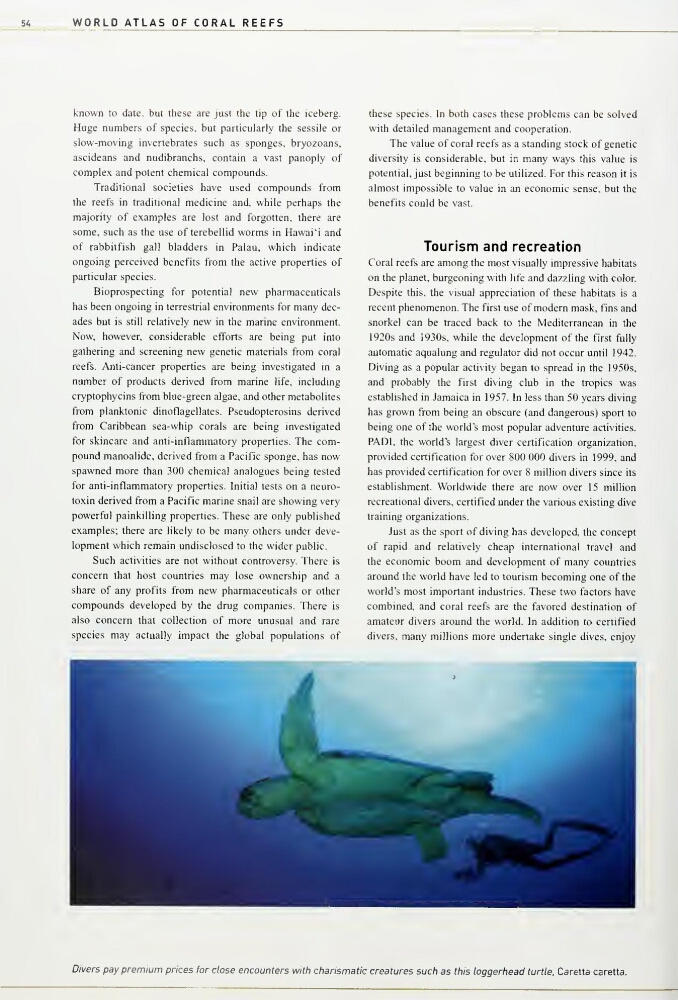
Divers pay premium prices for close encounters with charismatic creatures such as this loggerhead turtle, Caretta caretta.
WORLD ATLAS OF CORAL REEFS
known to date, but these are just the tip of the iceberg.
Huge numbers of species, but particularly the sessile or
slow-moving invertebrates such as sponges, bryozoans,
ascideans and nudibranchs. contain a vast panoply of
complex and potent chemical compounds.
Traditional societies have used compounds from
the reefs in traditional medicine and, while perhaps the
majority of examples are lost and forgotten, there are
some, such as the use of terebellid worms in Hawai'i and
of rabbitfish gall bladders in Palau, which indicate
ongoing perceived benefits from the active properties of
particular species.
Bioprospecting for potential new pharmaceuticals
has been ongoing in terrestrial environments for many decades but is still relatively new in the marine environment.
Now, however, considerable efforts are being put into
gathering and screening new genetic materials from coral
reefs. Anti-cancer properties are being investigated in a
number of products derived from marine life, including
cryptophycins from blue-green algae, and other metabolites
from planktonic dinoflagellates. Pseudopterosins derived
from Caribbean sea-whip corals are being investigated
for skincare and anti-inflammatory properties. The compound manoalide. derived from a Pacific sponge, has now
spawned more than 300 chemical analogues being tested
for anti-inflammatory properties. Initial tests on a neurotoxin derived from a Pacific marine snail are showing very
powerful painkilling properties. These are only published
examples: there are likely to be many others under development which remain undisclosed to the wider public.
Such activities are not without controversy. There is
concern that host countries may lose ownership and a
share of any profits from new pharmaceuticals or other
compounds developed by the drug companies. There is
also concern that collection of more unusual and rare
species may actually impact the global populations of
these species. In both cases these problems can be solved
with detailed management and cooperation.
The value of coral reefs as a standing stock of genetic
diversity is considerable, but in many ways this value is
potential, just beginning to be utilized. For this reason it is
almost impossible to value in an economic sense, but the
benefits could be vast.
Tourism and recreation
Coral reefs are among the most visually impressive habitats
on the planet, burgeoning with life and dazzling with color.
Despite this, the visual appreciation of these habitats is a
recent phenomenon. The first use of modern mask, fins and
snorkel can be traced back to the Mediterranean in the
1920s and 1930s, while the development of the first fully
automatic aqualung and regulator did not occur until 1942.
Diving as a popular activity began to spread in the 1950s,
and probably the first diving club in the tropics was
established in Jamaica in 1957. In less than 50 years diving
has grown from being an obscure (and dangerous) sport to
being one of the worlds most popular adventure activities.
PADI, the world's largest diver certification organization,
provided certification for over 800 000 divers in 1999, and
has provided certification for over 8 million divers since its
establishment. Worldwide there are now over 15 million
recreational divers, certified under the various existing dive
training organizations.
Just as the sport of diving has developed, the concept
of rapid and relatively cheap international travel and
the economic boom and development of many countries
around the world have led to tourism becoming one of the
world's most important industries. These two factors have
combined, and coral reefs are the favored destination of
amateur divers around the world. In addition to certified
divers, many millions more undertake single dives, enjoy
Divers pay premium prices for close encounters with charismatic creatures such as this loggerhead turtle, Caretta caretta.