

Signs of Change
exact origins remain unclear it is highly likely that reefs
were being used as one source of such products. The use
of cowrie shells as currency was another ancient and widespread utilization, and at least some of them would have
come from reefs. E.xamples of shell currency have been
found across Africa and South Asia to China. There is
evidence of a trade in these shells from India to China from
records back to 400 AD, while the Maldives became known
as the Money Islands because of the preponderance of shells
in those areas. Cowries were widely used m some cultures
into the mid- 19th century.
The jewellery and curio industry
Pearls and coral are still widely harvested today for
international trade. For pearls, the development of aquaculture techniques has greatly influenced the value and
geographic spread of pearl culture. Today the pearl
industry is dominated by Australia (especially Western
Australia). Japan and French Polynesia, but pearl aquaculture is widespread across island locations in the Pacific
and there is a continuing small-scale natural pearl industry,
notably in India.
Corals, particularly red pink and black, are widely used
in the jewellery industry, and in many cases this use can be
traced back to antiquity. While these corals are not restricted
to coral reef regions, reefs are a major source, particularly
for black corals. This industry was unsustainable in many
countries and, like the trade in scleractinian corals (see box
on the aquarium trade on page 50). is now strictly regulated
under CITES. The USA is again the major consumer of
these products, while Taiwan and the Philippines have
tended to dommate the export statistics. Within the USA -
in the Hawaiian islands - there is also a substantial black
coral harvest. This is relatively well managed, with a
minimum size restriction preventing overutilization.
The use of turtle shell was once very popular in
jewellery and other decorative ornaments, but the scarcity
of marine turtles combined with strict controls on the
trade in turtle products has now greatly reduced the size
of this trade.
Building materials
The earliest structures to have been built from coral and
reef rock were probably walls and pens associated with
the capture of fish, but there is also a long tradition of
removing materials from coral reefs and nearby lagoons
and sand flats, particularly for building purposes. The use
of coral rock in the construction of stone buildings also
goes back many centuries, notably in houses along the
Red Sea and in the Maldives.
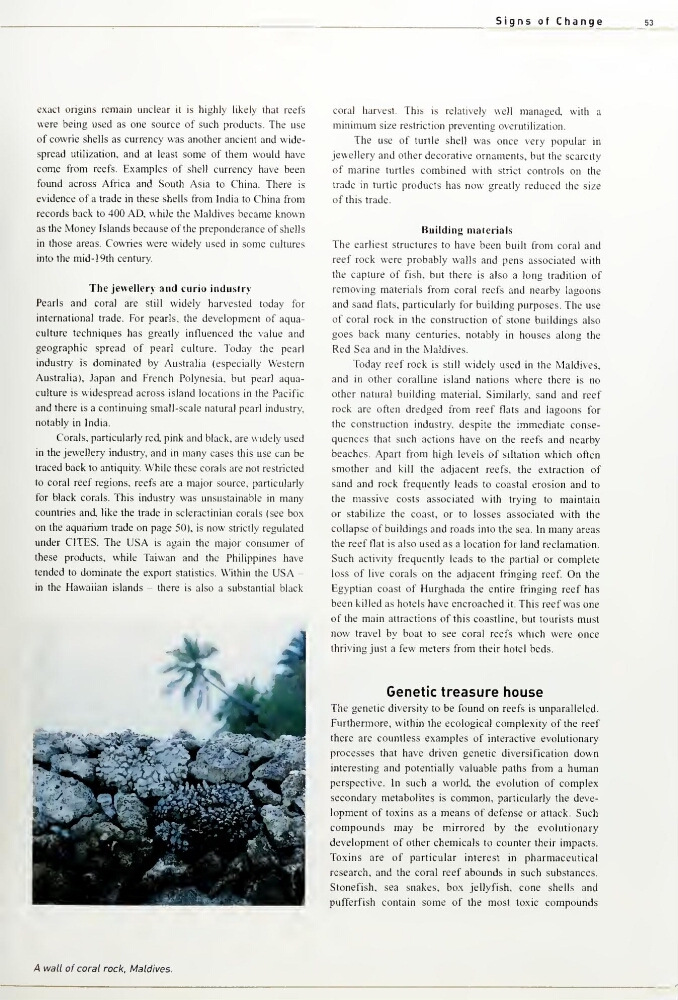
Today reef rock is still widely used in the Maldives,
and in other coralline island nations where there is no
other natural building material. Similarly, sand and reef
rock are often dredged from reef flats and lagoons for
the construction industry, despite the immediate consequences that such actions have on the reefs and nearby
beaches. Apart from high levels of siltation which often
smother and kill the adjacent reefs, the extraction of
sand and rock frequently leads to coastal erosion and to
the massive costs associated with trying to maintain
or stabilize the coast, or to losses associated with the
collapse of buildings and roads into the sea. In many areas
the reef flat is also used as a location for land reclamation.
Such activity frequently leads to the partial or complete
loss of live corals on the adjacent fringing reef On the
Egyptian coast of Hurghada the entire fringing reef has
been killed as hotels have encroached it. This reef was one
of the main attractions of this coastline, but tourists must
now travel by boat to see coral reefs which were once
thriving just a few meters from their hotel beds.
Genetic treasure house
The genetic diversity to be found on reefs is unparalleled.
Furthermore, within the ecological complexity of the reef
there are countless examples of interactive evolutionary
processes that have driven genetic diversification down
interesting and potentially valuable paths from a human
perspective. In such a world, the evolution of complex
secondary metabolites is common, particularly the development of toxins as a means of defense or attack. Such
compounds may be mirrored by the evolutionary
development of other chemicals to counter their impacts.
Toxins are of particular interest in pharmaceutical
research, and the coral reef abounds in such substances.
Stonefish, sea snakes, box jellyfish, cone shells and
pufferfish contain some of the most toxic compounds
A wall of coral rock, Maldives.
exact origins remain unclear it is highly likely that reefs
were being used as one source of such products. The use
of cowrie shells as currency was another ancient and widespread utilization, and at least some of them would have
come from reefs. E.xamples of shell currency have been
found across Africa and South Asia to China. There is
evidence of a trade in these shells from India to China from
records back to 400 AD, while the Maldives became known
as the Money Islands because of the preponderance of shells
in those areas. Cowries were widely used m some cultures
into the mid- 19th century.
The jewellery and curio industry
Pearls and coral are still widely harvested today for
international trade. For pearls, the development of aquaculture techniques has greatly influenced the value and
geographic spread of pearl culture. Today the pearl
industry is dominated by Australia (especially Western
Australia). Japan and French Polynesia, but pearl aquaculture is widespread across island locations in the Pacific
and there is a continuing small-scale natural pearl industry,
notably in India.
Corals, particularly red pink and black, are widely used
in the jewellery industry, and in many cases this use can be
traced back to antiquity. While these corals are not restricted
to coral reef regions, reefs are a major source, particularly
for black corals. This industry was unsustainable in many
countries and, like the trade in scleractinian corals (see box
on the aquarium trade on page 50). is now strictly regulated
under CITES. The USA is again the major consumer of
these products, while Taiwan and the Philippines have
tended to dommate the export statistics. Within the USA -
in the Hawaiian islands - there is also a substantial black
coral harvest. This is relatively well managed, with a
minimum size restriction preventing overutilization.
The use of turtle shell was once very popular in
jewellery and other decorative ornaments, but the scarcity
of marine turtles combined with strict controls on the
trade in turtle products has now greatly reduced the size
of this trade.
Building materials
The earliest structures to have been built from coral and
reef rock were probably walls and pens associated with
the capture of fish, but there is also a long tradition of
removing materials from coral reefs and nearby lagoons
and sand flats, particularly for building purposes. The use
of coral rock in the construction of stone buildings also
goes back many centuries, notably in houses along the
Red Sea and in the Maldives.
Today reef rock is still widely used in the Maldives,
and in other coralline island nations where there is no
other natural building material. Similarly, sand and reef
rock are often dredged from reef flats and lagoons for
the construction industry, despite the immediate consequences that such actions have on the reefs and nearby
beaches. Apart from high levels of siltation which often
smother and kill the adjacent reefs, the extraction of
sand and rock frequently leads to coastal erosion and to
the massive costs associated with trying to maintain
or stabilize the coast, or to losses associated with the
collapse of buildings and roads into the sea. In many areas
the reef flat is also used as a location for land reclamation.
Such activity frequently leads to the partial or complete
loss of live corals on the adjacent fringing reef On the
Egyptian coast of Hurghada the entire fringing reef has
been killed as hotels have encroached it. This reef was one
of the main attractions of this coastline, but tourists must
now travel by boat to see coral reefs which were once
thriving just a few meters from their hotel beds.
Genetic treasure house
The genetic diversity to be found on reefs is unparalleled.
Furthermore, within the ecological complexity of the reef
there are countless examples of interactive evolutionary
processes that have driven genetic diversification down
interesting and potentially valuable paths from a human
perspective. In such a world, the evolution of complex
secondary metabolites is common, particularly the development of toxins as a means of defense or attack. Such
compounds may be mirrored by the evolutionary
development of other chemicals to counter their impacts.
Toxins are of particular interest in pharmaceutical
research, and the coral reef abounds in such substances.
Stonefish, sea snakes, box jellyfish, cone shells and
pufferfish contain some of the most toxic compounds
A wall of coral rock, Maldives.