

52
WORLD ATLAS OF CORAL REEFS
tied to any ecological restoration and, all too often,
wastelands are left with unproductive and still highly
polluted pools in the place of former mangroves.
Pearl collection can be traced back several millennia to
the pearl divers of the Middle East. However, the farming
of pearl oysters is more recent, occurring only since the
techniques for pearl culture were developed. It is now widespread in a number of reef regions, but most notably with
the culture of blacklip pearl oysters Piitcuida margaritifera.
One of the largest producers is French Polynesia, where
extensive pearl farms have been developed in the lagoons of
a number of atolls. The oysters, which are filter feeders, are
suspended in the water column. Thus far no adverse longterm effects from these farms have been noted on the surrounding reefs, although there have been mass mortalities,
with associated temporary eutrophication of parts of the
lagoons on a few occasions.
The culture of particular organisms on the reef flat
is also increasing. Aquaculture of giant clams (several
species of the family Tridacnidae) has been developed
in a number of Pacific islands and in Australia. Farmed
clams are used both in the aquarium trade and as food,
both as a high value export and for local consumption.
Another perhaps more widespread activity in reef flat
and shallow lagoon areas is the cultivation of algae.
Seaweeds are used both as a source of food and as a
raw material from which a group of natural gums are
extracted for use as thickening or gelling agents,
including sodium alginate, carrageenin and agar Various
species are exploited, including Eiicheiima and Sargassiim.
Algal farming is widespread in countries of the Pacific
and Indian Oceans, with the largest tropical exporters
being the Philippines, Indonesia and Tanzania, and it is
also being developed in some parts of the Caribbean.
These and other activities clearly impact the natural
ecosystem function, both through the smothering effect
by the cultured organism over existing benthic species,
but also from the trampling of the reef flat. At the same
time, however, their impact is limited to a small area and
may be more than countered by the reduced impact on
other parts of the reef as local communities turn their
attention to aquaculture.
Other types of aquaculture in reef regions include the
rearing of trochus (a mollusc used for food but also an
important species in the mother-of-pearl industry), and a
small but growing interest in sponge farming. Efforts are
also underway to develop techniques for culturing sea
cucumbers (holothurians). The culture of corals and fish
for the marine ornamental trade is a more challenging
activity, and is often undertaken under more controlled
conditions in large-volume aquaria adjacent to coral reefs,
or m the importing countries of North America and Europe.
Other reef products
Harvesting of reef resources also goes beyond food
values, and mention has already been made of the use
of aquaculture for pearl production. The aquarium trade is
a relatively new use of reefs with significant economic
importance in some areas (see page 50). Reefs are also
widely used for the collection of materials for jewellery
and other ornaments, while the bare materials of the reef
have often been used as a base for construction.
Mother-of-pearl ornamentation can be traced back to
Thebes in Egypt in 3200 BC. and pearls themselves have
been foimd in China dating back to 2500 BC. While their
iSftS^^
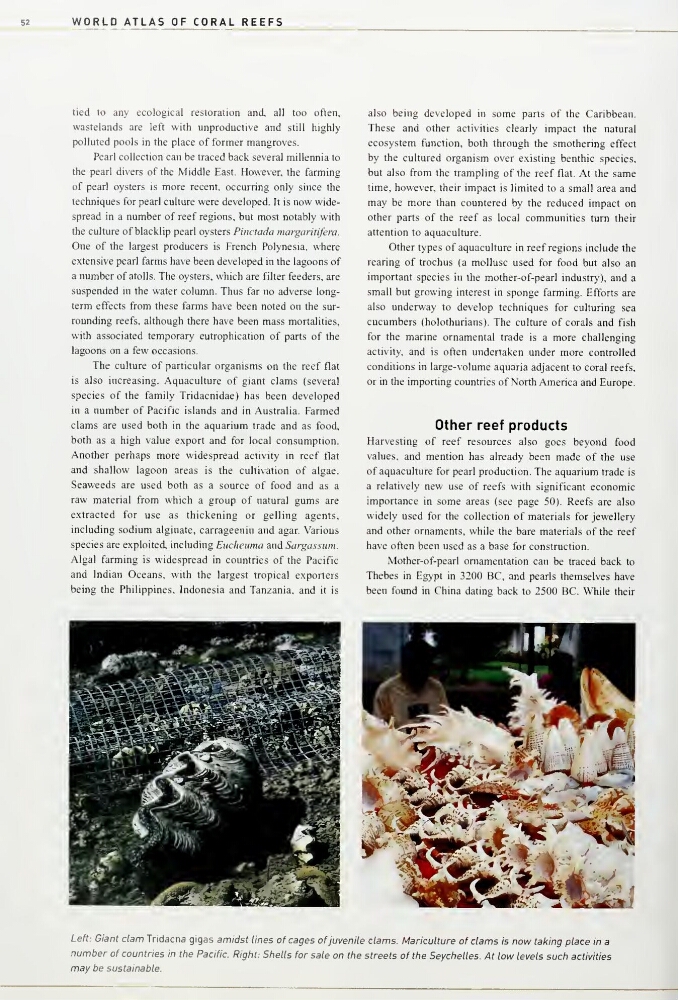
Left: Giant clam Tridacna gigas amidst lines of cages of juvenile clams. I^lariculture of clams is now taking place in a
number of countries in ttie Pacific. Rigt^t: Sfiells for sale on tf)e streets of tfie Seyctielles. At low levels sucti activities
may be sustainable.
WORLD ATLAS OF CORAL REEFS
tied to any ecological restoration and, all too often,
wastelands are left with unproductive and still highly
polluted pools in the place of former mangroves.
Pearl collection can be traced back several millennia to
the pearl divers of the Middle East. However, the farming
of pearl oysters is more recent, occurring only since the
techniques for pearl culture were developed. It is now widespread in a number of reef regions, but most notably with
the culture of blacklip pearl oysters Piitcuida margaritifera.
One of the largest producers is French Polynesia, where
extensive pearl farms have been developed in the lagoons of
a number of atolls. The oysters, which are filter feeders, are
suspended in the water column. Thus far no adverse longterm effects from these farms have been noted on the surrounding reefs, although there have been mass mortalities,
with associated temporary eutrophication of parts of the
lagoons on a few occasions.
The culture of particular organisms on the reef flat
is also increasing. Aquaculture of giant clams (several
species of the family Tridacnidae) has been developed
in a number of Pacific islands and in Australia. Farmed
clams are used both in the aquarium trade and as food,
both as a high value export and for local consumption.
Another perhaps more widespread activity in reef flat
and shallow lagoon areas is the cultivation of algae.
Seaweeds are used both as a source of food and as a
raw material from which a group of natural gums are
extracted for use as thickening or gelling agents,
including sodium alginate, carrageenin and agar Various
species are exploited, including Eiicheiima and Sargassiim.
Algal farming is widespread in countries of the Pacific
and Indian Oceans, with the largest tropical exporters
being the Philippines, Indonesia and Tanzania, and it is
also being developed in some parts of the Caribbean.
These and other activities clearly impact the natural
ecosystem function, both through the smothering effect
by the cultured organism over existing benthic species,
but also from the trampling of the reef flat. At the same
time, however, their impact is limited to a small area and
may be more than countered by the reduced impact on
other parts of the reef as local communities turn their
attention to aquaculture.
Other types of aquaculture in reef regions include the
rearing of trochus (a mollusc used for food but also an
important species in the mother-of-pearl industry), and a
small but growing interest in sponge farming. Efforts are
also underway to develop techniques for culturing sea
cucumbers (holothurians). The culture of corals and fish
for the marine ornamental trade is a more challenging
activity, and is often undertaken under more controlled
conditions in large-volume aquaria adjacent to coral reefs,
or m the importing countries of North America and Europe.
Other reef products
Harvesting of reef resources also goes beyond food
values, and mention has already been made of the use
of aquaculture for pearl production. The aquarium trade is
a relatively new use of reefs with significant economic
importance in some areas (see page 50). Reefs are also
widely used for the collection of materials for jewellery
and other ornaments, while the bare materials of the reef
have often been used as a base for construction.
Mother-of-pearl ornamentation can be traced back to
Thebes in Egypt in 3200 BC. and pearls themselves have
been foimd in China dating back to 2500 BC. While their
iSftS^^
Left: Giant clam Tridacna gigas amidst lines of cages of juvenile clams. I^lariculture of clams is now taking place in a
number of countries in ttie Pacific. Rigt^t: Sfiells for sale on tf)e streets of tfie Seyctielles. At low levels sucti activities
may be sustainable.