

Signs of Change
produce annual reports specifying the quantity of
trade that has taken place in each listed species.
In 1997 a total of 1 200 tons of coral was
traded Internationally, with 56 percent imported
by the USA and 15 percent by the European Union.
Approximately half of this was live coral for aquaria,
a tenfold Increase on the amount of live coral traded
in the late 1980s.
No marine aquarium fish or invertebrates other
than clams or corals are listed under CITES. Only
very rough estimates of trade figures are available,
suggesting that 15-20 million fish from approximately 1 000 species may be traded per year. The
trade In Individual fish species is unknown, and no
data exist on the extent of the trade in Invertebrates
other than corals and clams.
Thus, while the current impacts of the aquarium trade remain poorly known, the potential for
this industry is considerable. It Is quite possible to
manage aquarium fisheries at low and sustainable
levels. It is further possible to capture live species
using non-destructive techniques. With well managed shipping and husbandry, mortality can also be
kept very low, as has already been shown by some
operators in the industry. Targeting mostly non-food
species, aquarium fisheries can, in theory at least,
provide an alternative economic activity for low
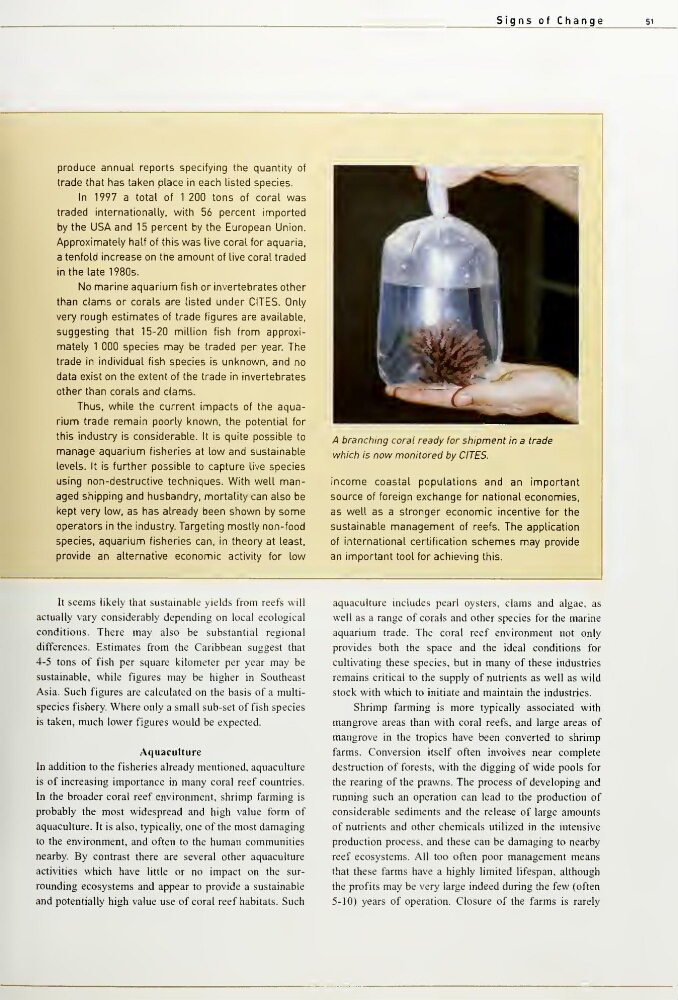
A branching coral ready for shipment in a trade
which is now monitored by CITES.
income coastal populations and an important
source of foreign exchange for national economies,
as well as a stronger economic incentive for the
sustainable management of reefs. The application
of international certification schemes may provide
an important tool for achieving this.
It seems likely that sustainable yields from reefs will
actually vary considerably depending on local ecological
conditions. There may also be substantial regional
differences. Estimates from the Caribbean suggest that
4-5 tons of fish per square kilometer per year may be
sustainable, while figures may be higher in Southeast
Asia. Such figures are calculated on the basis of a multispecies fishery. Where only a small sub-set offish species
is taken, much lower figures would be expected.
Aquaculture
In addition to the fisheries already mentioned, aquaculture
is of increasing importance in many coral reef countries.
In the broader coral reef environment, shrimp farming is
probably the most widespread and high value form of
aquaculture. It is also, typically, one of the most damaging
to the environment, and often to the human communities
nearby. By contrast there are several other aquaculture
activities which have little or no impact on the surrounding ecosystems and appear to provide a sustainable
and potentially high value use of coral reef habitats. Such
aquaculture includes pearl oysters, clams and algae, as
well as a range of corals and other species for the marine
aquarium trade. The coral reef environment not only
provides both the space and the ideal conditions for
cultivating these species, but in many of these industries
remains critical to the supply of nutrients as well as wild
stock with which to initiate and maintain the industries.
Shrimp farming is more typically associated with
mangrove areas than with coral reefs, and large areas of
mangrove in the tropics have been converted to shrimp
farms. Conversion itself often involves near complete
destruction of forests, with the digging of wide pools for
the rearing of the prawns. The process of developing and
running such an operation can lead to the production of
considerable sediments and the release of large amounts
of nutrients and other chemicals utilized in the intensive
production process, and these can be damaging to nearby
reef ecosystems. All too often poor management means
that these farms have a highly limited lifespan, although
the profits may be very large indeed during the few (often
5-10) years of operation. Closure of the farms is rarely
produce annual reports specifying the quantity of
trade that has taken place in each listed species.
In 1997 a total of 1 200 tons of coral was
traded Internationally, with 56 percent imported
by the USA and 15 percent by the European Union.
Approximately half of this was live coral for aquaria,
a tenfold Increase on the amount of live coral traded
in the late 1980s.
No marine aquarium fish or invertebrates other
than clams or corals are listed under CITES. Only
very rough estimates of trade figures are available,
suggesting that 15-20 million fish from approximately 1 000 species may be traded per year. The
trade In Individual fish species is unknown, and no
data exist on the extent of the trade in Invertebrates
other than corals and clams.
Thus, while the current impacts of the aquarium trade remain poorly known, the potential for
this industry is considerable. It Is quite possible to
manage aquarium fisheries at low and sustainable
levels. It is further possible to capture live species
using non-destructive techniques. With well managed shipping and husbandry, mortality can also be
kept very low, as has already been shown by some
operators in the industry. Targeting mostly non-food
species, aquarium fisheries can, in theory at least,
provide an alternative economic activity for low
A branching coral ready for shipment in a trade
which is now monitored by CITES.
income coastal populations and an important
source of foreign exchange for national economies,
as well as a stronger economic incentive for the
sustainable management of reefs. The application
of international certification schemes may provide
an important tool for achieving this.
It seems likely that sustainable yields from reefs will
actually vary considerably depending on local ecological
conditions. There may also be substantial regional
differences. Estimates from the Caribbean suggest that
4-5 tons of fish per square kilometer per year may be
sustainable, while figures may be higher in Southeast
Asia. Such figures are calculated on the basis of a multispecies fishery. Where only a small sub-set offish species
is taken, much lower figures would be expected.
Aquaculture
In addition to the fisheries already mentioned, aquaculture
is of increasing importance in many coral reef countries.
In the broader coral reef environment, shrimp farming is
probably the most widespread and high value form of
aquaculture. It is also, typically, one of the most damaging
to the environment, and often to the human communities
nearby. By contrast there are several other aquaculture
activities which have little or no impact on the surrounding ecosystems and appear to provide a sustainable
and potentially high value use of coral reef habitats. Such
aquaculture includes pearl oysters, clams and algae, as
well as a range of corals and other species for the marine
aquarium trade. The coral reef environment not only
provides both the space and the ideal conditions for
cultivating these species, but in many of these industries
remains critical to the supply of nutrients as well as wild
stock with which to initiate and maintain the industries.
Shrimp farming is more typically associated with
mangrove areas than with coral reefs, and large areas of
mangrove in the tropics have been converted to shrimp
farms. Conversion itself often involves near complete
destruction of forests, with the digging of wide pools for
the rearing of the prawns. The process of developing and
running such an operation can lead to the production of
considerable sediments and the release of large amounts
of nutrients and other chemicals utilized in the intensive
production process, and these can be damaging to nearby
reef ecosystems. All too often poor management means
that these farms have a highly limited lifespan, although
the profits may be very large indeed during the few (often
5-10) years of operation. Closure of the farms is rarely