

56
WORLD ATLAS OF CORAL REEFS
Threats to reefs
Coral
reefs in their natural state have often been
considered as highly stable ecosystems with their
tight ecological complexity protecting a finely
balanced and highly sensitive ecosystem. Even minor
changes to the species balance, it is suggested, will have
repercussions across the ecosystem. Other ecologists have
challenged this view and pointed to the many apparently
catastrophic events which are regular occurrences on
some of the world's reefs. There is evidence that certain
levels of disturbance, such as physical damage from major
storms, or even the impacts of diseases, may actually be of
benefit to a reef ecosystem over the longer term. Without
the constant shifts and changes of conditions which these
natural events produce, conditions might favor particular
species to the detriment of others, and diversity on the
reefs might be reduced. Arguments about the true stability
and complexity of interrelationships on coral reefs will
continue for many years, but it remains clear that reefs
have survived and even thrived in areas where disturbance
can be a regular occurrence. Unfortunately, it is equally
true that recent decades have created levels of stress to
coral reefs that are unprecedented in the recent history of
the planet. These human disturbances are not only intense,
but are widespread in every part of every ocean. In many
areas they also compound one another, or are further
exacerbated by natural disturbances.
The true resilience of coral reefs is now being tested
to extreme levels over large areas of the planet, and the
result has been considerable degradation, with loss of
ecosystem function in many areas. In a few places reefs
seem to have disappeared completely, and have been
replaced by other ecosystems of lower diversity and
productivity. As such changes occur, the many important
goods and services which the reef formerly provided
become diminished or are lost.
Most human-induced impacts fall into four broad
categories: pollution, sedimentation, overfishing and
climate change. Direct physical damage presents a fifth
factor, more limited in spatial extent, but in some cases
more damaging and irreversible than any of the others.
The actual effects of these impacts on particular reefs may
vary. They may be complicated by their interactions with
one another, or be countered by natural mitigating factors
or further human intervention. In a few cases, changes or
apparent degradation on the reefs cannot be directly traced
to single, or even multiple stressors, and yet there may still
be a link to human impacts.
In the following account, the effects of these broad
categories of stress are first considered. More complex
phenomena are then addressed independently: the crownof-thorns starfish, the Diadema die-off and the global
patterns of coral diseases. As threats combine so the
resulting impacts may be greatly exacerbated. A final section looks at how this may work in practice, and further
summarizes a recent global study which attempted to map
the global patterns of stress to the worlds coral reefs.
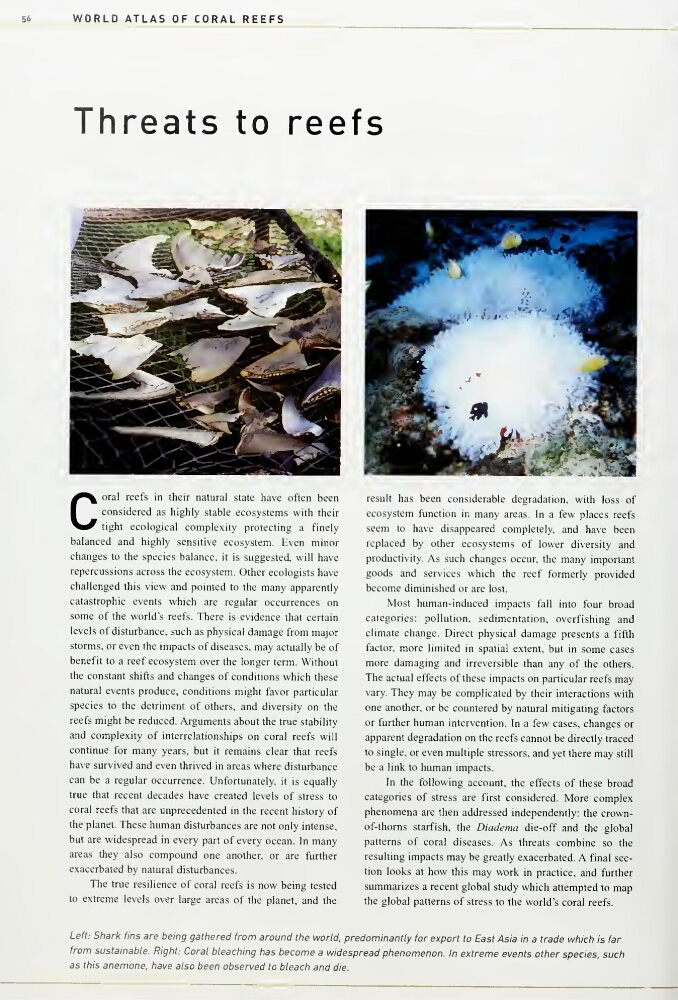
Left: Shark fins are being gattiered from around ttie world, predominantly for export to East Asia in a trade whicf) is far
from sustainable. Right: Coral bleaching has become a widespread phenomenon. In extreme events other species, such
as this anemone, have also been observed to bleach and die.
WORLD ATLAS OF CORAL REEFS
Threats to reefs
Coral
reefs in their natural state have often been
considered as highly stable ecosystems with their
tight ecological complexity protecting a finely
balanced and highly sensitive ecosystem. Even minor
changes to the species balance, it is suggested, will have
repercussions across the ecosystem. Other ecologists have
challenged this view and pointed to the many apparently
catastrophic events which are regular occurrences on
some of the world's reefs. There is evidence that certain
levels of disturbance, such as physical damage from major
storms, or even the impacts of diseases, may actually be of
benefit to a reef ecosystem over the longer term. Without
the constant shifts and changes of conditions which these
natural events produce, conditions might favor particular
species to the detriment of others, and diversity on the
reefs might be reduced. Arguments about the true stability
and complexity of interrelationships on coral reefs will
continue for many years, but it remains clear that reefs
have survived and even thrived in areas where disturbance
can be a regular occurrence. Unfortunately, it is equally
true that recent decades have created levels of stress to
coral reefs that are unprecedented in the recent history of
the planet. These human disturbances are not only intense,
but are widespread in every part of every ocean. In many
areas they also compound one another, or are further
exacerbated by natural disturbances.
The true resilience of coral reefs is now being tested
to extreme levels over large areas of the planet, and the
result has been considerable degradation, with loss of
ecosystem function in many areas. In a few places reefs
seem to have disappeared completely, and have been
replaced by other ecosystems of lower diversity and
productivity. As such changes occur, the many important
goods and services which the reef formerly provided
become diminished or are lost.
Most human-induced impacts fall into four broad
categories: pollution, sedimentation, overfishing and
climate change. Direct physical damage presents a fifth
factor, more limited in spatial extent, but in some cases
more damaging and irreversible than any of the others.
The actual effects of these impacts on particular reefs may
vary. They may be complicated by their interactions with
one another, or be countered by natural mitigating factors
or further human intervention. In a few cases, changes or
apparent degradation on the reefs cannot be directly traced
to single, or even multiple stressors, and yet there may still
be a link to human impacts.
In the following account, the effects of these broad
categories of stress are first considered. More complex
phenomena are then addressed independently: the crownof-thorns starfish, the Diadema die-off and the global
patterns of coral diseases. As threats combine so the
resulting impacts may be greatly exacerbated. A final section looks at how this may work in practice, and further
summarizes a recent global study which attempted to map
the global patterns of stress to the worlds coral reefs.
Left: Shark fins are being gattiered from around ttie world, predominantly for export to East Asia in a trade whicf) is far
from sustainable. Right: Coral bleaching has become a widespread phenomenon. In extreme events other species, such
as this anemone, have also been observed to bleach and die.