

48
WORLD ATLAS OF CORAL REEFS
offshore. Away from artisanal communities, harvesting by
hand is still the predominant method for collecting many
species, including the commercial fisheries for trochus,
conch, clams, lobster and sea cucumbers.
The use of nets on reefs is widespread. Cast nets are
often used in shallow water. These are circular nets with
a weighted perimeter. Typically the fisher stands in the
water or walks towards a school of fish, then casts the nets
over them. The weighted edges fall first, encircling and
trapping the fish. Fixed nets are also placed on the reef
flat and reef slope. Although they are a highly effective
means of fishing, nets often get snagged on coral and
cause breakage, and are sometimes abandoned.
Fish traps range in size from small portable structures
carried on boats through to sizeable structures built of
stone, wood or bamboo directly on the reef flat. Typically
the former use baits to attract fish, while the latter rely on
fish becoming trapped at low tide, or may involve actively
driving fish into the traps.
The use of spears is still widespread in most areas.
Prior to the availability of masks to see underwater, most
spearing was done from the surface, and this is still the
case in some places. Single or multi-pronged spears are
stabbed or thrown at the targets. Underwater spearing was
originally dominated by long spears which were lunged
or stabbed at the target species. The use of spear guns is
now a widespread and highly effective means of fishing.
Spears are typically propelled by a rubber cord, and are
attached to the gun by a narrow line which enables the
fisher to hold on to the spear and fish after firing.
Hook and line fishing is also widely used on reefs.
Historical records of hooks go back many centuries, and
there are examples made from mother of pearl, turtle shell.
wood and many other materials. Today they are almost
exclusively made from metal and attached to modern
monofilament lines (metal traces are also commonly used,
particularly for sharks which can bite through polypropylene line). Hook and line is used both on reef flats and over
the reef slope. Techniques involve stationary baited lines
and also trolling, in which lines are towed behind a boat and
usually attract fish with a lure rather than bait.
Driving fish into traps or nets is still undertaken in a
few areas. Traditional methods involved the setting of
a trap (fixed structures of the type described above, or
an equivalent structure made up of fixed nets) and then
chasing or frightening the fish into the trap using several
people, sometimes carrying leaves or other items to help
corral the fish. Two further destructive methods of driving fish into nets on the reef slope have been noted in
Southeast Asia. Miiro-ami fishing involves a line of breathholding divers swimming down below a large suspended
net armed with poles or rocks on lines. The divers literally
smash the reef with the rocks or poles to chase the fish
upward into the nets. (The divers are often children, and
there is little or no concern for their welfare or safety.)
Now illegal everywhere, some muro-ami fishing has been
replaced by a technique known as paaling in which the
divers hold hoses with compressed air and drive the fish
towards the nets with walls of bubbles.
Poisons or stupefactants have been used as a means
of catching fish for many years. In traditional societies
particular species of plant have been found to stun or kill
fish. In more recent times detergents and bleaches have
been found to have the same effect, while sodium cyanide
is now the most widely used chemical. These materials are
placed in tide pools, poured into the water or more directly
squirted into the nooks and crannies of the reef slope. The
fish are then simply collected by hand.
Blast fishing is the most destructive fishing method
on reefs. Explosives are usually home-made, often using
fertilizers, although dynamite is sometimes used. They are
typically thrown by hand towards the reef and explode on
the water surface. The shock wave from the blast kills all
the fish which have gas-filled swim bladders (the majority
of species). It is non-selective, and many of the individuals are lost as they sink to the bottom or become
caught among the coral.
The targets
Within the great diversity of life on the reef there is a
similar diversity in the species that are targeted for food,
and tastes and traditions vary across the globe. Some
groups, such as groupers and lobsters, are taken just about
everywhere. Rabbitfish. parrotfish. snappers and emperors are also widely taken. In areas where tourism is
dominant, certain species are often particularly popular
and highly valuable, including grouper and snapper.
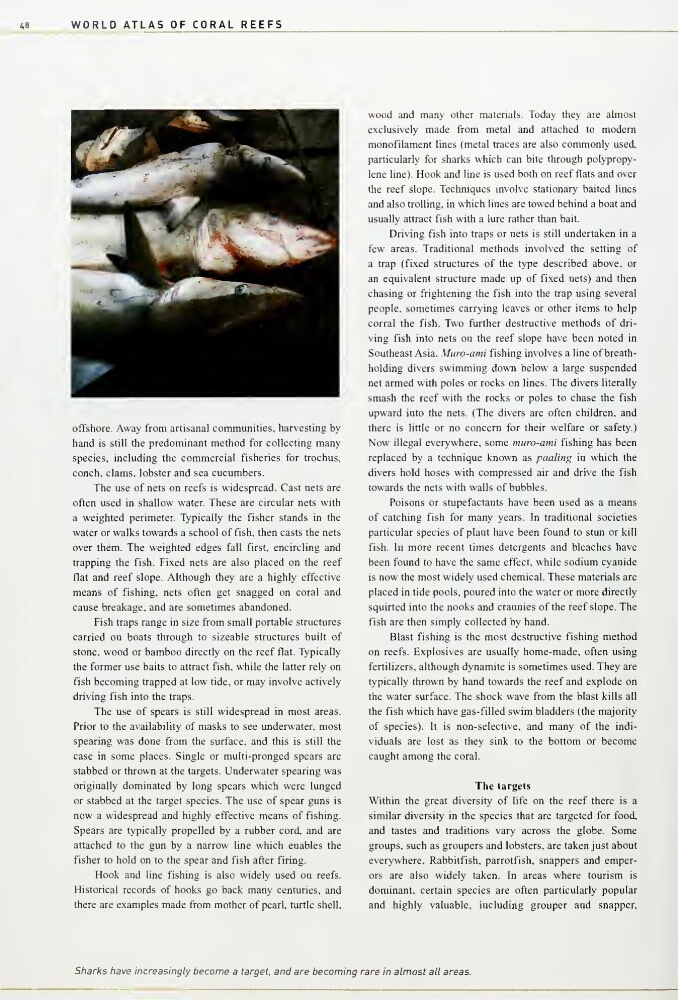
Sharks have increasingly become a target, and are becoming rare in almost all areas.
WORLD ATLAS OF CORAL REEFS
offshore. Away from artisanal communities, harvesting by
hand is still the predominant method for collecting many
species, including the commercial fisheries for trochus,
conch, clams, lobster and sea cucumbers.
The use of nets on reefs is widespread. Cast nets are
often used in shallow water. These are circular nets with
a weighted perimeter. Typically the fisher stands in the
water or walks towards a school of fish, then casts the nets
over them. The weighted edges fall first, encircling and
trapping the fish. Fixed nets are also placed on the reef
flat and reef slope. Although they are a highly effective
means of fishing, nets often get snagged on coral and
cause breakage, and are sometimes abandoned.
Fish traps range in size from small portable structures
carried on boats through to sizeable structures built of
stone, wood or bamboo directly on the reef flat. Typically
the former use baits to attract fish, while the latter rely on
fish becoming trapped at low tide, or may involve actively
driving fish into the traps.
The use of spears is still widespread in most areas.
Prior to the availability of masks to see underwater, most
spearing was done from the surface, and this is still the
case in some places. Single or multi-pronged spears are
stabbed or thrown at the targets. Underwater spearing was
originally dominated by long spears which were lunged
or stabbed at the target species. The use of spear guns is
now a widespread and highly effective means of fishing.
Spears are typically propelled by a rubber cord, and are
attached to the gun by a narrow line which enables the
fisher to hold on to the spear and fish after firing.
Hook and line fishing is also widely used on reefs.
Historical records of hooks go back many centuries, and
there are examples made from mother of pearl, turtle shell.
wood and many other materials. Today they are almost
exclusively made from metal and attached to modern
monofilament lines (metal traces are also commonly used,
particularly for sharks which can bite through polypropylene line). Hook and line is used both on reef flats and over
the reef slope. Techniques involve stationary baited lines
and also trolling, in which lines are towed behind a boat and
usually attract fish with a lure rather than bait.
Driving fish into traps or nets is still undertaken in a
few areas. Traditional methods involved the setting of
a trap (fixed structures of the type described above, or
an equivalent structure made up of fixed nets) and then
chasing or frightening the fish into the trap using several
people, sometimes carrying leaves or other items to help
corral the fish. Two further destructive methods of driving fish into nets on the reef slope have been noted in
Southeast Asia. Miiro-ami fishing involves a line of breathholding divers swimming down below a large suspended
net armed with poles or rocks on lines. The divers literally
smash the reef with the rocks or poles to chase the fish
upward into the nets. (The divers are often children, and
there is little or no concern for their welfare or safety.)
Now illegal everywhere, some muro-ami fishing has been
replaced by a technique known as paaling in which the
divers hold hoses with compressed air and drive the fish
towards the nets with walls of bubbles.
Poisons or stupefactants have been used as a means
of catching fish for many years. In traditional societies
particular species of plant have been found to stun or kill
fish. In more recent times detergents and bleaches have
been found to have the same effect, while sodium cyanide
is now the most widely used chemical. These materials are
placed in tide pools, poured into the water or more directly
squirted into the nooks and crannies of the reef slope. The
fish are then simply collected by hand.
Blast fishing is the most destructive fishing method
on reefs. Explosives are usually home-made, often using
fertilizers, although dynamite is sometimes used. They are
typically thrown by hand towards the reef and explode on
the water surface. The shock wave from the blast kills all
the fish which have gas-filled swim bladders (the majority
of species). It is non-selective, and many of the individuals are lost as they sink to the bottom or become
caught among the coral.
The targets
Within the great diversity of life on the reef there is a
similar diversity in the species that are targeted for food,
and tastes and traditions vary across the globe. Some
groups, such as groupers and lobsters, are taken just about
everywhere. Rabbitfish. parrotfish. snappers and emperors are also widely taken. In areas where tourism is
dominant, certain species are often particularly popular
and highly valuable, including grouper and snapper.
Sharks have increasingly become a target, and are becoming rare in almost all areas.