

Signs of C h ange
The importance of reefs
Around
the worli reefs are an enormously valuable
resource. In some cases, efforts have been made to
calculate simple economic statistics to capture this
value, but it is equally important to look beyond dollar
values. Reefs are a source of employment, a source of
food, a source of protection and a source of leisure. In
many places where there are reefs there are few other
natural resources which can replace such functions, and
in this sense a simple economic value pales into insignificance against social, nutritional, cultural and other
measures. Perhaps the earliest services to humans ever
provided by reefs were those of protecting coastlines and
even creating new land. Former reefs underlie many
coastal lands, while at the present time many islands, and
indeed entire nations, are built on the coral rock and sand
which is an integral part of a living reef ecosystem.
Coastal populations have similarly relied upon reefs for
food since pre-history. Today many coastal communities
rely on reefs in a similar way, catching fish for their own
use, but fisheries have also diversified considerably, and
reef fish, molluscs and crustaceans are now a major part
of several commercial fisheries. Recent times have
witnessed other uses of reefs, most notably in their
explosive popularity as places for recreation and tourism
in the last few decades.
Fisheries
Reefs, and particularly reef flats, have been used as an
abundant and productive source of food for millennia. The
earliest dated use comes from middens (waste dumps) containing shells and other remains in localities as far apart
as Australia and the Americas, showing active gathering
of reef flat organisms for food. The oldest site currently
known is Matenkupum in Papua New Guinea, where fish
bones and shells gathered by humans from reef flat and
mangrove areas have been dated back some 32 000 years.
The initial use of coral reefs for food was undoubtedly restricted to the reef flats. Fish and shellfish
were probably captured directly by hand, or by nets,
spears, poison or traps. There is little or no evidence of
outer reef-slope species in these early middens, and no
evidence of fish hooks. However, offshore fisheries
probably developed very early. The travels of Polynesians,
ancient Egyptians and others are clearly dated back at
least 3 000-4 000 years and show considerable seafaring
abilities. It seems likely that coastal navigation pre-dates
this by several millennia, and would undoubtedly have
been linked to the utilization of the rich resources which
lay beyond the reef flat.
Today, reef fisheries are globally significant. In many
nations, particularly those of the Pacific islands, coral
reefs provide one of the major sources of animal protein.
In a number of countries, including the Maldives, Kiribati.
Tokelau and Tuvalu, an average of over 100 kilos of fish
are consumed per person every year. In each of these cases
the majority of these fish are nearshore species taken by
artisanal fisheries. At the same time, commercial fisheries
have been developing rapidly in many areas, with sales not
only locally but also to export markets.
Fishing methods
Coral reef fisheries are typically multi-species fisheries
and, because of this and the complex nature of the reef
environment, they are also typically multi-gear fisheries.
Only large industrial fishing gears are excluded (long
lines, drift nets and most trawls) but, apart from these,
almost every technique has been utilized at some point
or other.
Gleaning, or harvesting by hand, is still one of the
most widely used and effective methods for collecting
certain species. This is especially common on the reef flat,
where crustaceans, molluscs, sea cucumbers, sea urchins
and a host of other species may be collected by hand.
In many societies such work is traditionally undertaken
by women and children, while men may fish from boats
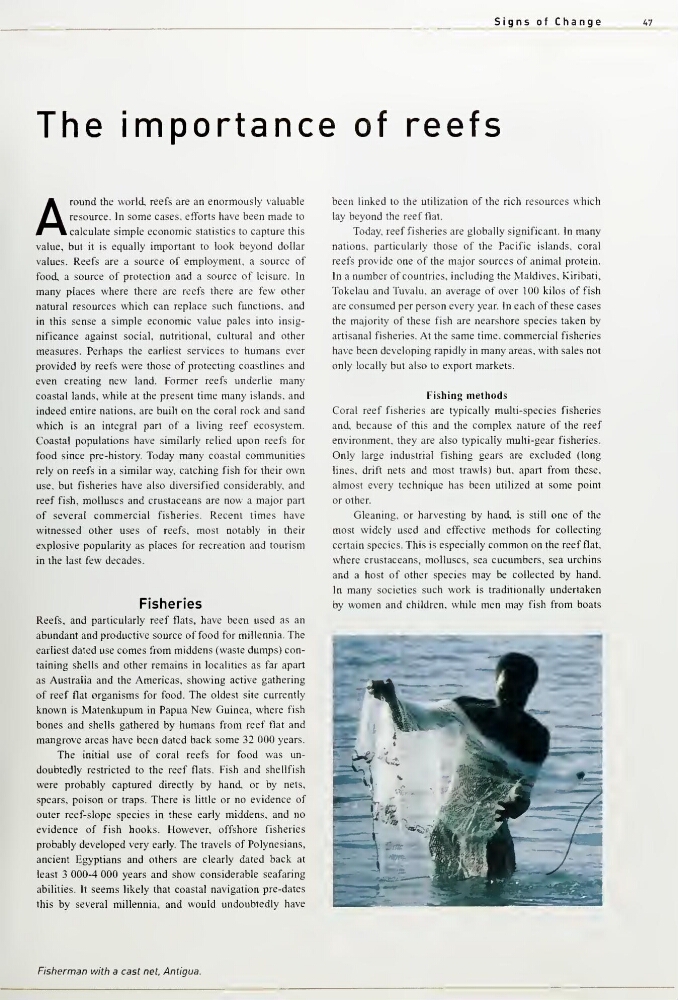
Fisherman with a cast net, Antigua.
The importance of reefs
Around
the worli reefs are an enormously valuable
resource. In some cases, efforts have been made to
calculate simple economic statistics to capture this
value, but it is equally important to look beyond dollar
values. Reefs are a source of employment, a source of
food, a source of protection and a source of leisure. In
many places where there are reefs there are few other
natural resources which can replace such functions, and
in this sense a simple economic value pales into insignificance against social, nutritional, cultural and other
measures. Perhaps the earliest services to humans ever
provided by reefs were those of protecting coastlines and
even creating new land. Former reefs underlie many
coastal lands, while at the present time many islands, and
indeed entire nations, are built on the coral rock and sand
which is an integral part of a living reef ecosystem.
Coastal populations have similarly relied upon reefs for
food since pre-history. Today many coastal communities
rely on reefs in a similar way, catching fish for their own
use, but fisheries have also diversified considerably, and
reef fish, molluscs and crustaceans are now a major part
of several commercial fisheries. Recent times have
witnessed other uses of reefs, most notably in their
explosive popularity as places for recreation and tourism
in the last few decades.
Fisheries
Reefs, and particularly reef flats, have been used as an
abundant and productive source of food for millennia. The
earliest dated use comes from middens (waste dumps) containing shells and other remains in localities as far apart
as Australia and the Americas, showing active gathering
of reef flat organisms for food. The oldest site currently
known is Matenkupum in Papua New Guinea, where fish
bones and shells gathered by humans from reef flat and
mangrove areas have been dated back some 32 000 years.
The initial use of coral reefs for food was undoubtedly restricted to the reef flats. Fish and shellfish
were probably captured directly by hand, or by nets,
spears, poison or traps. There is little or no evidence of
outer reef-slope species in these early middens, and no
evidence of fish hooks. However, offshore fisheries
probably developed very early. The travels of Polynesians,
ancient Egyptians and others are clearly dated back at
least 3 000-4 000 years and show considerable seafaring
abilities. It seems likely that coastal navigation pre-dates
this by several millennia, and would undoubtedly have
been linked to the utilization of the rich resources which
lay beyond the reef flat.
Today, reef fisheries are globally significant. In many
nations, particularly those of the Pacific islands, coral
reefs provide one of the major sources of animal protein.
In a number of countries, including the Maldives, Kiribati.
Tokelau and Tuvalu, an average of over 100 kilos of fish
are consumed per person every year. In each of these cases
the majority of these fish are nearshore species taken by
artisanal fisheries. At the same time, commercial fisheries
have been developing rapidly in many areas, with sales not
only locally but also to export markets.
Fishing methods
Coral reef fisheries are typically multi-species fisheries
and, because of this and the complex nature of the reef
environment, they are also typically multi-gear fisheries.
Only large industrial fishing gears are excluded (long
lines, drift nets and most trawls) but, apart from these,
almost every technique has been utilized at some point
or other.
Gleaning, or harvesting by hand, is still one of the
most widely used and effective methods for collecting
certain species. This is especially common on the reef flat,
where crustaceans, molluscs, sea cucumbers, sea urchins
and a host of other species may be collected by hand.
In many societies such work is traditionally undertaken
by women and children, while men may fish from boats
Fisherman with a cast net, Antigua.