

46
WORLD ATLAS OF CORAL REEFS
Chapter 2
Signs of Change
Coral
reefs are a rare but critically important resource. For ttie most part they
are located tar from major towns and
cities, and many of the largest expanses
of reefs in the world are located in some
of the most remote areas of the planet. Despite this
apparent scarcity and remoteness, coral reefs are
probably the most familiar marine habitat to peoples
across the globe. In the developed nations they feature in ecology lessons, holiday brochures, advertising
campaigns, tropical aquaria and numerous wildlife
documentaries. In many of the countries in which they
occur they are a critical part of everyday existence,
providing coastal defense, a source of food, recreation
and income. These same reefs are increasingly being
seen at the global level as a rare resource of incalculable value for current and future generations,
a global heritage of incredible beauty, immense
productivity and unparalleled diversity. In this chapter
we explore the different ways in which humans have
used reefs over the millennia and particularly in the
present day. We go on to consider the problems which
many of these uses are now creating for the survival
of coral reefs. Finally we consider some of the positive
actions that are being taken to prevent further damage or to reverse the decline; actions which benefit
not only the reefs themselves, but also the populations who rely on them.
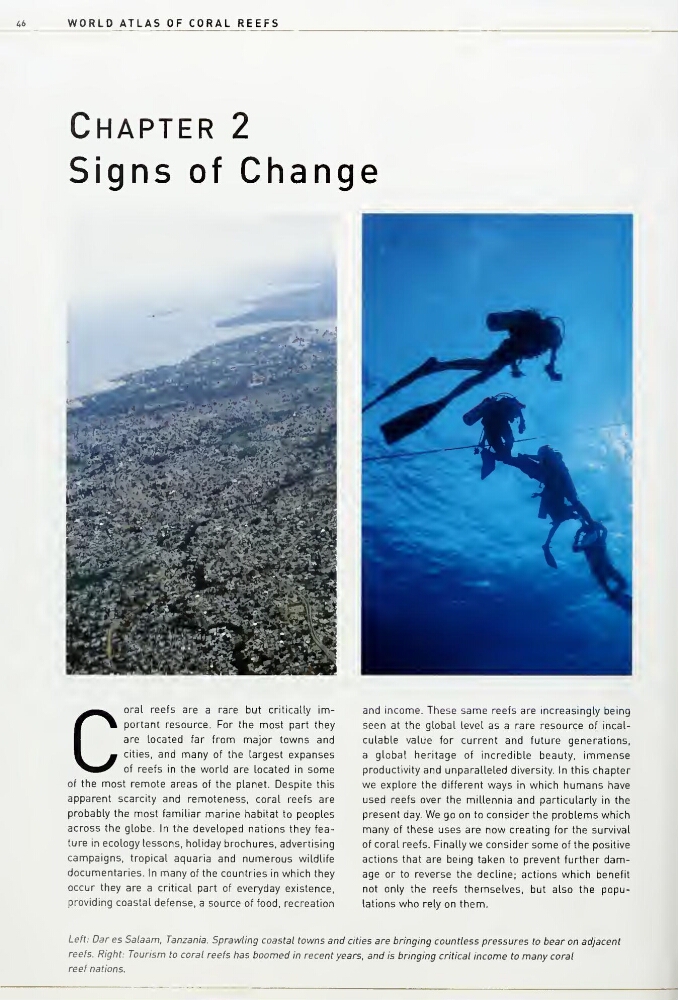
Left: Dar es Salaam. Tanzania. Sprawling coastal towns and cities are bringing countless pressures to bear on adjacent
reefs. Rigfit: Tourism to coral reefs has boomed in recent years, and is bringing critical income to many coral
reef nations.
WORLD ATLAS OF CORAL REEFS
Chapter 2
Signs of Change
Coral
reefs are a rare but critically important resource. For ttie most part they
are located tar from major towns and
cities, and many of the largest expanses
of reefs in the world are located in some
of the most remote areas of the planet. Despite this
apparent scarcity and remoteness, coral reefs are
probably the most familiar marine habitat to peoples
across the globe. In the developed nations they feature in ecology lessons, holiday brochures, advertising
campaigns, tropical aquaria and numerous wildlife
documentaries. In many of the countries in which they
occur they are a critical part of everyday existence,
providing coastal defense, a source of food, recreation
and income. These same reefs are increasingly being
seen at the global level as a rare resource of incalculable value for current and future generations,
a global heritage of incredible beauty, immense
productivity and unparalleled diversity. In this chapter
we explore the different ways in which humans have
used reefs over the millennia and particularly in the
present day. We go on to consider the problems which
many of these uses are now creating for the survival
of coral reefs. Finally we consider some of the positive
actions that are being taken to prevent further damage or to reverse the decline; actions which benefit
not only the reefs themselves, but also the populations who rely on them.
Left: Dar es Salaam. Tanzania. Sprawling coastal towns and cities are bringing countless pressures to bear on adjacent
reefs. Rigfit: Tourism to coral reefs has boomed in recent years, and is bringing critical income to many coral
reef nations.