

Sig ns of Ch a n g
e
lobster and conch. Among other groups, taste varies
between localities and certain species are not popular,
either a result of long-standing traditions or more recent
reputations. The taste for shark flesh, for example, is
highly localized. While many cultures do not like to eat
shark there are others where it is very popular. Certain
Pacific islanders have traditionally hunted sharks for
many years, luring them alongside small fishing boats and
capturing them with nooses in the days before strong
hooks and steel traces. Marine turtles and their eggs were
once popular worldwide, but the last century has seen
their decimation in almost all areas and most countries
now forbid or greatly restrict their hunting. The presence
of ciguatera, a natural toxin (see page 31), in certain fish
species appears to have some regional variation, but in
many areas where it is more prevalent this has led to the
avoidance of certain groups, such as jacks, barracuda and
large snappers, which are more likely to carry the toxins.
Many coral reef animals have complex breeding
cycles which involve regular spawning at the same
locality. Such occurrences are often linked to the phases
of the moon and may be monthly or annual, and in some
cases they involve very large aggregations of fish, which
may have swum many kilometers to reach the spawning
site. Scientific knowledge of these patterns is very recent,
but in many cases they have been known to fisherfolk,
particularly in the Pacific islands, for many years. Such
aggregations make highly productive fishing sites, but
they are also extremely susceptible to overfishing and it is
possible in the course of only one or two spawning events
to decimate an entire population of a species over a wide
area of reef Traditional societies have often recognized
the importance of these sites and imposed restrictions to
prevent overharvesting. One rather unusual species targeted by traditional fishers in a number of Pacific islands
is the palolo worm, which is the breeding phase of a rockdwelling polychaete worm Palolo siciliensis. These swarm
to the surface typically for two nights in succession every
12 to 13 lunar months, when they become the center of a
great celebration, collected in great numbers and eaten
either raw or cooked.
The demands of non-traditional societies combined
The live fish trade
Recent years have seen a spectacular growth In
the demand for live lish in a number of Chinese
restaurants in East Asia, notably in Hong Kong.
Particular species are targeted, predominantly
groupers and the humphead wrasse Cheilinus
unduiatus. In 1997 it was estimated that Hong Kong
imported some 32 000 tons of live food fish. Typical
wholesale prices for these were US$40-100 per kilo,
such that the overall annual value of this industry
was estimated at US$500 million for Hong Kong
alone. Market prices are considerably higher.
While smaller fish are favored by many, another
aspect to this trade has been the purchase of the
largest possible fishes, which have become a status
symbol in major celebrations and business dinners.
There are records of individual fish measuring more
than 2 meters in length retailing for more than
US$10 000. The impact on the natural stocks of
these species has been considerable. With such high
values, many of these species have been all but
decimated from the reefs around Southeast Asia,
and vessels are collecting live fish from locations
in the Western Indian Ocean and into the Pacific
to meet demands in Asia. Unfortunately it is these
largest individuals which have the greatest reproductive potential and so recovery from such drastic
overfishing is likely to be slow.
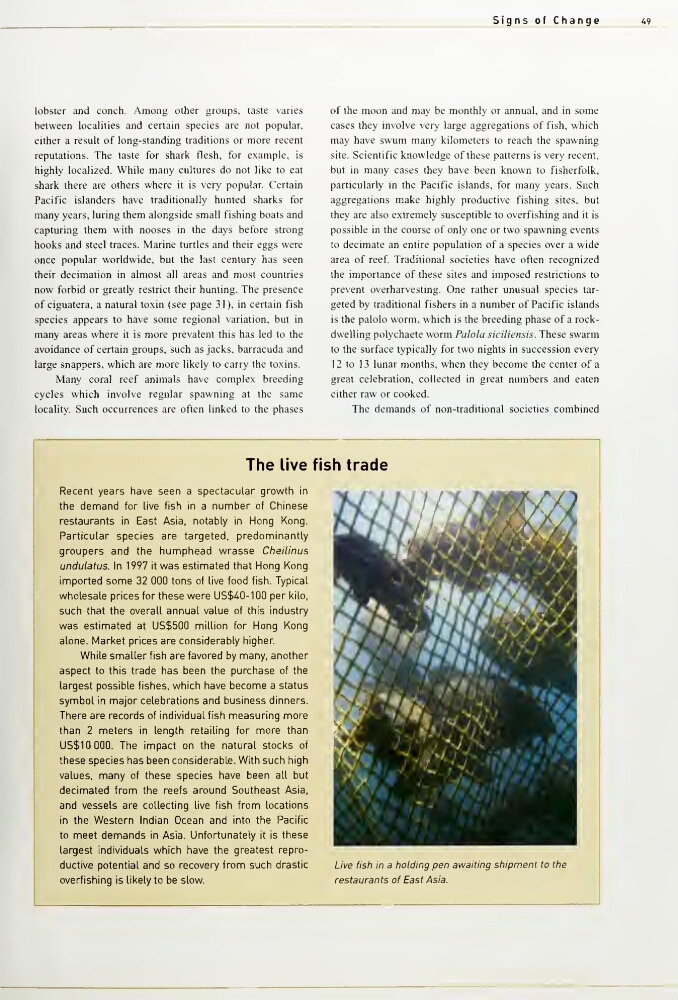
Live fish in a holding pen awaiting shipment to the
restaurants of East Asia.
e
lobster and conch. Among other groups, taste varies
between localities and certain species are not popular,
either a result of long-standing traditions or more recent
reputations. The taste for shark flesh, for example, is
highly localized. While many cultures do not like to eat
shark there are others where it is very popular. Certain
Pacific islanders have traditionally hunted sharks for
many years, luring them alongside small fishing boats and
capturing them with nooses in the days before strong
hooks and steel traces. Marine turtles and their eggs were
once popular worldwide, but the last century has seen
their decimation in almost all areas and most countries
now forbid or greatly restrict their hunting. The presence
of ciguatera, a natural toxin (see page 31), in certain fish
species appears to have some regional variation, but in
many areas where it is more prevalent this has led to the
avoidance of certain groups, such as jacks, barracuda and
large snappers, which are more likely to carry the toxins.
Many coral reef animals have complex breeding
cycles which involve regular spawning at the same
locality. Such occurrences are often linked to the phases
of the moon and may be monthly or annual, and in some
cases they involve very large aggregations of fish, which
may have swum many kilometers to reach the spawning
site. Scientific knowledge of these patterns is very recent,
but in many cases they have been known to fisherfolk,
particularly in the Pacific islands, for many years. Such
aggregations make highly productive fishing sites, but
they are also extremely susceptible to overfishing and it is
possible in the course of only one or two spawning events
to decimate an entire population of a species over a wide
area of reef Traditional societies have often recognized
the importance of these sites and imposed restrictions to
prevent overharvesting. One rather unusual species targeted by traditional fishers in a number of Pacific islands
is the palolo worm, which is the breeding phase of a rockdwelling polychaete worm Palolo siciliensis. These swarm
to the surface typically for two nights in succession every
12 to 13 lunar months, when they become the center of a
great celebration, collected in great numbers and eaten
either raw or cooked.
The demands of non-traditional societies combined
The live fish trade
Recent years have seen a spectacular growth In
the demand for live lish in a number of Chinese
restaurants in East Asia, notably in Hong Kong.
Particular species are targeted, predominantly
groupers and the humphead wrasse Cheilinus
unduiatus. In 1997 it was estimated that Hong Kong
imported some 32 000 tons of live food fish. Typical
wholesale prices for these were US$40-100 per kilo,
such that the overall annual value of this industry
was estimated at US$500 million for Hong Kong
alone. Market prices are considerably higher.
While smaller fish are favored by many, another
aspect to this trade has been the purchase of the
largest possible fishes, which have become a status
symbol in major celebrations and business dinners.
There are records of individual fish measuring more
than 2 meters in length retailing for more than
US$10 000. The impact on the natural stocks of
these species has been considerable. With such high
values, many of these species have been all but
decimated from the reefs around Southeast Asia,
and vessels are collecting live fish from locations
in the Western Indian Ocean and into the Pacific
to meet demands in Asia. Unfortunately it is these
largest individuals which have the greatest reproductive potential and so recovery from such drastic
overfishing is likely to be slow.
Live fish in a holding pen awaiting shipment to the
restaurants of East Asia.