

WORLD ATLAS OF CORAL REEFS
MM
of tiny spicules in the body wall. They have a mouth at one
end which is typically ringed by tentacles, while the anus
lies at the other end. Tube feet are concentrated along
the bottoin of the body and used in locomotion in some
groups. Some are detrital feeders, and many of the more
conspicuous forms on reefs feed by ingesting sand and
digesting the microfauna it contains. Others, mainly burrowing species, have long and highly branched tentacles
which they use to collect plankton. As a form of defense,
many sea cucumbers eject a number of sticky tubules from
their anus when threatened. If these do not sufficiently deter
their predators they may also eviscerate, expelling most of
their mtemal organs through their anus. These are highly
edible and the predator may feed on these while the animal
escapes and begins to regenerate its internal organs.
Tunicates
This group includes a number of planktonic salps, but most
important on the reefs are the ascideans or sea squirts.
These are sessile animals and typically have a tube-like
structure with a large opening, the inhalent siphon into
which water is drawn, passing through narrow pores or gill
slits before being exhaled through a slightly smaller
exhalent siphon. Food is captured from this water onto
mucus. This group is well represented and quite diverse on
most reefs. Some are solitary, although even these are often
found in aggregations, while others are colonial and the
individual zooids may be more difficult to distinguish.
Quite a number of species on the reef have developed a
tight association with blue-green algal symbionts.
Fishes
Fish are one of the most conspicuous elements of reef life,
being diverse, highly active, and often among the most
colorful elements of reef communities. Over 4 000 species
offish inhabit coral reefs, representing over 25 percent of
all marine fish species. Although not restricted to reef
environments, quite a number of groups are distinctively
associated with the reefs and a number of these are briefly
described below.
Groupers (Serranidae)
A large group of highly active carnivorous fishes,
typically with large mouths and more than one row of
teeth. One highly distinctive sub-group are the anthiases,
small and colorful zooplankton feeders often forming
dense schools over coral heads. Most of the remainder are
large stocky fishes which may be active or ambush-based
predators, mostly feeding on fishes and crustaceans. The
giant grouper Epinephelus lanceolatus is the largest true
reef fish, recorded to over 270 centimeters long and more
than 400 kilos in weight.
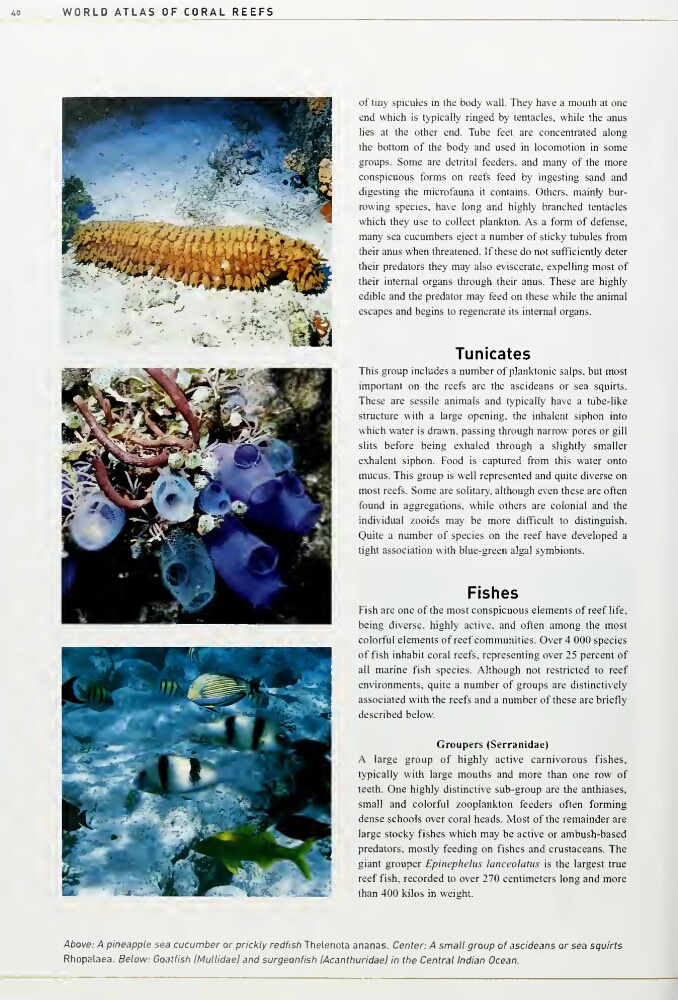
Above: A pineapple sea cucumber or prickly redfish Thelenota ananas. Center: A small group of ascideans or sea squirts
Rhopalaea. Below: Goatfish iMullidael and surgeonfish lAcanthuridael in the Central Indian Ocean.
MM
of tiny spicules in the body wall. They have a mouth at one
end which is typically ringed by tentacles, while the anus
lies at the other end. Tube feet are concentrated along
the bottoin of the body and used in locomotion in some
groups. Some are detrital feeders, and many of the more
conspicuous forms on reefs feed by ingesting sand and
digesting the microfauna it contains. Others, mainly burrowing species, have long and highly branched tentacles
which they use to collect plankton. As a form of defense,
many sea cucumbers eject a number of sticky tubules from
their anus when threatened. If these do not sufficiently deter
their predators they may also eviscerate, expelling most of
their mtemal organs through their anus. These are highly
edible and the predator may feed on these while the animal
escapes and begins to regenerate its internal organs.
Tunicates
This group includes a number of planktonic salps, but most
important on the reefs are the ascideans or sea squirts.
These are sessile animals and typically have a tube-like
structure with a large opening, the inhalent siphon into
which water is drawn, passing through narrow pores or gill
slits before being exhaled through a slightly smaller
exhalent siphon. Food is captured from this water onto
mucus. This group is well represented and quite diverse on
most reefs. Some are solitary, although even these are often
found in aggregations, while others are colonial and the
individual zooids may be more difficult to distinguish.
Quite a number of species on the reef have developed a
tight association with blue-green algal symbionts.
Fishes
Fish are one of the most conspicuous elements of reef life,
being diverse, highly active, and often among the most
colorful elements of reef communities. Over 4 000 species
offish inhabit coral reefs, representing over 25 percent of
all marine fish species. Although not restricted to reef
environments, quite a number of groups are distinctively
associated with the reefs and a number of these are briefly
described below.
Groupers (Serranidae)
A large group of highly active carnivorous fishes,
typically with large mouths and more than one row of
teeth. One highly distinctive sub-group are the anthiases,
small and colorful zooplankton feeders often forming
dense schools over coral heads. Most of the remainder are
large stocky fishes which may be active or ambush-based
predators, mostly feeding on fishes and crustaceans. The
giant grouper Epinephelus lanceolatus is the largest true
reef fish, recorded to over 270 centimeters long and more
than 400 kilos in weight.
Above: A pineapple sea cucumber or prickly redfish Thelenota ananas. Center: A small group of ascideans or sea squirts
Rhopalaea. Below: Goatfish iMullidael and surgeonfish lAcanthuridael in the Central Indian Ocean.