

The World of Coral Reefs
Feather stars (Crinoidea)
These have a very simple, small body or calyx from which
five arms radiate. These branch almost immediately and
hence most feather stars appear to have numerous arms.
Each is equipped with many short pinnules and the arms
are used to sweep the water for plankton. Below the calyx
are numbers of short, dextrous cirri which are used for
locomotion and to grip the substrate. Most feather stars
are nocturnal.
Starfish (Asteroidea)
The starfish, or sea stars, are a well known group. Most
have five arms, and in many cases the body organs are
housed, or extend into, these arms. They have a mouth on
their underside and anus facing upwards. Many species
are capable of extruding their stomachs through this
opening in order to facilitate digestion. They move using
the large numbers of tube feet on their underside. Starfish
include detritus feeders, omnivores and predators. One
of the better known is the crown-of-thorns starfish
Acanlluister planci, a large and unusual looking starfish
with a large central body, numerous legs and a covering of
sharp spines. It is a regular predator of scleractinian corals
(see page 60).
Brittle stars (Ophiuroidea)
These are somewhat similar to starfish in general body
plan. They have a distinct central disc containing the body
organs, with a ventral mouth, but they have a very simple
digestive system and no anus. Most have only five arms.
which are slender, highly mobile and typically covered in
spines. They use these arms, rather than their simple tube
feet, for locomotion. Most are detritus feeders, grazing
the substrate beneath them. Others utilize their arms,
sometimes with a mucous web, to sweep the water and
capture prey, while some are more active predators. The
basket stars are a sub-group with highly branched arms
used to filter the water at night.
Urchins (Echinoidea)
Sea urchins are a highly distinctive group. They have no
arms, and the small plates of the skeleton have fused to
form a "test" which acts like a shell to protect the internal
organs, but is in turn covered by a thin layer of living
tissue. The body is typically further protected by a large
number of spines. All urchins are grazers or detrital
feeders, and have a powerful set of scraping jaws on their
underside. Among the most familiar species on the reef
are the long-spined species of the family Diadematidae,
bearing highly elongated (typically 20 centimeters long)
dark spines. These perform a critical function as grazers in
many reef ecosystems and their loss on some Caribbean
reefs has been linked to rapid declines in coral cover as
algal growth predominates (see page 61). A number of
urchins have developed secondary bilateral symmetry and
have adapted to a burrowing lifestyle. These include the
heart urchins and the highly flattened sand dollars.
Sea cucumbers (Holothurians)
These are elongated, sometimes even worm-like, creatures
in which the calcareous skeleton is highly reduced to a mass
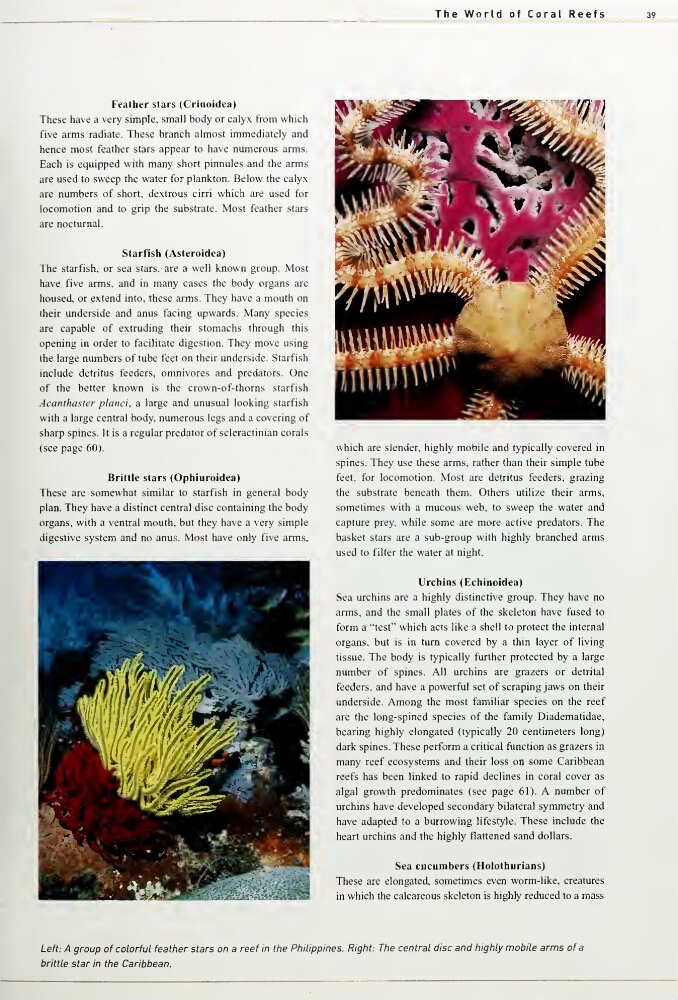
Left: A group of colorful feather stars on a reef in the Philippines. Right: The central disc and highly mobile arms of a
brittle star in the Caribbean.
Feather stars (Crinoidea)
These have a very simple, small body or calyx from which
five arms radiate. These branch almost immediately and
hence most feather stars appear to have numerous arms.
Each is equipped with many short pinnules and the arms
are used to sweep the water for plankton. Below the calyx
are numbers of short, dextrous cirri which are used for
locomotion and to grip the substrate. Most feather stars
are nocturnal.
Starfish (Asteroidea)
The starfish, or sea stars, are a well known group. Most
have five arms, and in many cases the body organs are
housed, or extend into, these arms. They have a mouth on
their underside and anus facing upwards. Many species
are capable of extruding their stomachs through this
opening in order to facilitate digestion. They move using
the large numbers of tube feet on their underside. Starfish
include detritus feeders, omnivores and predators. One
of the better known is the crown-of-thorns starfish
Acanlluister planci, a large and unusual looking starfish
with a large central body, numerous legs and a covering of
sharp spines. It is a regular predator of scleractinian corals
(see page 60).
Brittle stars (Ophiuroidea)
These are somewhat similar to starfish in general body
plan. They have a distinct central disc containing the body
organs, with a ventral mouth, but they have a very simple
digestive system and no anus. Most have only five arms.
which are slender, highly mobile and typically covered in
spines. They use these arms, rather than their simple tube
feet, for locomotion. Most are detritus feeders, grazing
the substrate beneath them. Others utilize their arms,
sometimes with a mucous web, to sweep the water and
capture prey, while some are more active predators. The
basket stars are a sub-group with highly branched arms
used to filter the water at night.
Urchins (Echinoidea)
Sea urchins are a highly distinctive group. They have no
arms, and the small plates of the skeleton have fused to
form a "test" which acts like a shell to protect the internal
organs, but is in turn covered by a thin layer of living
tissue. The body is typically further protected by a large
number of spines. All urchins are grazers or detrital
feeders, and have a powerful set of scraping jaws on their
underside. Among the most familiar species on the reef
are the long-spined species of the family Diadematidae,
bearing highly elongated (typically 20 centimeters long)
dark spines. These perform a critical function as grazers in
many reef ecosystems and their loss on some Caribbean
reefs has been linked to rapid declines in coral cover as
algal growth predominates (see page 61). A number of
urchins have developed secondary bilateral symmetry and
have adapted to a burrowing lifestyle. These include the
heart urchins and the highly flattened sand dollars.
Sea cucumbers (Holothurians)
These are elongated, sometimes even worm-like, creatures
in which the calcareous skeleton is highly reduced to a mass
Left: A group of colorful feather stars on a reef in the Philippines. Right: The central disc and highly mobile arms of a
brittle star in the Caribbean.